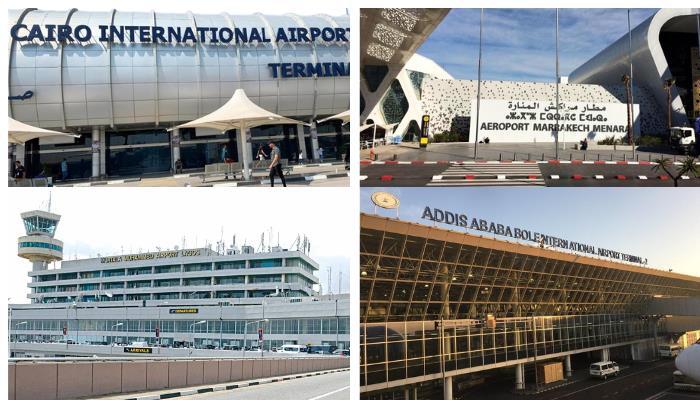
Africa’s aviation market continued to expand in June 2026, supported by stronger domestic travel demand and sustained capacity growth among the continent’s leading airlines.
- +Top 10 busiest airports in Africa by outbound seats – June 2026
While performance varied across individual markets, the overall trend points to a resilient recovery, with airlines adding more seats to meet rising passenger demand and strengthen connectivity within Africa and beyond.
While performance varied across individual markets, the overall trend points to a resilient recovery, with airlines adding more seats to meet rising passenger demand and strengthen connectivity within Africa and beyond.
This month’s ranking of Africa’s busiest airports by outbound seats is based on data from global aviation analytics firm OAG.
South Africa remained the continent’s largest domestic aviation market, offering 1.5 million seats during the month. Elsewhere, domestic markets delivered mixed results. The Republic of Congo recorded the fastest growth, with domestic capacity increasing 31.3% to 122,100 seats.
Nigeria posted the largest increase in absolute terms, adding 130,200 seats for a 21.7% year-on-year rise, reflecting growing demand for domestic air travel. In contrast, Kenya experienced a decline, with domestic capacity falling 18.7%, equivalent to 76,400 fewer seats compared with the same period last year.
Africa’s airline industry also maintained its growth momentum. Ethiopian Airlines retained its position as the continent’s largest carrier, operating 2 million seats in June 2026, a 10% increase or 179,300 additional seats year-on-year. Among the continent’s top 10 airlines, Air Algérie recorded the fastest growth at 11.2%, followed by Royal Air Maroc with a 10.8% increase, highlighting continued expansion by North African carriers as airlines invest in larger networks and increased capacity to meet rising travel demand.
Here are the top 10 busiest airports in Africa by outbound seats in June 2026.
Lagos’ Murtala Muhammed International Airport (LOS), Nigeria’s busiest aviation gateway, has secured a place among Africa’s 10 busiest airports by seat capacity after recording the fastest year-on-year growth on the continent.
According to the latest aviation data, Lagos recorded a 16.7% increase in airline seat capacity, rising from 357,799 seats in the same period of 2025 to 417,622 seats in 2026. The strong performance was the highest growth rate among Africa’s top 10 busiest airports, reflecting rising demand for both domestic and international air travel.
The growth propelled Lagos into the continental top 10, reinforcing the airport’s position as Nigeria’s primary aviation hub and one of Africa’s fastest-growing air travel markets.
Murtala Muhammed International Airport, located in Ikeja, Lagos State, has long served as Nigeria’s main international gateway. Originally built during World War II as Lagos Airport, it was renamed in 1976 after former Nigerian Head of State Murtala Muhammed. The airport underwent a major transformation with the commissioning of its international terminal in 1979, while the privately funded MMA2 domestic terminal was added in 2007 to support growing passenger traffic.
Tunis–Carthage International Airport (TUN), Tunisia’s primary international gateway, retained its place among Africa’s busiest airports after recording steady growth in airline seat capacity.
The airport handled 422,531 seats this month, representing a 2.7% year-on-year increase from 411,248 seats during the same period in 2025. The modest growth reflects stable demand for air travel and reinforces Tunis’ role as a key aviation hub connecting North Africa with Europe, the Middle East, and other African destinations.
Located in the capital city of Tunis, Tunis–Carthage International Airport serves as the country’s main airport and is the primary hub for Tunisair, Tunisair Express, Nouvelair, and Tunisavia. Named after the ancient city of Carthage, the airport has been central to Tunisia’s aviation sector for decades.
Jomo Kenyatta International Airport (NBO), Kenya’s largest and busiest airport, ranked eighth among Africa’s busiest airports by seat capacity after recording steady year-on-year growth.
The airport handled 486,910 airline seats this month, up 5.1% from 463,439 seats during the same period in 2025. The increase reinforces Nairobi’s position as East Africa’s leading aviation gateway and a critical hub linking the region to Europe, the Middle East, Asia, and the Americas.
Located about 18 kilometres southeast of Nairobi’s city centre, Jomo Kenyatta International Airport serves more than 50 countries and is the primary hub for Kenya Airways. Renamed in 1978 in honour of Kenya’s first President, Jomo Kenyatta, the airport handled more than 9 million passengers and over 364,000 tonnes of cargo in 2024, making it one of Africa’s busiest airports.
Marrakech Menara Airport (RAK), Morocco’s second-busiest airport, ranked seventh among Africa’s busiest airports by seat capacity after posting strong year-on-year growth driven by rising tourism demand.
The airport recorded 496,926 airline seats this month, up 7.5% from 462,334 seats during the same period in 2025. The increase underscores the continued expansion of Morocco’s aviation sector and the country’s growing appeal as a leading international tourist destination.
Located about six kilometres southwest of Marrakech’s city centre, Marrakech Menara Airport serves as a major gateway for leisure and business travellers. The airport handled more than 9.3 million passengers in 2025, cementing its position among Africa’s busiest airports and Morocco’s second-largest aviation hub after Casablanca.
The airport connects Marrakech to more than 60 international destinations through over 30 airlines, with particularly strong links to Europe, where the city remains one of the continent’s most popular holiday destinations.
Cape Town International Airport (CPT), South Africa’s second-busiest airport, ranked sixth among Africa’s busiest airports by seat capacity after recording steady year-on-year growth.
The airport handled 515,746 airline seats this month, representing a 4.1% increase from 495,627 seats during the same period in 2025. The growth reflects sustained passenger demand and Cape Town’s expanding role as a major international tourism and business gateway.
Located approximately 20 kilometres from Cape Town’s central business district, Cape Town International Airport is one of Africa’s leading aviation hubs, connecting travellers to more than 31 destinations across Africa, Europe, the Middle East, Asia, the Americas, and Australia. The airport currently supports about 228 weekly international flights, strengthening South Africa’s global connectivity.
Houari Boumediene International Airport (ALG), Algeria’s largest and busiest airport, ranked fifth among Africa’s busiest airports by seat capacity after recording steady year-on-year growth.