Tinubu Declares National Emergency On Poverty, Insecurity As Labour, Opposition Demand Urgent Reforms
President Bola Tinubu’s national emergency declaration on poverty and insecurity has triggered urgent reform demands from labour unions and opposition leaders.
President Bola Tinubu’s national emergency declaration on poverty and insecurity has triggered urgent reform demands from labour unions and opposition leaders.
President Bola Tinubu’s declaration of a national emergency on poverty and insecurity on May Day triggered a wave of demands from opposition leaders and organised labour for urgent, far-reaching reforms to address Nigeria’s deepening socio-economic challenges.
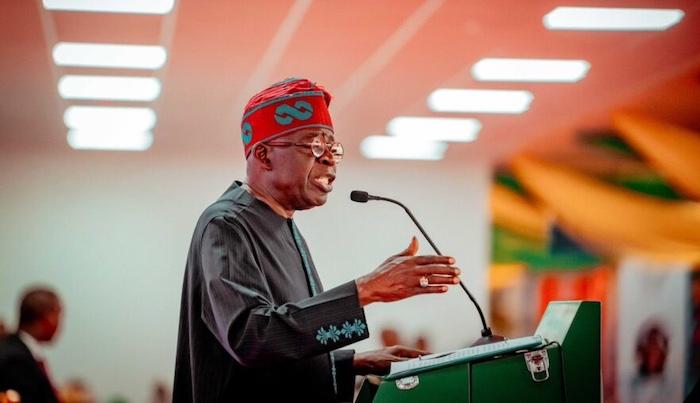
Tinubu, made the declaration on Friday in Abuja, in his address to the workers and labour unions during the 2026 May Day celebrations.
This was as the two Labour centres in the country, the Nigeria Labour Congress (NLC) and the Trade Union Congress (TUC) insisted that they will only cooperate with any party that commits to their charter of demands on workers welfare especially security, free education, public healthcare among others as the 2027 elections draw near.
In their May Day messages, opposition leaders like Peter Obi called for choosing of leaders based on competence while David Mark, leader of the African Democratic Congress (ADC) promised a living wage for workers should his party take over power and former Vice President Atiku Abubakar knocked President Tinubu’s government for making life difficult for workers through inept leadership.The President, who was represented by the Secretary to the Government of the Federation, Senator George Akume, aligned his message with the global May Day theme on the Decent Work Agenda championed by the International Labour Organisation that there cannot be decent work where workers fear for their lives or where wages cannot feed a family aligning.
Tinubu admitted that insecurity and poverty constituted “significant obstacles” but insisted his administration was tackling both with urgency.
He referenced the launch of the Community Protection Guards Initiative, where over 45,000 young Nigerians were recruited to secure communities as one of the measures to address insecurity.
The President also highlighted a raft of economic and social interventions under his Renewed Hope Agenda, including expanded cash transfers reaching 15 million vulnerable households and lifting an estimated 7.5 million Nigerians out of poverty.
Tinubu added that legacy projects such as the Lagos-Calabar Coastal Highway and the Ajaokuta-Kaduna-Kano Gas Pipeline had generated over 600,000 jobs.
He said workers’ welfare was paramount for his administration, which has implemented a new national minimum wage, cleared pension arrears, and reintroduced gratuity payments from January 2026.
He stated that over 800,000 informal sector workers had been enrolled in the micro pension scheme, while small businesses continued to benefit from a N200 billion MSME support fund.
Tinubu said: “There cannot be decent work where workers fear for their lives, where wages cannot feed a family, or where insecurity disrupts farms, factories, markets, and other economic activities. These hydra-headed challenges, the government notes, have been treated as a national emergency due to their impact on productivity, livelihoods, and the confidence of both workers and employers.
“The administration also acknowledged that insecurity and poverty remain major obstacles to building a peaceful Nigeria where citizens can “sleep with their eyes closed,” and to achieving the Decent Work Agenda as envisioned by the International Labour Organisation.”
Tinubu affirmed that the agenda was not merely an international framework but a national imperative, aligned with the vision of a country where hard work is rewarded, opportunities are accessible without discrimination, and every citizen can reach their full potential.
He assured labour unions that despite the challenges, the government would not relent in its efforts, as it is confronting the issues through deliberate, coordinated, and sustained actions, backed by targeted policies and the resilience of security personnel—some of whom have paid the ultimate price in the line of duty.
The President appealed to the NLC and the TUC to sustain dialogue and restraint in industrial disputes.
“Strike should be the last resort, not the first,” he said, urging collaboration to achieve lasting reforms.
Tinubu also extolled security forces for their sacrifices, which guaranteed economic activities, linking improved safety directly to job creation and national growth.
He reaffirmed his administration’s commitment, noting Nigeria remained on course to defeat insecurity and reduce poverty, promising a future where “decent work is not a privilege for a few, but a reality for all.”
Tinubu further explained that the federal government has adopted a multi-dimensional approach to mitigate poverty by developing policies focused on job creation, economic diversification and social protection.
He said: “Through targeted interventions in agriculture, small and medium enterprises, infrastructure development, and skill acquisition, we are laying a solid foundation for inclusive growth. These are evident in the government’s key 2024-2026 interventions and initiatives, namely the National Agricultural Growth Scheme-Agro-pocket (NAGS-AP), the Dry Season Farming Schemes, the Mechanisation Drives, the Post-Harvest Management, the Financial Inclusion and support, anchored in the Bank of Agriculture, the Security for Farmers through the Nigeria Security and Civil Defence Corps (NSCDC) deployment of 10,000 Agro-Rangers to 19 states to protect farmers and farm produce from banditry, among others.
“To you our dear workers, I say this clearly; your welfare remains a priority. We are committed to improving working conditions, promoting fair wages, and ensuring that every Nigerian worker enjoys dignity, safety and equal opportunity in the workplace; hence, the recent reactivation of the payment of gratuity to Nigerian workers with effect from January 2026.
“As I proceed, let me pause to acknowledge a truth that we must not ignore; insecurity and poverty remain significant obstacles to achieving a peaceful Nigeria where the citizens can sleep with their two eyes closed and ultimately achieve the Decent Work Agenda as envisioned by the International Labour Organisation (ILO).
“To us as a government, the Decent Work Agenda is not just an international framework, it is a national imperative as it aligns with our national priorities, as well as a vision of a Nigeria where hard work is rewarded, where opportunities devoid of all forms of discrimination are accessible, and where every citizen can attain their full potential,” he added.
President Tinubu said that government has launched the Community Protection Guards Initiative in partnership with State governments to further support the already existing legal and institutional security frameworks.