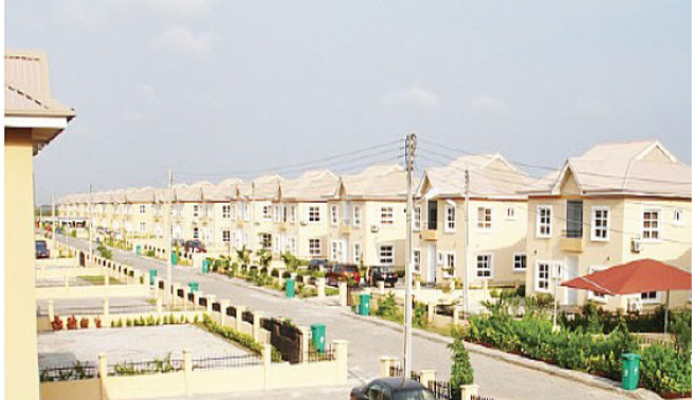
The Lagos State government has raised the hope of homebuyers in the state with 10,623 delivered home units and numerous ongoing projects that are expected to deliver more housing units, adding to the existing stock and reducing the deficit.
- +Lagos raises homebuyers’ hope with 10,623 houses, ongoing projects
The delivered units are products of the effort of the state’s Ministry of Housing at providing affordable homes through direct budgetary funding, which yielded 4,414 units of one, two- and three-bedroom homes, while Public Private Partnership (PPP) across the housing sector provided additional 6,209 homes for allottees, giving a total of 10,623 units.
The delivered units are products of the effort of the state’s Ministry of Housing at providing affordable homes through direct budgetary funding, which yielded 4,414 units of one, two- and three-bedroom homes, while Public Private Partnership (PPP) across the housing sector provided additional 6,209 homes for allottees, giving a total of 10,623 units.
These home units represent the Governor Babajide Sanwo-Olu administration’s intervention in the state’s housing sector and a response to the housing deficit, which, according to a recent report, is a little below three million units.
Moruf Akinderu-Fatai, the state’s Commissioner for Housing, who gave these hints at a ministerial press briefing to commemorate the third year in office of Governor Sanwo-Olu’s second term, explained that in October 2025, they delivered and commissioned the Akinsanya Sunny Ajose Estate (Phase 1), comprising 420 units of one, two- and three-bedroom apartments.
“In November 2025, we commissioned another 233 units of quality, affordable housing within the Abraham Adesanya Housing Estate (Parcel A & B) – a flagship Joint Venture with Urban Shelter. These two developments bring the total number of housing estates completed under the Sanwo Olu administration across Lagos’s five divisions to 23 since 2019,” the commissioner said.
He disclosed that Lagos was only responding to what he described as a global problem, quoting the UN-Habitat, which says that nearly half of humanity, approximately 3.4 billion people, lack access to secure, safe, and adequate housing.
According to him, this crisis has left over 300 million people homeless and forced more than 1.1 billion individuals into informal settlements and slums. The shortage of adequate housing has worsened by 30 percent in just over a decade, with the global deficit now exceeding 268 million housing units.
“This global challenge is acutely mirrored in Nigeria, Africa’s most populous nation. For years, the narrative of a 22-million-unit housing deficit was widely quoted, but the National Housing Data Technical Committee recently inaugurated by the Federal Ministry of Housing and Urban Development has provided a more precise, data-driven assessment.
Their report, unveiled in January 2026, reveals that Nigeria’s housing deficit currently stands at 14.925 million units. Even more alarming is the finding that an additional 15.2 million existing homes are classified as structurally inadequate or substandard. At the current rate of development, with annual formal production struggling to keep pace, experts warn that the effective shortage could reach 28 million units within the next few years,” he stated.
He noted that at the national level, the federal government has rolled out its most ambitious housing agenda to date, anchored on a new national strategy of land reforms, urban renewal, and robust Public-Private Partnerships.
A flagship initiative under this agenda is the Ministry of Finance Incorporated (MOFI) Real Estate Investment Fund (MREIF) which was launched in 2025 and listed on the Nigerian Exchange.
“MREIF is a government-backed, market-driven fund designed to inject massive liquidity into the housing sector. By mobilising both private and institutional capital, the fund provides affordable mortgage financing at a competitive single-digit interest rate of 9.75 percent per annum, with tenures extending up to 20 years. The fund has already disbursed billions to support home ownership,” the commissioner said.
According to him, Lagos is intentional about providing housing for its residents, pointing out that beyond the Ministry of Housing, there are three other agencies that are also responsible for the implementation of the plans and strategies of the state government in the housing sector.
These agencies are the Lagos State Development and Property Corporation (LSDPC) headed by Ayodeji Joseph, Lagos State Mortgage Board (LMB) headed by Bayowa Foresythe, and Lagos State Real Estate Regulatory Authority (LASRERA) under the able leadership of the Special Adviser to the Governor of Lagos State on Housing.