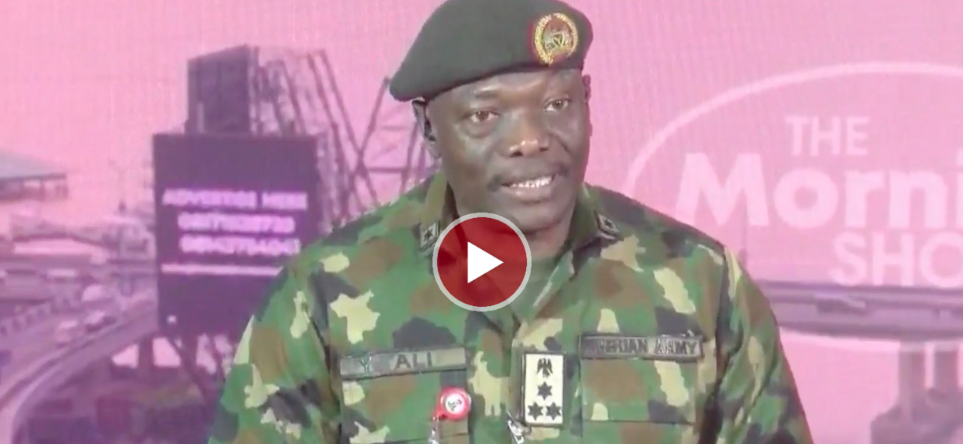
Demand for names of reintegrated 744 ‘repentant terrorists’ misplaced – Safe Corridor Coordinator, Brig Gen Yusuf Ali
- +How are the critics playing into the hands of terrorists?
The Coordinator of Operation Safe Corridor, a government initiative to deradicalise, rehabilitate, and reintegrate ‘repentant’ or low-risk terrorists, Brig Gen Yusuf Ali, speaks with DANIEL AYANTOYE on the controversy trailing the reintegration of 744 repentant terrorists into society and the monitoring mechanisms in place
The Coordinator of Operation Safe Corridor, a government initiative to deradicalise, rehabilitate, and reintegrate ‘repentant’ or low-risk terrorists, Brig Gen Yusuf Ali, speaks with DANIEL AYANTOYE on the controversy trailing the reintegration of 744 repentant terrorists into society and the monitoring mechanisms in place
Public backlash has followed the Federal Government’s plan to reintegrate 744 repentant terrorists who recently completed its deradicalisation, rehabilitation, and reintegration programme. How do you assess this development?
First, let’s correct one impression: the use of “ex-terrorist” needs to be reassessed. According to the International Covenant on Civil and Political Rights, individuals who have been cleared of criminal activities should not be referred to with labels associated with that criminality, in order to avoid stigmatisation. On the issue of repentant terrorists, they are not terrorists; they are victims of terrorism.
Given that these individuals have reportedly participated in killings and widespread destruction, on what basis are they being classified as victims of terrorism?
I believe you were in this country a few weeks ago when the Attorney-General and Minister of Justice, and the Minister of Defence spoke about hundreds of Boko Haram members who have been convicted. Some were given life imprisonment, while others received various sentences. He also mentioned that some individuals had been cleared by the Ministry of Justice, as they were not members of the group. Once they are cleared, because of the long period they spent in the bush with Boko Haram, they may have internalised certain experiences, including anger arising from their circumstances.
How did they end up in the bush working for Boko Haram if they were not terrorists or external mercenaries brought into the country?
Some of them were abducted. Others had their parents forced at gunpoint to hand them over to the terrorists, after which they were taken away. So, when such individuals have the opportunity to escape, they do so and surrender to the government. Under international law of armed conflict, once a person has surrendered, they cannot be killed. After they have been cleared, given the length of time they spent there, they must undergo extensive psychosocial therapy to address issues such as anger, drug use, and related challenges. Some resorted to drugs due to depression and other factors; they therefore undergo drug rehabilitation, religious reorientation, and psychosocial therapies before reintegration into society. The essence of this process is to ensure they do not pose a danger when reintegrated. This is the role of Operation Safe Corridor—administering these processes and providing these individuals, who are also victims of terrorism, with a new orientation. Therefore, referring to them as ex-terrorists is misplaced and incorrect; they should be described as victims of terrorism.
The 744 individuals who have surrendered, been deradicalised, and reintegrated are no longer available for terrorist groups to recruit for their campaign of destruction against the country. Let us give the country the benefit of the doubt and appreciate what the government is doing. This is about peacebuilding, not merely winning a war. Winning a war is the role of the kinetic line of operation. Those who are actual terrorists rarely surrender unless captured in combat; such individuals are prosecuted, found guilty by the courts, and imprisoned.
Let us avoid negative narratives so we do not inadvertently play into the hands of terrorists seeking to create discord in the country. The more divided we are on this issue, the more vulnerable we become. Those criticising this non-kinetic approach without full understanding may unintentionally be aiding terrorist objectives.
How are the critics playing into the hands of terrorists?
Their aim is to increase their numbers. If these 744 individuals had remained with them, it would have boosted their ranks and enabled them to continue wreaking havoc in society.
How do you differentiate real terrorists from those who were forcefully recruited?
That responsibility lies with the Ministry of Justice, not Operation Safe Corridor. Operation Safe Corridor serves as a repository. It is the court that determines who are truly victims of circumstance and not members of terrorist groups. That is why they are categorised as low-risk individuals eligible for deradicalisation, rehabilitation, and reintegration.
Are there reported cases of previously reintegrated individuals causing security or social problems within their communities?
So far, no community has reported any issues involving the more than 3,000 individuals reintegrated into society over the past 10 years of the programme. There has been no such case; otherwise, the media would have widely reported it by now. Due to the successes recorded, countries such as Colombia, Somalia, Mali, and other Sahel nations are studying Operation Safe Corridor for possible adoption. Colombia, which has experienced conflict for about 60 years, only began to achieve notable results after adopting a similar approach about three years ago. Despite their progress, they are still looking to Nigeria’s model, particularly because Nigeria is implementing disarmament, demobilisation, and reintegration while the conflict is ongoing—an approach typically undertaken after conflicts. This underscores the advantage of combining kinetic and non-kinetic strategies simultaneously. The insecurity being experienced is partly an attempt by terrorists to intimidate the country, not necessarily an indication that these approaches are failing. As Nigerians, we must unite against these threats to decisively overcome them.
Concerns have also been raised about possible sabotage within the security architecture, with some attributing it to previously reintegrated ex-terrorists. How do you respond to this perspective?
They are not from Operation Safe Corridor. You are aware that states also run their own DDR programmes, such as the Borno model and others. Recently, there were reports that Kano State carried out a similar initiative and released some bandits. In essence, states are implementing their own DDR frameworks. However, the national Operation Safe Corridor is a multi-agency initiative involving several ministries, departments, and agencies operating in line with global best practices. International bodies such as the European Union, the United Nations, and others monitor the process to ensure compliance with global standards. Over the past 10 years, the programme has remained commendable, with no negative records recorded so far.
What mechanisms have been put in place to ensure that repentant terrorists do not return to criminal activities?