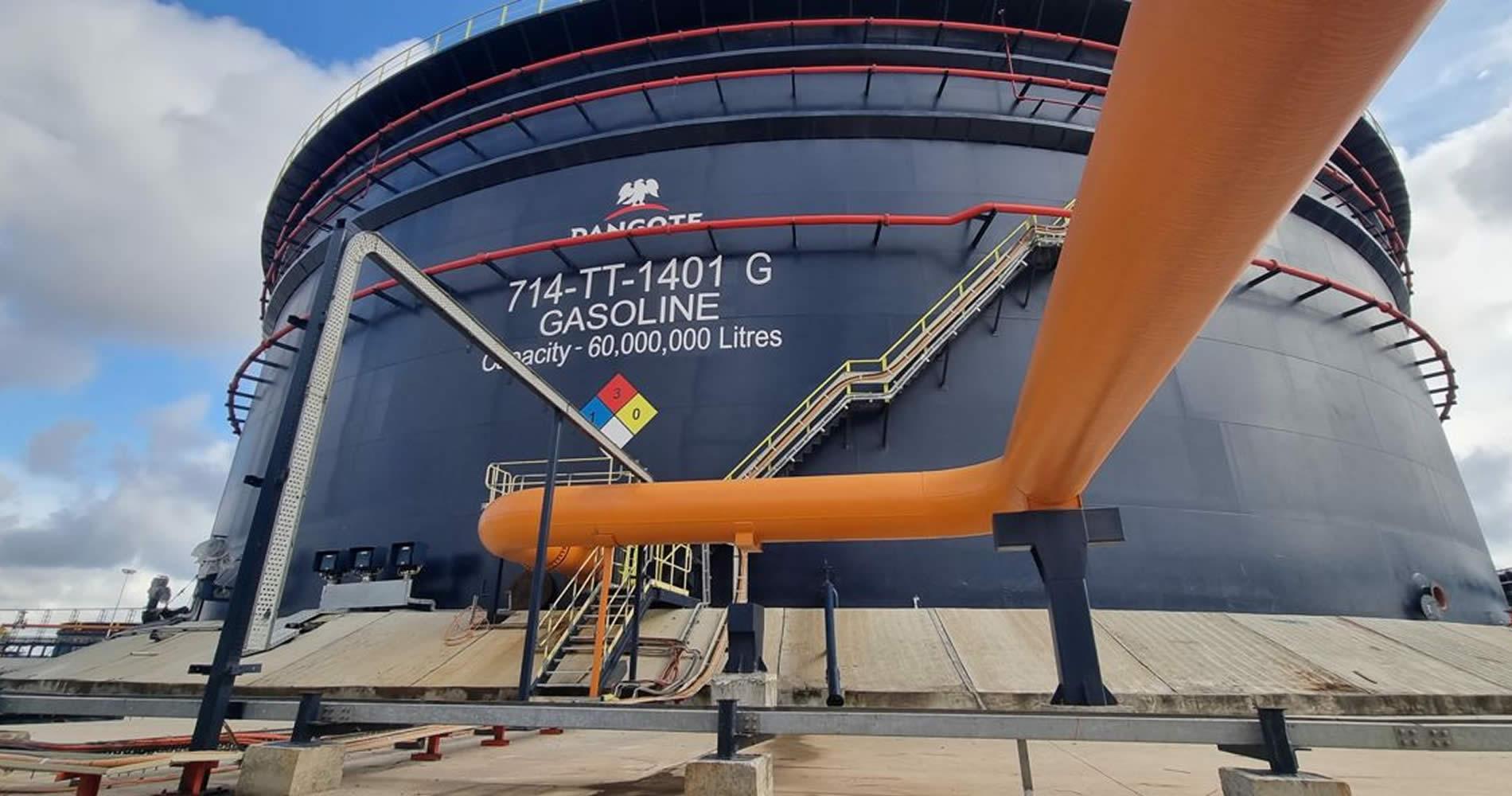
Nigeria’s Federal Government cast the Dangote Petroleum Refinery and Petrochemicals as central to President Bola Tinubu’s target of a $1 trillion economy, as the facility’s owner disclosed that the plant, once running at full tilt, will process the equivalent of roughly 10percent of United States refining capacity.
- +Our refinery represents 10% of US refining capacity – Aliko Dangote
John Enoh, minister of state for industry, made the remarks Wednesday after touring the 700,000 barrel-a-day refinery along with the adjoining Dangote Petrochemicals complex and Dangote Fertiliser Limited in Lagos, at the head of a delegation that included ministry directors, regulators and agency heads.
John Enoh, minister of state for industry, made the remarks Wednesday after touring the 700,000 barrel-a-day refinery along with the adjoining Dangote Petrochemicals complex and Dangote Fertiliser Limited in Lagos, at the head of a delegation that included ministry directors, regulators and agency heads.
“You cannot be Minister in charge of Industry and not visit the Dangote Refinery,” Enoh said. “This facility matters because of what it represents for Nigerian industry, for our people and for the realisation of President Bola Tinubu’s vision of a one trillion-dollar economy.”
The minister framed the plant as proof of Nigeria’s shift up the value chain. “The more a country adds value to its products, the more respect it earns globally. The Dangote Refinery stands today as one of the strongest demonstrations of that principle,” he said.
He credited the refinery with helping flip Nigeria’s global standing from perennial importer of refined fuel to exporter, pointing to shipments that reached the Middle East during recent supply disruptions. “When global supply disruptions occurred, Nigeria was able to export petroleum products to markets in the Middle East and beyond. That is an extraordinary achievement and one that deserves recognition,” Enoh said.
Enoh also pushed back on longstanding concerns about the refinery’s single-train design, arguing that scheduled upkeep hasn’t knocked the plant offline. “The issues surrounding the single-train configuration are much clearer now. Even during scheduled maintenance, operations continued,” he said.
The government pledged continued engagement with Dangote Industries through the Industrial Revolution Work Group and ministerial roundtables, with financing access for manufacturers flagged as a priority. Enoh singled out Aliko Dangote as “Nigeria’s foremost industrialist” and tied his contribution to the Nigeria Industrial Policy’s goals of lifting manufacturing’s share of GDP to about 20 percent by 2030 and 25 percent by 2035. “We want to be judged by the extent to which we implement this policy,” he said.
Speaking alongside the minister, Dangote Industries president Aliko Dangote pressed the government to keep industrialisation at the core of economic policy. “There is no way to create jobs and prosperity without industrialisation,” he said, adding that domestic investor success is what ultimately draws foreign capital: “When local investors thrive, they send a powerful signal that the environment is conducive for investment.”
Dangote pointed to a recent unsecured, unrated bond priced below Nigeria’s sovereign benchmark as evidence of investor appetite for credible private-sector borrowers, and said policy consistency matters more to investors than incentives do.
He also disclosed the refinery’s global scale for the first time in these terms: at full capacity, the plant will equal about 10 percent of US refining capacity and draw on roughly 2.5 percent of globally traded crude.
Dangote called the refinery the biggest business risk of his career, built through the pandemic, currency volatility and lender scepticism.
“What we have achieved here has never been done before on this scale,” he said. “Once one person succeeds, many others will be encouraged to follow.”