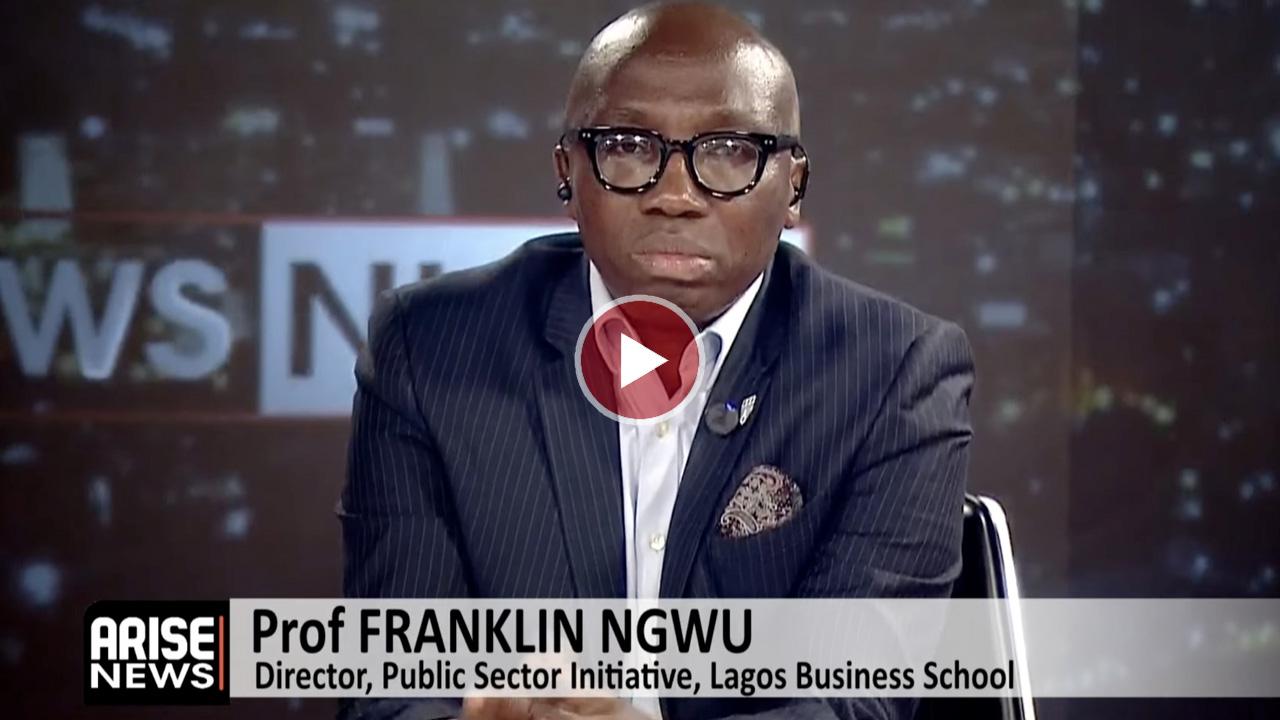
Franklin Ngwu: Tinubu, Finance Minister Must Explain Nigeria’s Revenue Collection And Implementation
Professor Franklin Ngwu says rising revenue hasn’t improved key sectors, urging President Tinubu, Wale Edun to explain spending and accountability.
Professor Franklin Ngwu says rising revenue hasn’t improved key sectors, urging President Tinubu, Wale Edun to explain spending and accountability.
Director of Public Sector Initiative, Lagos Business School, Professor Franklin Ngwu has questioned why rising revenue has not improved key sectors, urging President Bola Ahmed Tinubu and the Minister of Finance, to explain how funds are managed.
“A situation where we are saying that we are the poverty capital of the world, while insecurity is increasing and education and health are not doing well—meanwhile, we are being told that revenue has gone up since 2023—it seems there is a serious disconnect. And the buck stops at the office of the President and Minister of Finance to really tell Nigerians what is really happening with our revenue collection and implementation,” he urged.
Speaking in an interview with ARISE NEWS on Monday, where he examined concerns over low budget released and alleged resource diversion, Prof. Ngwu said the way public funds are managed is concerning.
“I think the way we are running our public financial management in Nigeria is concerning; it’s giving people serious concern in terms of the way things are going,” he noted.
He further criticised the poor execution of government budgets, noting that low implementation rates continue to undermine development outcomes. According to him, the rollover of unspent funds and overlapping budget cycles reflect deeper structural weaknesses in Nigeria’s public financial management system.
“Remember that last year, in 2025, we had a program where we discussed that we had three budgets running at the same time: the 2023 budget, the 2024 budget, and the 2025 budget, all at the same time. It was a crazy kind of confusion. And now we’re in 2026. When we reviewed the 2025 budget, even that provided by the Federal Government, it revealed that they only implemented about 30% of the capital budget. And as you earlier stated, the President now approved the reallocation or moving of most of the items from 2025 to 2026, extending it to about June 30th. I’m not sure—and that’s the feeling of many Nigerians—that in terms of the way we manage our public finances, it can be better. This relates also to not only the security, but even health, education, and all the critical sectors. A situation where we are not even achieving up to 40% in terms of implementation of the budget is really a cause to worry. At the end of the day, we are having more revenue as you stated, but in terms of key social-economic indicators like poverty, education, and insecurity, all of them are heading in the wrong direction,” he said.
He called on President Tinubu and relevant authorities to urgently reform budget implementation processes.
“So the question then is: what should be done? I believe that the President and the government need to sit back and rethink the essence of governance and see how we can really translate this increase in revenue to tangible results that Nigerians can see,” Prof Ngwu advised.
Addressing the concerns raised by the World Bank, Ngwu said the concerns raised by the World Bank point to deeper transparency issues in Nigeria’s revenue management framework. He noted that while the government maintains that the deductions are legitimate first-line charges, the lack of clear, publicly accessible breakdowns raises accountability questions.
“When I read the first World Bank report, I think it made me start thinking: the TSA (Treasury Single Account), are we no longer following it, or is the TSA still in operation? Remember that the TSA is meant to help us bring all the revenues of the government into one account before disbursement. This would help the government know their fiscal and financial position, help the government curb corruption, and bring transparency and accountability. And now the World Bank is saying that between 2023 to 2025, about 41% of the revenue collected—which is about 34 trillion—was actually deducted before it got to the Federation Account. I read the report released by the Federal Ministry of Finance; I’m not sure they addressed the key issues. But what the World Bank is saying is that the revenue collection agencies, like the Nigeria Customs Service, the Nigerian National Petroleum Corporation (NNPC), and the Federal Inland Revenue Service (FIRS), deduct this money before it gets to the Federation Account.
“So I expect, and I think many Nigerians are also asking, that the Federal Government provide more clarification with regards to some of these issues. The idea of removing 34-something trillion—about 41% from the revenue collected—is quite concerning. The question is: what did they use this 30-something trillion to do within this period? And of course, you now bring up the issue where they say they’ve met their revenue targets, but at the end of the day, even the allocations to critical sectors of the economy are not receiving them. Remember also that the Federal Government said that they agreed with some of the things the World Bank report said—but this idea of revenue not being properly accounted for calls for questioning and maybe proper auditing or transparency and accountability on the part of the revenue-collecting agencies,” he stressed.
Speaking further, Prof Ngwu added that the severe shortfall in funding for critical security institutions, including the Nigerian Army and Air Force, highlights a troubling pattern in national priorities.
“I think it calls for better management of our budgeting system. And also, let me even start by this idea: we make a budget, but we don’t implement it. Like I said, for the 2025 budget, in terms of capital expenditure, only 30% can be said to be implemented. 70% was moved to 2026. And that’s exactly the same thing we had in 2025, 2024, and 2023. The Army getting only 7% of their disbursement—meanwhile, we are being ravaged by insecurity—there’s nobody that will not be worried by this kind of situation. I think it’s also time for us to rethink in terms of going back to a zero-budgeting system, whereby we are sure of the revenue that we have before we now start budgeting for the expenditure we’re going to implement.