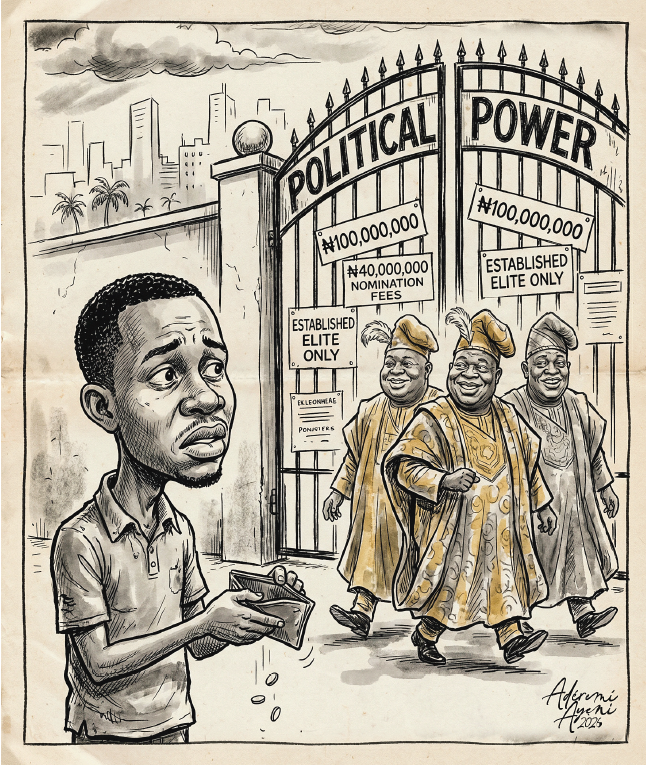
One of the most powerful phrases young Nigerians grow up hearing is “you are the leaders of tomorrow.” Demographically, that promise should be within reach. With a median age of about 18 and more than 60 percent of the population under 25, Nigeria has one of the youngest populations in the world. Legally, the pathway appears open. The “Not Too Young to Run” Act, signed into law on May 31, 2018, lowered the minimum age for presidential candidates from 40 to 35. But in practice, Nigeria’s political system remains one of the most financially exclusionary in the world. The system expands eligibility in law while restricting access in reality.
- +Nigeria’s current political system prices young people out of power
In July 2024, the national minimum wage was raised to N70,000 per month, roughly N840,000 annually.
In July 2024, the national minimum wage was raised to N70,000 per month, roughly N840,000 annually. According to the Nigerian Consumer Outlook Report 2025 by SEID, less than 1% of Nigerians earn above N1 million monthly, while the majority earns below N100,000 or have no stable income. Unemployment and underemployment remain widespread, particularly among young people.
Poverty deepens this constraint. The World Bank estimates that more than 60 percent of Nigerians live below the national poverty line. For young Nigerians, savings are rare and access to capital is minimal. Now contrast this with the cost of political participation.
In the 2023 election cycle, major parties set presidential nomination forms at staggering levels. The All Progressives Congress pegged its form at N100 million, while the People’s Democratic Party had N40 million. Even smaller parties, though cheaper, still asked for millions of naira. Similar patterns exist across other offices. Nomination forms for governorship, National Assembly, and state legislative seats routinely run into millions, placing even mid-level political participation beyond the reach of most young Nigerians.
Put differently, a young Nigerian earning N100,000 monthly would need to save their entire income, without spending a naira, for decades to afford a N100 million form. That is before campaign costs, logistics, media exposure, mobilisation, and the entrenched patronage networks often described as godfatherism. This is not simply a high barrier. It is a filtering system.
A political structure that demands such financial commitment effectively ensures that only individuals with access to wealth, either personal or through elite sponsorship, can compete. The result is not just exclusion, but dependence. For many young aspirants, the inability to self-finance does not eliminate ambition; it redirects it toward political patrons. In exchange for funding, loyalty is secured, and future decision-making is shaped long before office is attained.
This dynamic is not limited to national offices. At the local level, where youth participation should be most accessible, a different form of exclusion persists. Local government systems, despite ongoing reforms and the push for greater autonomy, are often shaped by political appointments and patronage arrangements rather than open electoral competition. Ward-level and council positions, which could serve as entry points for young leaders, are frequently absorbed into broader political structures, limiting independent access.
The case for youth inclusion is often framed in demographic terms, mainly that a young population should produce young leaders. The real argument however is not about age as entitlement, but about alignment. Younger leaders are more directly connected to the realities shaping Nigeria’s future: unemployment, digital transformation, migration, and education gaps.
However, youth alone is not a guarantee of better governance. Without institutional strength, political experience, and independence from patronage, younger leaders can replicate the same systemic failures as their predecessors. The issue, therefore, is not simply replacing older leaders with younger ones, but creating conditions where leadership at any age can function effectively and accountably.
Historically, youth leadership in Nigeria is not unprecedented. Yakubu Gowon assumed leadership at 31, albeit through a military coup. While that pathway is neither democratic nor desirable, it reflects a time when leadership was less constrained by financial gatekeeping. Today, the barrier is less about age and more about access.
Globally, youth leadership is not theoretical. Sanna Marin became prime minister of Finland at 34, while Sebastian Kurz rose to office at 31 as Chancellor of Austria. These outcomes were not driven by age alone, but by political systems that allow internal party mobility, regulate campaign financing, and reduce the dominance of money in electoral competition. Nigeria’s system operates differently. It is heavily monetised, and that monetisation shapes outcomes. A system that is expensive to enter is often expensive to sustain. Addressing this in Nigeria requires an intentional structural reform.
First, nomination fees must be subject to reasonable caps to prevent economic exclusion across all levels of office. Second, political financing should evolve toward more transparent models, including public campaign support, to reduce dependence on wealthy sponsors. Third, internal party processes must become more open and competitive, limiting the influence of gatekeepers. Campaign finance rules and spending limits must be monitored and applied consistently. Without this, reforms risk becoming symbolic. Finally, leadership pipelines must be strengthened. Mentorship, institutional support, and capacity-building programmes can help young candidates navigate political systems without relying entirely on patronage networks. Lowering the age requirement was a necessary step. It addressed formal exclusion. But the deeper challenge remains economic and structural.
Until Nigeria reduces the cost of political participation and weakens the grip of money across its political system, leadership will remain less a contest of ideas and more a function of access to capital. For millions of young Nigerians, the promise of leadership will remain not a pathway, but a deferred possibility.