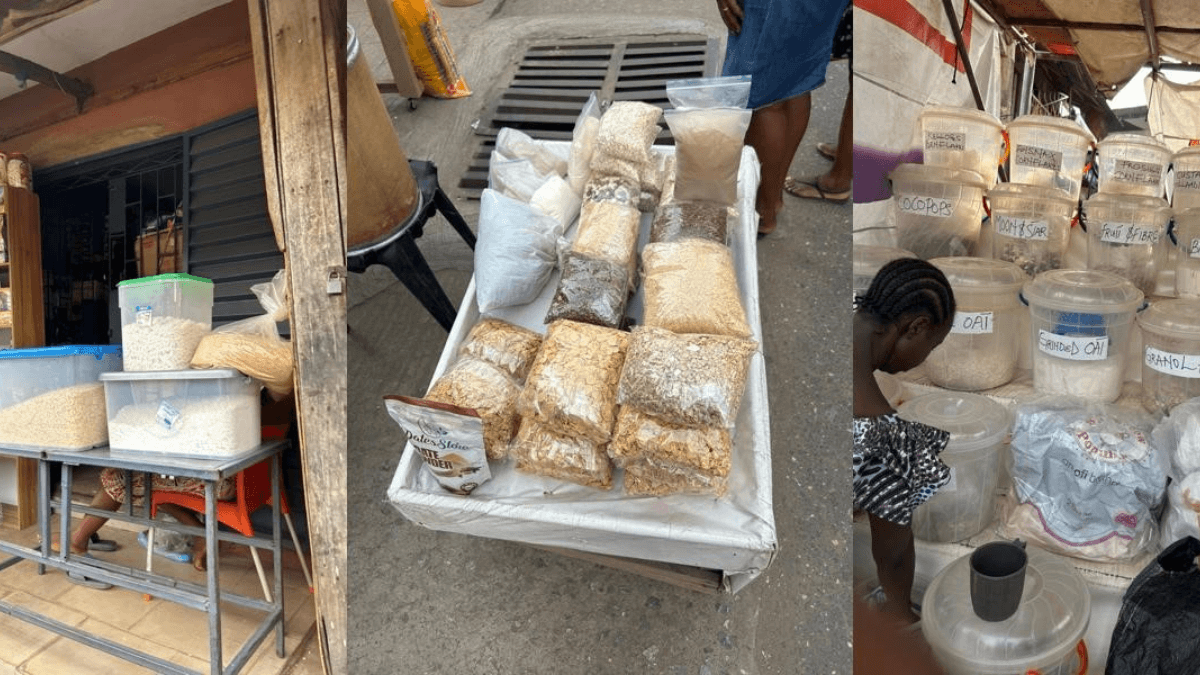
In many Nigerian markets, food items are removed from branded packs and resold in nylon bags, buckets, and plastic cups. BusinessDay investigations found that many come from expired, near-expiry, or rejected factory stocks, fuelling a multi-billion-naira illegal trade that exposes consumers to health risks. SODIQ OJUROUNGBE writes
- +Repackaged expired products dominate Nigeria’s N34trn food market
- +Looking for cheaper food items
- +From factory floor to market stall
A closer look shows the paint buckets are filled with food items such as cornflakes, oats, semolina, and powdered milk, each marked only with a small piece of paper taped to the side to indicate its content.
A closer look shows the paint buckets are filled with food items such as cornflakes, oats, semolina, and powdered milk, each marked only with a small piece of paper taped to the side to indicate its content.
Behind the counter, the trader, later identified as Iyabo, dips a plastic cup into one of the buckets and scoops out the cornflakes. Two quick measures go into a thin nylon bag, which she twists and ties before handing it to the waiting customer.
“Two cups, that is enough for breakfast tomorrow,” the buyer says softly.
The customer slips the bag into her handbag and steps aside as another buyer stretches out a hand with crumpled naira notes.
For many of the buyers gathered around the stall, it is simply a cheaper way to put food on the table in difficult times. However, cornflakes, oats, tea, and powdered milk are not produced unbranded in Nigeria. They are food items normally sold in sealed cartons, sachets, and tins, stamped with brand names, batch numbers, production dates, and expiry labels meant to guide and protect consumers.
But in Ishaga, like in many markets, the labels and boxes have been removed. What remains are open buckets and plastic cups used to sell food items whose origins are no longer clear.
Looking for cheaper food items
Several kilometres away in the crowded Ile-epo market, 42-year-old Ibrahim Musa wove through a row of stalls stacked with nylon bags of white grains and powdered foods. He paused at one where semolina and macaroni were being measured into small plastic bowls.
“For N3,000, give me a ‘paint’ of that,” he said, pointing at a sack of semolina.
The trader scooped from the plastic, poured it into a nylon bag, tied it tight, and handed it over. Like the cornflakes in Ishaga, the product had no name, no label, and no clue of its origin.
He stated, “Things are hard now, and we have to work with a budget. In the supermarket, the same size of semolina costs almost triple.”
What Musa and other buyers never stop to ask, is how these foods ended up in open sacks and paint buckets, far from the safety of their original packaging.
An investigation by BusinessDay into the supply chain revealed that many of the food items sold in this form once carried popular brand identities before their packaging was stripped away.
It was gathered that once these products are removed from their original branded packaging, they are sold in bulk to middlemen who repackage them into sacks, buckets, and nylon bags before distributing them to traders in open markets.
From Ishaga to Agege, Mile 12, and other markets across Lagos, this practice has quietly grown into a thriving underground trade, supplying thousands of households in search of cheaper alternatives.
It was discovered that food items, such as cornflakes, oats, semolina, powdered milk, tea, and macaroni, are typically produced under tightly controlled conditions by manufacturers and released to the market in sealed cartons, sachets, or tins carrying brand names, batch numbers, manufacturing dates, and expiry information. This fast-moving consumer goods (FMCG) market was valued at $25 billion (N34 trillion) in 2025. Key segments include staples like rice, vegetable oil, and noodles.
In Nigeria, food manufacturers are required to comply with strict packaging and labelling rules enforced by the National Agency for Food and Drug Administration and Control (NAFDAC), which mandates that packaged food must clearly display production details, ingredient lists, and expiry dates before they are released for sale.
According to the agency’s guidelines on food labelling, these details ensure that products can be traced in the event of contamination, spoilage, or safety concerns.
But BusinessDay Investigations found that products scooped daily into cups and plastic in Ishaga, Ile-epo, Agege and other markets no longer carry these identifiers. Instead, they appear in an entirely different form.
During visits to several markets in Lagos, this reporter observed traders selling these products from open sacks stacked behind their stalls.
Some of the plastics used for display had small handwritten labels like ‘Cornflakes’, ‘Oat’, or ‘Milk’, while in other cases, empty plastic cans bore improvised labels such as ‘Tea’ or ‘Cornflakes’.
Market traders told our correspondent that they usually buy these products in bulk from distributors who have already removed them from their original packaging.
“They bring it in sacks, the cornflakes, oats. We buy the sack and then measure it for customers,” said Solomon at the Agege market.
At the Ile-epo market, another trader explained that the goods often arrive through middlemen who supply large consignments.
“They come with a truck and deliver it to many people here. If you want cornflakes, they bring a sack. If you want milk, they bring that,” she added.
From factory floor to market stall
BusinessDay’s investigation traced how stripped and repackaged food products move through a largely unregulated system that begins in factories and ends with consumers.
As part of this investigation, our correspondent was introduced to a middleman who only identified himself as Chinedu, operating within the trade, who offered to facilitate entry into the business and explained how the system worked.
Chinedu said a minimum of N10 million was required to participate, describing it as the baseline capital needed to connect with manufacturing companies and bid for what he termed ‘disposable goods.’
According to him, these goods are typically sold off at significantly reduced prices through informal bidding arrangements, where interested buyers are invited to compete for bulk quantities.
“You will need at least N10 million to start. That is what it takes to link you up with the companies. They call us to bid, and whoever pays immediately takes the goods,” he said
He explained that the items available through this process are not limited to food, but include anything classified as ‘disposable’ by manufacturing firms, ranging from plastics and metals to processed food products.
For food items, he said the products usually fall into specific categories of those nearing expiry, those that have reached their “best before” dates, or those that failed internal quality checks due to packaging defects, labelling errors, or minor inconsistencies.
Under standard regulatory expectations, such products are meant to be properly disposed of or redirected in line with safety guidelines.