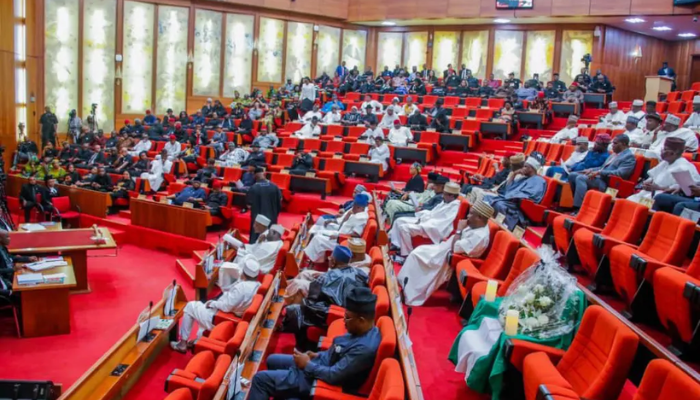
Nigeria moved a step closer to creating state police forces after the Senate passed a constitutional amendment bill for a second reading, advancing a long-debated proposal to decentralise policing amid worsening security challenges across the country.
- +Police Bill advances as States weigh billion-naira rollout costs
The legislation could ultimately require states to spend tens of billions of naira to recruit, train and equip police officers at internationally recognised policing benchmarks.
The legislation could ultimately require states to spend tens of billions of naira to recruit, train and equip police officers at internationally recognised policing benchmarks. While the projected costs would once have posed a major obstacle, rising allocations from the Federation Account Allocation Committee (FAAC) have strengthened state finances, potentially improving their capacity to fund independent police services.
The debate now shifts from whether states should control policing to whether they can build professional, adequately funded forces while safeguarding them from political interference and ensuring effective coordination with federal law enforcement agencies.
BusinessDay’s analysis suggests that establishing and sustaining a functional state policing system could require tens of billions of naira in initial investment and recurring annual expenditure.
The analysis, based on globally referenced police-to-population benchmarks and current estimates for police training and operational equipment in Nigeria, indicates that a medium-sized state with a population of five million people could require nearly N50 billion simply to recruit, train and equip a police force, excluding infrastructure, salaries, vehicles, weapons and technology.
The issue of state policing has gained renewed attention amid growing concerns over insecurity, including banditry, kidnapping, communal clashes and other violent crimes across different parts of the country. Proponents argue that state-controlled police formations would improve local intelligence gathering, enhance response times and complement the efforts of the Nigeria Police Force.
However, questions remain about funding, operational independence and sustainability.
While there is no universally mandated ratio of police officers to citizens, the United Nations and the International Association of Chiefs of Police frequently reference a benchmark of about 300 police officers per 100,000 residents, equivalent to one officer for every 333 people.
Applying this benchmark to a state with a population of five million residents would require approximately 15,000 police officers to provide adequate policing coverage.
Under current arrangements in Nigeria, recruits undergoing training at police colleges typically receive monthly stipends ranging from N10,000 to N45,000, depending on educational qualifications and entry level. Using the upper estimate of N45,000 monthly over a six-month training period, each recruit would receive approximately N270,000 in allowances.
For a state seeking to train 15,000 officers, the total stipend bill would amount to about N4.05 billion. Analysts note that this figure covers only trainee allowances and does not include the costs of instructors, training facilities, accommodation, feeding, logistics and curriculum development.
According to estimates from state security support organisations such as the Lagos State Security Trust Fund, properly equipping a police officer with complete operational gear costs at least 3 million. The equipment package typically includes bulletproof vests, ballistic helmets, uniforms, boots and non-lethal operational tools such as tasers and tear gas.
At that rate, equipping a force of 15,000 officers would cost approximately N45 billion. When combined with training stipends, the initial personnel preparation cost rises to about N49.05 billion.
Experts say the actual cost of establishing a state police service would be far higher because the training and equipment figures do not account for essential infrastructure and operational assets. Such a police service would require state headquarters, area commands, divisional offices, barracks, training institutions, armouries and detention facilities.
In addition, states would need to invest heavily in patrol vehicles, motorcycles, communication systems, surveillance technology, emergency response centres, digital crime databases and command-and-control infrastructure. Weapons procurement, ammunition stockpiles and maintenance facilities would also constitute major expenditure items. If officers earn an average salary and allowance package of N150,000 per month, a 15,000-member force would cost approximately N27 billion annually in wages. Should the average monthly compensation rise to N200,000, annual personnel expenditure would increase to about N36 billion.
These estimates exclude pension obligations, healthcare benefits, insurance, housing allowances and operational logistics. The financial implications differ according to population size, as a state with three million residents would require approximately 9,000 officers and an estimated N29.43 billion in initial recruitment, training and equipment costs. For a state with seven million people, the requirement rises to about 21,000 officers at a startup cost of roughly N68.67 billion. Meanwhile, a state with 10 million residents could need as many as 30,000 officers, pushing the initial investment to more than N98 billion before infrastructure and operational expenses are considered.
Speaking in separate interviews with BusinessDay, Lawrence Alobi, former Commissioner of Police for the Federal Capital Territory, and Idowu Isamotu, an Abuja-based security analyst, argued that while state policing could significantly improve security response and community-based law enforcement, adequate legal safeguards and funding mechanisms must be put in place to prevent political interference and operational inefficiencies.
Alobi explained that the ongoing legislative process seeks to alter Nigeria’s policing structure by allowing states to establish and operate their own police services alongside the federal police. According to him, the proposed arrangement would create clearer divisions of responsibility between federal and state policing authorities, with certain offences falling within the jurisdiction of state police while crimes that transcend state boundaries would remain under federal control.
He noted that federal authorities would also intervene in situations where criminal activities overwhelm state police capabilities or involve multiple states. “There must be collaboration between the federal police and state police with a view to ensuring effective policing and security across the country,” he said. The retired police chief warned that financing state police operations would be one of the most significant challenges facing the initiative. He stressed that policing is highly capital-intensive and requires substantial investments in personnel, logistics, technology and operational equipment.