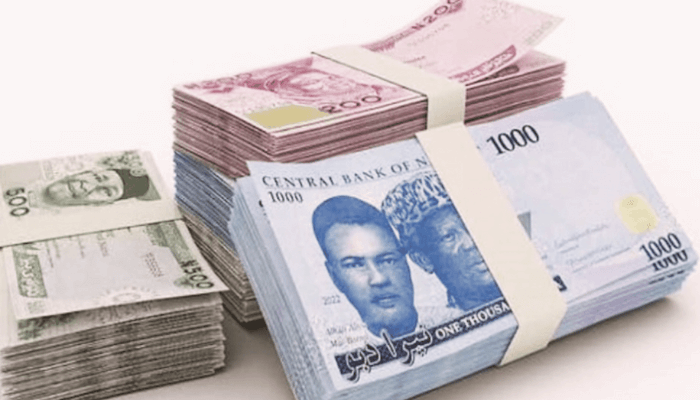
Nigeria’s naira has outperformed most of its African peers in 2026, even as the Middle East conflict adds volatility to global currency markets.
- +Naira outshines African peers despite mounting FX pressure
A report by United Capital Plc shows the naira appreciated 6.7 per cent against the US dollar year-to-date as of 24 April, compared with declines across several major African currencies — the Kenyan shilling fell 0.27 per cent, the Angolan kwanza 0.09 per cent, the South African rand 0.34 per cent and the Ghanaian cedi 5.30 per cent over the same period.
A report by United Capital Plc shows the naira appreciated 6.7 per cent against the US dollar year-to-date as of 24 April, compared with declines across several major African currencies — the Kenyan shilling fell 0.27 per cent, the Angolan kwanza 0.09 per cent, the South African rand 0.34 per cent and the Ghanaian cedi 5.30 per cent over the same period.
Ayodele Akinwunmi, chief economist at United Capital, attributed the naira’s gains to stronger external buffers, policy reforms and improved FX supply, including robust reserves that have enabled the Central Bank of Nigeria (CBN) to support the currency, alongside reforms that improved transparency and reduced volatility. Inflows from oil and non-oil exports, and tighter monitoring of FX transactions, also boosted supply.
Pressure is nonetheless building beneath the surface.
The naira eased last week as FX liquidity slowed and external reserves continued to decline. CBN data show the currency weakened N14.57 week-on-week to N1,364.24 per dollar at the Nigerian Foreign Exchange Market on Monday — a 1.07 per cent depreciation from N1,358.44 the previous week.
At the parallel market, the naira held steady at N1,400 per dollar. The gap between the official and parallel rates narrowed to N36 from N42 the previous week.
Ayokunle Olubunmi, head of financial institutions ratings at Agusto & Co, said increased CBN intervention has helped the naira hold up despite weakening underlying liquidity.
External reserves fell 3.16 per cent to $48.44 billion as of 23 April, down from a peak of $50.02 billion in March.
FX liquidity has also weakened. FMDQ data show total market inflows declined 7 per cent month-on-month to $4.1 billion in March. Analysts at Quest Merchant Bank attributed the drop partly to seasonal factors — noting similar moderation in March 2025 — but flagged a sharp contraction in inflows from local individuals, which fell to $22.2 million from $697.8 million the previous month.
The CBN stepped up intervention in response, with FX sales rising 112 per cent month-on-month to $691 million in March. Exporter inflows remained a steady source of supply, edging down 2 per cent to $770.3 million.
The naira had already come under strain in March, depreciating approximately 1.3 per cent month-on-month to close at N1,387 per dollar, according to Quest Merchant Bank data.
Remittance inflows have weakened sharply. CBN figures show direct remittances fell 46.22 per cent to $107.47 million in January from $200.31 million in December.
CBN Governor Olayemi Cardoso has set a target of $1 billion in monthly remittance inflows by year-end, up from approximately $600 million currently. Measures under way include enabling Bank Verification Numbers for Nigerians abroad and integrating international money transfer operators to reduce friction and deepen formal FX channels.
“The Central Bank has done much to create an enabling environment. What is needed now is for banks to develop products that encourage diaspora Nigerians to channel funds through formal systems,” Cardoso said, adding that early signs point to improving momentum.
Separately, FMDQ data show the naira reversed part of its earlier gains during the week, with the official rate weakening 0.47 per cent amid lower turnover. Interbank activity also slowed, with turnover dropping 49.56 per cent and the number of deals falling from 594 to 346.
Across Africa, currency performance is diverging, reflecting differences in external buffers, commodity exposure and policy credibility. Tunisia’s dinar trades at approximately 2.86 per dollar, Libya’s at 6.31 under tight management, Morocco’s dirham at 9.01 — supported by diversified exports — and Botswana’s pula at 13.05, backed by diamond revenues. South Africa’s rand, at 15.87, continues to serve as a regional anchor, with Eswatini’s lilangeni and Lesotho’s loti both pegged at approximately 15.90.
The Middle East conflict is adding further pressure, reshaping energy flows and driving volatility across emerging markets. A joint policy brief by the African Development Bank, African Union, UNDP and UNECA said the impact remains uneven. Nigeria is expected to benefit from higher oil prices and increased refining capacity, while South Africa, Namibia and Mauritius are seeing increased maritime traffic as vessels divert around the Cape of Good Hope. The brief warned, however, that these gains are unlikely to fully offset inflationary pressures, fiscal strain and broader external vulnerabilities.
A UNDP-led brief urged African central banks to adopt flexible exchange-rate frameworks, curb speculative activity during periods of stress and coordinate closely with fiscal authorities.
For Nigeria, the naira’s resilience reflects the impact of reform and intervention — but also the growing tension between improved policy credibility and weakening FX liquidity as global shocks ripple through markets.