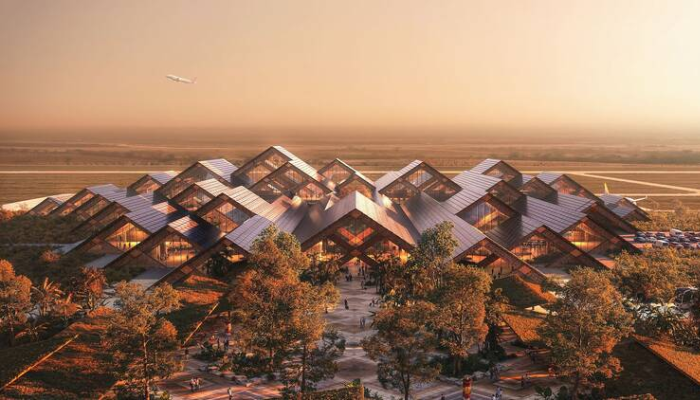
Bhutan is preparing for one of the biggest shifts in its tourism and economic strategy in decades, as the Himalayan kingdom moves ahead with plans for a new international airport and a large-scale urban development in its southern region.
- +Bhutan opens a new chapter in tourism with airport and planned city in Gelephu
For a country known for limiting visitor numbers and carefully managing foreign access, the project signals a notable step toward wider global engagement while keeping its long-standing commitment to controlled tourism.
For a country known for limiting visitor numbers and carefully managing foreign access, the project signals a notable step toward wider global engagement while keeping its long-standing commitment to controlled tourism.
At the centre of this transition is Gelephu, a lowland town near Bhutan’s border with India. There, a new international airport is scheduled to open in 2029. The airport is expected to become the country’s main aviation hub and a gateway to the proposed Gelephu Mindfulness City (GMC), a planned administrative and economic zone designed to attract residents, businesses and travellers.
Earlier this year, Bhutan’s King, Jigme Khesar Namgyel Wangchuck, joined thousands of volunteers to help clear land for the airport project. The development has already gained global attention after receiving the Future Project of the Year award at the 2025 World Architecture Festival.
The airport’s design reflects Bhutan’s cultural identity, with a timber terminal built from local wood and intended to regulate humidity naturally. Plans also include spaces for yoga, meditation and wellness activities. However, beyond its design, the airport’s significance lies in its role in expanding access to Bhutan.
For years, Bhutan has remained one of the world’s least accessible destinations.
The kingdom only began welcoming tourists in 1974, when it introduced a “High Value, Low Volume” policy aimed at protecting its heritage and environment. Until the Covid-19 pandemic, most international visitors had to book through licensed Bhutanese tour operators and pay a daily package rate that covered accommodation, transport, meals and a guide.
Since 2022, Bhutan has revised that structure, replacing the all-inclusive tariff with a Sustainable Development Fee of $100 per adult per night, while allowing travellers to arrange their own logistics separately.
Even with these changes, Bhutan has retained its focus on regulated tourism.
The country’s only international airport has been in Paro, in western Bhutan. The airport is served by two airlines and handles a limited number of flights each day. Due to its location in a narrow mountain valley, landings require pilots to navigate visually without radar support. Fewer than 50 pilots are qualified to land there.
As a result, reaching Bhutan often involves long layovers in cities such as Bangkok, Kathmandu or Delhi, with travel costs remaining high.
The new airport in Gelephu is expected to change that.
With a projected capacity of 123 flights a day, it could significantly increase the number of international arrivals and reposition Bhutan as a more connected destination in South Asia.
But the airport is only one part of a wider national strategy.
The Gelephu Mindfulness City is intended to serve as an independent city within Bhutan, blending investment incentives, environmental planning and cultural principles. Officials say it could eventually house up to one million Bhutanese and foreign residents by 2060.
The idea was first conceived more than a decade ago, but the pandemic accelerated its urgency.
Bhutan’s prolonged closure during Covid-19 weakened the tourism sector and added pressure to an ongoing youth migration trend. Policymakers now see GMC as a way to create employment, attract international business and broaden the country’s economic base.
“GMC will create a lot of job and investment opportunities,” Dr Lotay Tshering, former prime minister and current governor of GMC, said. “But we must have flights coming in… we must have passengers.”
For tourism officials, the project is also about changing how visitors experience Bhutan.
Most international tourists currently follow routes through western and central Bhutan, visiting destinations such as Thimphu, Punakha and Bumthang. Southern Bhutan, by contrast, has remained less visited.
Officials want Gelephu to become both a destination and a transit point for travellers.
“We envision Gelephu as a stopover for international visitors,” said Tshering Dolkar, the region’s tourism director. “Instead of flying through Hong Kong or Bangkok, travellers will opt to fly through Gelephu and spend some days on a jungle safari or in meditation.”
Southern Bhutan offers a different tourism profile from the mountain monasteries and alpine routes that define the country’s global image.
The region includes subtropical forests, rivers, farmland and access to Royal Manas National Park, Bhutan’s first national park. The reserve is home to elephants, rhinos, tigers, clouded leopards and hundreds of bird species, including the critically endangered white-bellied heron.
“Southern Bhutan, where mountains give way to jungle, is a hidden sanctuary for the natural world,” said Matthew DeSantis, founder of MyBhutan. “The south has become a haven for endangered species. It’s one of the wildest places on our planet.”
Tourism development in the region will also include spiritual and cultural experiences.
Plans are underway for retreat centres, temples and a proposed dzong with guest accommodation and spaces for Buddhist study and cultural performances.
A new 168km route known as the Lotus-Born Trail is also expected to open in 2028. The eight-day journey will connect southern Bhutan to central regions, following the path of Guru Rinpoche, who introduced Buddhism to Bhutan.
In addition, travellers will have access to rafting, birdwatching, eco-camps, homestays and fly-fishing facilities.
Local authorities are also revitalising Gelephu’s Old Town through a cultural and culinary programme designed to showcase southern Bhutan’s communities. Food offerings will include thali platters, dal and ema datshi, while a Heritage Village will present Bhutan’s traditional arts and crafts.
For Bhutan, the developments in Gelephu represent more than infrastructure expansion.
They reflect a balancing act between preserving identity and opening new pathways for growth.
“There aren’t too many raw jungles left in the world,” said Tshering. “This area is home toraw jungle with natural untamed tigers. That is the jewel we have.”
As construction continues, Bhutan is positioning itself to redefine its role in regional tourism and global investment, without abandoning the values that have long shaped the kingdom’s approach to development.
“We have an opportunity to try new things,” King Wangchuck said. “I hope this work will generate merit for generations to come.”