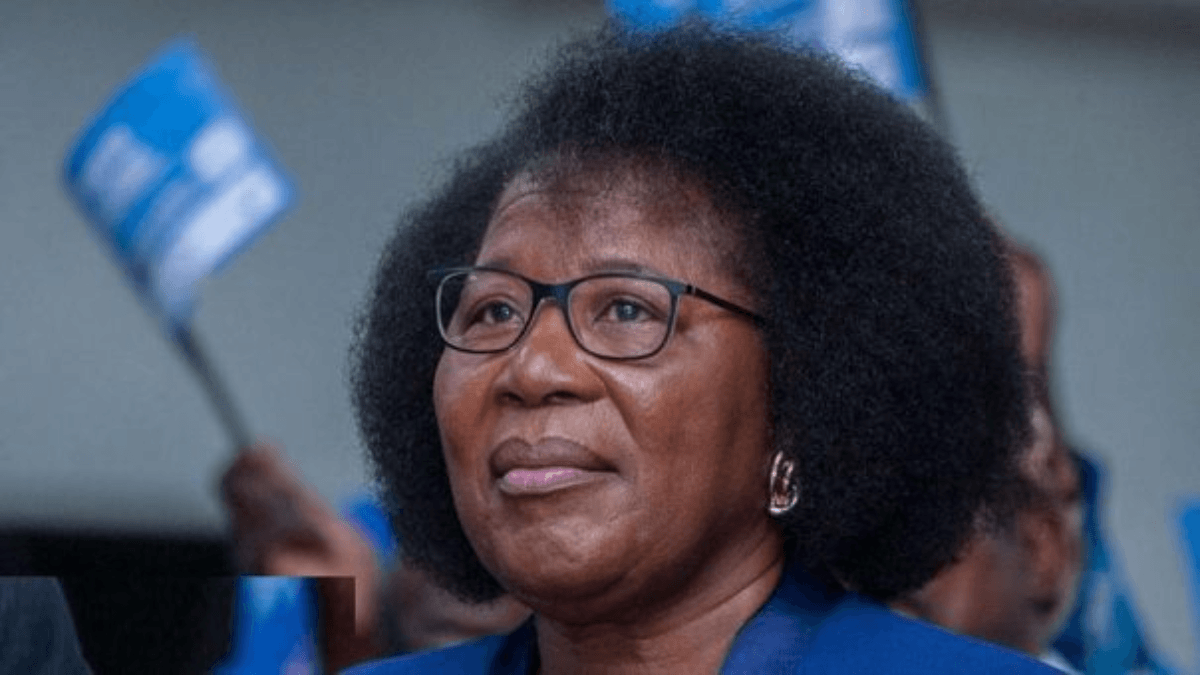
…Says Ezeilo has shown that human rights/women’s rights are not just a theory; but promise of safety and dignity for those most vulnerable.
- +Malawi Vice President extols Ezeilo at 60
Jane Ansah, the vice president of Malawi, has described Ngozi Ezeilo, a professor and United Nation’s Special Rapporteur on Trafficking in Persons, as a tireless champion of human rights and dignity and freedom for all.
Jane Ansah, the vice president of Malawi, has described Ngozi Ezeilo, a professor and United Nation’s Special Rapporteur on Trafficking in Persons, as a tireless champion of human rights and dignity and freedom for all.
Ansah, in a keynote speech titled ‘Women’s human rights and development: Bridging norms, institutions, and lived realities in Africa’, to mark the 60th birthday of Ezeilo, held Friday, March, 27, 2026 in Enugu, said that birthdays are often occasions for quiet reflection, moments where people pause to consider the passage of years and the experiences they have carried.
But in the case of Ezeilo, she said that reflection does not remain quiet for long, it rises into admiration, deep respect, and collective gratitude. “Hers is not merely a life lived; it is a life invested, invested in people, in institutions, and in ideals that uplift society as a whole.
“Today, we gather not merely to mark the passage of time, but to celebrate a life of purpose, courage, and extraordinary impact. We assemble in recognition of a woman whose journey has transcended personal achievement to become a symbol of hope, resilience, and unyielding commitment to justice.
“We are here to honour Joy Ngozi Ezeilo, a scholar, senior advocate, reformer, and above all, a tireless champion of human rights and dignity and freedom for all.”
She said that Ezeilo’s life and work exemplify how women’s rights can drive transformative development in Africa and beyond.
“Across sectors, regions, disciplines, and communities, Ezeilo has advanced a simple but powerful proposition that women’s rights are not peripheral, but central to sustainable democracy and development.
“As a scholar, she has shaped generations of students, through the development and teaching of courses on gender, human rights, and law. As a scholar-activist, her work with the Women Aid Collective (WACOL) and Tamar Sexual Assault Referral Centre have expanded access to justice for women and survivors of violence.
“At the global level, through her role as United Nations Special Rapporteur on Trafficking in Persons, she has engaged across continents, bringing visibility to the gendered dimensions of exploitation and the structural inequalities that sustain them. Whether in legislative chambers, courtrooms, community town halls, or international platforms, her work consistently conveys one enduring message: women’s rights are human rights, and their protection is indispensable to meaningful development.”
Ansah observed that African countries have made important progress on gender balance, by instituting laws prohibiting inequality and discrimination.
She said that countries have ratified key instruments, such as the United Nations Convention on Elimination of All Forms of Discrimination Against Women (CEDAW) and the Maputo Protocol to the African Charter on Human and People’s Rights.
She said that Nigeria reflects this progress, with legislative milestones, such as the Violence Against Persons (Prohibition) Act and the Child Rights Act, alongside constitutional guarantees of dignity and equality.
Ansah however argued that gender inequality persists in Africa, despite these legal gains, noting that legal frameworks operate within complex social and institutional contexts that are shaped by legal pluralism, where statutory, customary, and religious systems interact.
“These are further compounded by weak enforcement mechanisms, institutional fragmentation, and deeply entrenched patriarchal norms.
“In such contexts, the existence of progressive laws does not automatically translate into protection, empowerment, or justice. Nigeria provides a powerful example of this dynamic. Its legal landscape is defined by pluralism, where statutory, customary, and religious systems interact sometimes reinforcing, and at other times undermining, gender equality. For many women and girls, access to justice is uneven.
“Rights are often negotiated rather than guaranteed. And protection depends as much on location, identity, and socio-economic status as on formal legal provisions.”
She said that challenges, such as gender-based violence, harmful traditional practices, economic exclusion, and barriers to political participation are therefore not merely legal issues; they are development challenges shaped by law, yet not resolved by law alone.
“Beyond the legal and institutional dimensions, it is also important to recognise that development is incomplete without economic justice. Women’s human rights cannot be fully realised in contexts where structural economic barriers persist,” she stated.