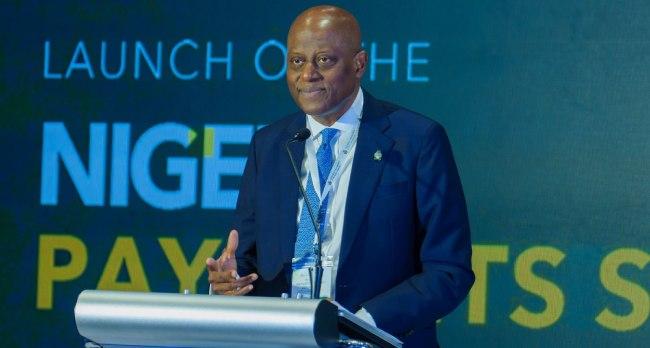
The Central Bank of Nigeria has said it is implementing a reform targeting 95 per cent financial inclusion, and “faster-than-a-blink” digital transactions, bringing millions more market women, farmers, and young people into the formal financial system.
- +Financial Inclusion To Hit 95% By 2028 — CBN
Speaking during the launch of the Payments System Vision 2028 (PSV 2028) Monday, the CBN Governor, Olayemi Cardoso, noted that “the goal is inclusion, not exclusion.”
Speaking during the launch of the Payments System Vision 2028 (PSV 2028) Monday, the CBN Governor, Olayemi Cardoso, noted that “the goal is inclusion, not exclusion.”
“By 2028, cash should no longer be king. We need to do a lot more work to build trust and ensure people have no doubt they are dealing with a strong and reliable payment system.
“A payment system is only as strong as the trust people have in it,” he said, noting that by 2028, the vision is to reduce fraud losses to less than 1% of all transactions and make people’s money safer in the digital system than under their mattresses
The apex bank governor, alongside other top CBN officials, explained that the document went beyond policy design, describing PSV 2028 as a blueprint for how Nigerians will transact, trade, save, and participate in an increasingly digital economy.
He described payment infrastructure as “invisible roads that move money,” stressing that efficient systems are now central to economic growth, competitiveness, and poverty reduction.
Cardoso warned against the country’s long-standing “start-stop” policy cycle, insisting that execution, not documentation, will define success.
He said, “The success of this vision will not be measured by the document, but by execution.”
The central bank governor said PSV 2028 was built on Nigeria’s two decades of rapid payments transformation, driven by instant payments, fintech expansion, and digital adoption.
According to him, the new framework will strengthen infrastructure, deepen inclusion, support innovation, enhance resilience, and improve the country’s integration into regional and global payment systems.
Cardoso emphasised implementation discipline, warning that reforms often lose impact due to inconsistent execution.
He said Nigeria must break from the pattern of policy disruption, insisting that continuity remains essential to unlocking long-term economic gains.
According to him, a central objective of PSV 2028 is to achieve 95 per cent financial inclusion by 2028, bringing about an additional 15 million Nigerians into the formal financial system.
Cardoso said financial inclusion was directly tied to poverty reduction and economic participation, stating that access to efficient payment systems determines whether citizens can fully engage in the economy.
He noted that cash should no longer define participation in economic activity, adding that digital financial access must become universal.
Cardoso was joined at the event by dignitaries, including Chief Executive, Sterling Bank Plc, Abubakar Suleiman; Managing Director/Chief Executive Officer, Nigeria Inter-Bank Settlement System (NIBSS) Plc, Premier Oiwoh; Director-General, Securities and Exchange Commission (SEC), Dr. Emomotimi Agama; and Managing Director/Chief Executive, Remita Payment Services Limited (RPSL), Deremi Atanda, among others.
The CBN governor also drew a direct connection between payment system efficiency and economic output, stating that PSV 2028 will contribute to GDP growth by improving productivity, reducing transaction costs, and expanding trade flows.
He said modern payment infrastructure was now a core driver of macroeconomic performance, adding that efficient systems strengthen investor confidence and support external sector stability.
Cardoso said Nigeria’s ambition was to ensure that by 2028, financial transactions were completed “faster than a blink,” building on existing real-time systems that already process millions of transactions in seconds.
He said the next phase of the reform will eliminate the remaining inefficiencies, interoperability gaps, and settlement delays across financial platforms.
The CBN governor set a target to reduce fraud losses to below 0.001 per cent of total transactions by 2028, adding that this will be achieved through stronger identity systems—NIN and BVN integration—combined with artificial intelligence-driven fraud detection tools.
He stressed that trust was central to digital finance, warning that without confidence in the system, adoption and inclusion gains can stall.
Cardoso said PSV 2028 was designed to position Nigeria as a global fintech hub, with explicit ambition to produce internationally competitive fintech unicorns.
He stated that open banking reforms had unlocked over 100 Application Programming Interfaces (APIs), creating opportunities for innovation, new products, and financial services expansion.
According to him, Nigerian innovators should be able to build global fintech solutions from Lagos, Abuja, and Kano, using domestic data and infrastructure.
He said the country must transition from a fintech adoption market to a fintech production and export economy.
Cardoso urged Nigerians to actively project their fintech achievements globally, warning that failure to tell the country’s own story risks allowing external narratives to define its progress, albeit in a way not comfortable for the country.
“If we do not tell the story, others will tell it for us,” he said.
Cardoso stated, “The central bank has provided a platform—but in fact, it is owned by everyone. As was said earlier—and I fully endorse it—we must work together to ensure execution.
“We must also measure performance. It is fine to have well-crafted words, but if we do not measure outcomes, we will lose track.
“We must keep in mind that there is a broader roadmap for outputs. As the government builds roads, schools, and hospitals, we here must also build the invisible roads that move money.”
He added, “And that is why Nigeria’s payments system vision 2028 is critical to national prosperity. Let us keep that in mind. The journey is still ongoing. That is part of it—and a major part of it. The journey is to lift people out of poverty, and to have an impact on GDP.
“Today’s payment systems process millions of transactions every day, and the majority are completed in less than 10 seconds.
“By 2028, our target is simple: every Nigerian—from Abuja to Brass—will be able to send and receive money faster than they can blink. Inclusion, not exclusion.”
The apex bank boss said, “In 2023, a large number of Nigerian adults had access to financial services. Under Vision 2028, I would like to see this reach 95 per cent inclusion—meaning 15 million more market women, farmers, and young people will gain access to financial services.”
He insisted that cash should not define participation in the economy.
According to him, “We must also build trust in the system. People must have confidence that they are dealing with a safe, reliable payments system. It is not enough for individuals to think, ‘I am fine, I can just use cash’, It is more than that.