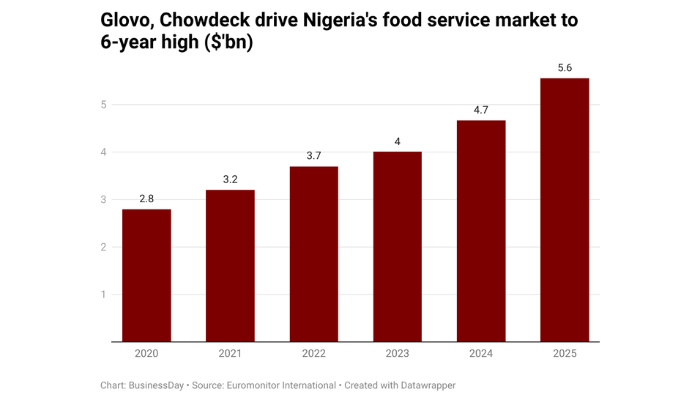
Nigeria’s foodservice industry reached its highest level in at least six years in 2026, driven by the rapid expansion of delivery platforms such as Glovo and Chowdeck, as consumers increasingly embrace convenience-led dining and digital ordering.
- +Glovo, Chowdeck fuel Nigeria’s foodservice boom as market hits six-year high
- +…Industry value rises to $5.6bn in 2025, records Africa’s second-fastest growth
- +Digital convenience drives growth
- +Nigeria joins world’s fastest-growing foodservice markets
- +Inflation pressures persist despite strong nominal growth
- +Food delivery platforms evolve into digital ecosystems
According to Euromonitor International’s latest Consumer Foodservice report obtained exclusively by BusinessDay, the value of the formal foodservice market in Africa’s most populous nation rose by 19.1 percent to $5.56 billion from $4.67 billion a year earlier, marking the strongest growth since the Covid-19 pandemic disrupted the industry in 2020.
…Industry value rises to $5.6bn in 2025, records Africa’s second-fastest growth
According to Euromonitor International’s latest Consumer Foodservice report obtained exclusively by BusinessDay, the value of the formal foodservice market in Africa’s most populous nation rose by 19.1 percent to $5.56 billion from $4.67 billion a year earlier, marking the strongest growth since the Covid-19 pandemic disrupted the industry in 2020.
The growth rate was the second-highest in the continent, behind Egypt’s 27.1 percent expansion, while South Africa recorded a comparatively modest 4.9 percent increase.
The report highlights how third-party delivery platforms are becoming central to the evolution of Nigeria’s urban consumer economy, transforming how consumers order, access, and consume food amid rising digital adoption and changing lifestyles.
“The rapid expansion of leading third-party delivery platforms such as Glovo and Chowdeck made a significant contribution to value sales last year,” Euromonitor said. “Growth in this channel reflects rising demand for convenience, as consumers increasingly shifted towards delivery-based fulfilment, particularly in urban areas.”
Digital convenience drives growth
The London-based research firm noted that both companies scaled aggressively last year by expanding their restaurant and rider networks across major cities while deploying promotions and subsidised delivery fees to attract price-sensitive consumers grappling with inflation.
The strategy appears to be paying off as delivery increasingly becomes embedded in everyday consumption patterns among urban Nigerians.
Founded in 2021 by Femi Aluko, Lanre Yusuf and Seun Williams, Chowdeck has emerged as one of the fastest-growing startups in Nigeria’s quick-commerce ecosystem, leveraging logistics efficiency, affordability and speed to deepen penetration in key cities, including Lagos and Abuja.
Meanwhile, Glovo, founded in Barcelona in 2015 by Oscar Pierre and Sacha Michaud, has expanded rapidly across emerging African markets including Nigeria, Kenya, Ghana, Uganda and Morocco. The company was acquired by Germany’s Delivery Hero in 2022 as part of the latter’s broader global expansion strategy.
“There is significant delivery innovation happening, and if you’ve noticed, there have been several promotions around delivery, especially through partnerships between restaurants and platforms like Glovo,” said Uchenna Uzo, professor of marketing at Lagos Business School. “Glovo was at the forefront of retail innovation last year, and that is helping to fuel the rise in demand.”
Euromonitor added that independent restaurants and chain operators are increasingly relying on delivery partnerships to strengthen fulfillment capabilities and meet evolving consumer expectations around speed and convenience.
Health-focused restaurant brand So Fresh, for instance, partnered with Chowdeck to improve accessibility to nutritious meals through efficient last-mile delivery services.
Nigeria joins world’s fastest-growing foodservice markets
Globally, consumer foodservice sales rose four percent to $3.36 trillion in 2025 despite persistent cost-of-living pressures across major economies. Asia Pacific remained the largest contributor, accounting for 40 percent of global sales.
Delivery channels are also capturing a growing share of consumer spending worldwide. Euromonitor estimates that delivery accounted for 22 percent of global foodservice spending last year, compared with just nine percent in 2019.
“Delivery fees have risen from nine percent in 2019 to 14 percent in 2025,” the report noted. “Even so, first-party and third-party players are exploring creative ways to justify these rising costs and push towards long-term operational solvency and consumer trust.”
Turkey, Egypt and Nigeria ranked among the world’s fastest-growing foodservice markets, underscoring the growing importance of emerging economies in shaping the future of global consumer dining trends.
“The industry is evolving rapidly, and the best is still yet to come,” Uzo said. “Food delivery is going to become far more mainstream as technology improves and service offerings become more sophisticated.”
Inflation pressures persist despite strong nominal growth
Despite the robust expansion in nominal terms, Euromonitor expects inflationary pressures to continue weighing on real consumer spending over the medium term.
The report projects foodservice sales in Nigeria to decline in constant-value terms over the forecast period as elevated prices erode purchasing power. However, transaction volumes are expected to remain resilient as consumers increasingly shift toward lower-cost dining channels, takeaway options and smaller-ticket purchases.
The number of foodservice outlets in the country rose by two percent to 356,385 in 2025, with street stalls and kiosks emerging as the best-performing category. The firm forecasts the sector’s value sales to grow at a compound annual growth rate of 13 percent over the coming years, while outlet numbers are expected to increase to 393,348.
To retain increasingly cost-conscious consumers, operators are intensifying investments in loyalty programmes, targeted promotions and digital engagement.
Sundry Foods, through its Kilimanjaro brand, expanded its loyalty initiatives and seasonal promotions in 2025, while Cold Stone Creamery Nigeria deployed aggressive discount campaigns and “buy one, get one free” offers to stimulate repeat purchases.
Food delivery platforms evolve into digital ecosystems
Industry analysts say the evolution of food delivery platforms could eventually extend beyond restaurant fulfilment into broader digital commerce ecosystems.
According to Uzo, consumers are increasingly adopting new lifestyles around food consumption, creating opportunities for platforms to integrate additional services into their applications.
“More products and services will be layered onto food delivery platforms, similar to embedded finance models where users can buy airtime, access loans, and carry out multiple transactions within a single platform,” he said. “Food delivery platforms are gradually evolving into ecosystems for a wide range of services.”
The trend mirrors broader shifts in emerging markets where technology platforms are increasingly combining logistics, payments, commerce and consumer services into integrated digital ecosystems.
Renewable energy adoption is also becoming a strategic priority for operators seeking to reduce operating costs and improve resilience amid Nigeria’s persistent electricity challenges.