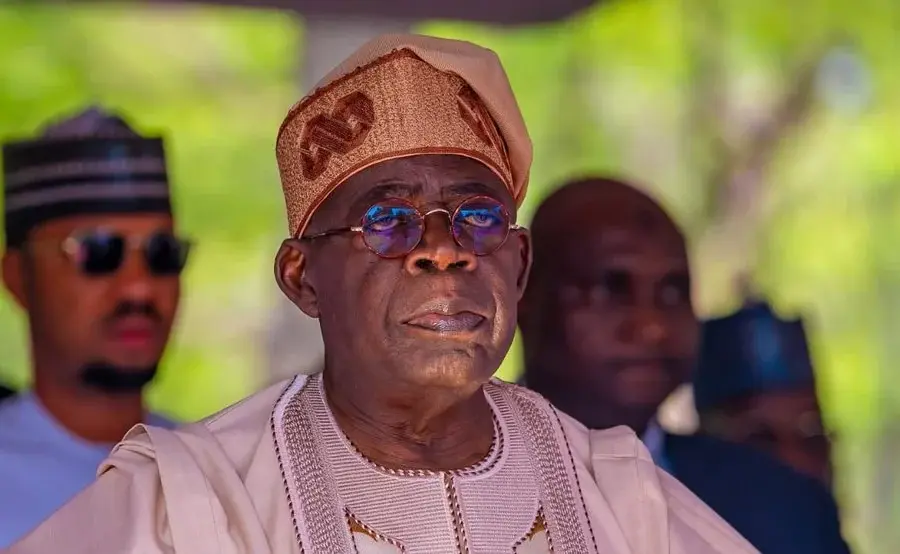
The Special Adviser to the President on Media and Public Communication, Sunday Dare, has defended President Bola Tinubu following criticism from the African Democratic Congress National Legislators Serving and Former Forum over remarks describing the party’s convention as noise and a street convention.
- +Presidency defends Tinubu’s ‘noise’ remark on ADC convention
Dare, in a detailed statement shared on Saturday via X, responded to the ADC-NF’s press conference in Abuja, where the group faulted President Tinubu’s description of the party’s recent convention as “noise” and a “street convention,” warning against actions they said could undermine Nigeria’s democracy.
Dare, in a detailed statement shared on Saturday via X, responded to the ADC-NF’s press conference in Abuja, where the group faulted President Tinubu’s description of the party’s recent convention as “noise” and a “street convention,” warning against actions they said could undermine Nigeria’s democracy.
The ADC forum, led by former House of Representatives member, Hon. Nnenna Ukeje, had argued that Nigeria is at a critical democratic juncture and accused the administration of shrinking political space, as reported by Vanguard.
The group also referenced Tinubu’s past as an opposition leader who once advocated political pluralism and judicial independence, saying his current leadership posture appears inconsistent with those democratic values.
But Dare dismissed the claims outright, describing the opposition group as “Nigeria’s latest bunch of conspiracy theorists” and accusing it of deliberately twisting the President’s remarks for political gain.
He wrote, “Even before the official commencement of the election season and before the polls open, the ‘opposition’, a hurriedly stitched together contraption in search of a launch pad are screaming blue murder.”
According to him, the pattern of opposition reaction was predictable, arguing that it involves what he described as efforts to discredit the President, question the electoral process, and make unverified allegations in a bid to attract international attention.
Dare said, “The script is familiar: attack and blackmail the President, discredit and second-guess the electoral process and hold press briefings to flaunt unsubstantiated allegations and lies against the administration.”
He insisted that President Tinubu’s comments on the ADC convention were misinterpreted, stressing that the President did not specifically mention the party in question. According to him, the remarks were general in nature and consistent with the President’s style of addressing national issues.
Dare further argued that the ADC’s decision to interpret the comments as targeted was misplaced, describing it as an “exercise in self-indictment.” He maintained that if the term “noise” appeared fitting to the party, then the issue lay more in its internal conduct than in the President’s statement.
Responding to claims that democracy was under threat, Dare rejected suggestions of institutional compromise, insisting that Nigeria’s democratic structure remains intact and functional.
He stated that the judiciary remains constitutionally independent and warned against what he described as politically motivated attempts to discredit the courts. According to him, “Nigeria’s judiciary remains constitutionally independent, and no amount of conjecture can substitute for evidence.”
Dare also addressed concerns raised by the ADC-NF regarding alleged executive interference in governance institutions, particularly references to comments attributed to the Chief of Staff. He dismissed such claims as selective and out of context, insisting that the President speaks through official channels and designated spokespersons in a clear and consistent manner.
On allegations of democratic decline, the presidential aide said such claims were exaggerated and not supported by facts. He argued that Nigeria’s constitutional order remains stable, noting that the separation of powers continues to function across the executive, legislature, and judiciary.
He also accused the ADC of projecting internal challenges onto the federal government, suggesting that the opposition party was struggling with cohesion and leadership disputes.
Dare said, “What is evident is a pattern: a party grappling with internal fragmentation, projecting its challenges outward. Instead of consolidating its ranks, resolving disputes, and presenting a credible alternative, the ADC has chosen the easier route—externalising blame and amplifying conspiracy.”
He further criticised what he described as “alarmist rhetoric” from the opposition, including claims of institutional capture and democratic collapse, insisting that such narratives were deliberately provocative and misleading.
Dare argued that Nigeria’s democracy should not be reduced to political press conferences, but strengthened through credible organisation and internal discipline within political parties.
He also pointed to contradictions within the opposition bloc, alleging that it is driven more by ambition than ideology, with no clear unifying philosophy among its members.
According to him, the ADC’s internal disagreements and past public statements by some of its leaders reflect a lack of cohesion, which he said undermines its credibility as a political alternative.
Dare concluded by reaffirming Tinubu’s democratic credentials, describing the President as a “committed democrat” who has consistently respected the rule of law, electoral outcomes, and due process both in opposition and in office.
He added that the Renewed Hope administration rejects attempts to distort facts or undermine confidence in democratic institutions, urging the opposition to focus on internal restructuring rather than public confrontation.
“Democracy is not sustained by press conferences—it is built through discipline, organisation, and credibility,” he said, adding that what Nigeria requires at this stage is leadership grounded in facts rather than rhetoric.