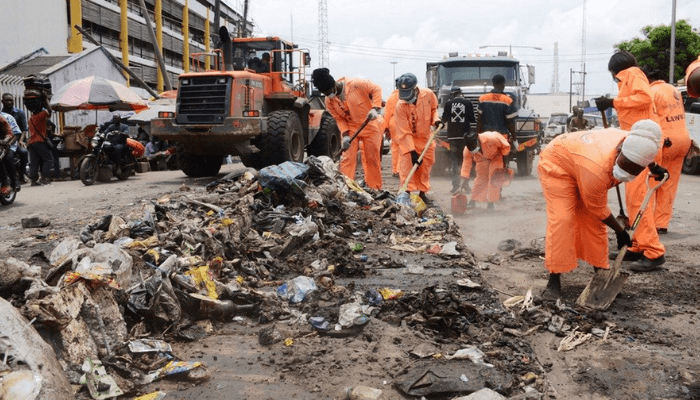
The Lagos State Government has reaffirmed its commitment to the monthly environmental sanitation exercise, declaring that the initiative is now a permanent feature of the state’s urban management strategy as it seeks to build a cleaner, healthier and more economically competitive city.
- +Lagos bets on environmental discipline to sustain economic growth
Officials say the exercise, reintroduced after nearly a decade, is designed not only to improve public hygiene but also to foster a culture of environmental responsibility among residents and businesses.
Officials say the exercise, reintroduced after nearly a decade, is designed not only to improve public hygiene but also to foster a culture of environmental responsibility among residents and businesses.
The position was reiterated during the second edition of the sanitation exercise held simultaneously across the state on Saturday.
Leading the exercise in Alimosho Local Government Area was Ibijoke Sanwo-Olu, the wife of the state governor, accompanied by Tokunbo Wahab, the Commissioner for the Environment and Water Resources; Rotimi Akodu, the Special Adviser to the governor on Environment; members of the Committee of Wives of Lagos State Officials (COWLSO), and other senior government officials.
In Apapa, Bode Agoro, the state’s Head of Service, coordinated monitoring activities alongside top civil servants.
Speaking with journalists after the exercise, Wahab commended residents and local authorities in Alimosho for maintaining a relatively clean environment, describing the council as one of the state’s best-performing local government areas in environmental management.
“We have observed that some local governments are doing remarkably well, and Alimosho stands out among them,” he said. “The council has demonstrated commitment by cleaning public spaces and deploying its own waste-compacting equipment to evacuate refuse. What is required now is sustained engagement with residents to deepen environmental consciousness.”
According to the commissioner, the sanitation programme remains central to the state’s broader sustainability agenda despite competing social and cultural activities.
“We have just concluded the Eid celebrations, and there were other festivities yesterday, but environmental sanitation remains a commitment we must keep. Every last Saturday of the month has been designated as Lagos Environmental Sanitation Day, and that commitment is non-negotiable,” he said.
Wahab noted that compliance among commercial transport operators had improved significantly compared to previous exercises, although the government would continue engaging stakeholders to ensure broader participation.
He stressed that the administration’s current strategy prioritises persuasion and public enlightenment over coercion.
“Our focus is not on imposing restrictions but on building conviction among residents. This programme was suspended for almost ten years, and Lagos today has a different demographic profile, with a growing youth population. We must therefore communicate the importance of environmental responsibility in a way that resonates with the people,” he explained.
The commissioner added that the government is working to establish environmental sanitation as a social norm, encouraging Lagosians to dedicate at least two hours each month to cleaning their surroundings.
Also speaking, Head of Service Bode Agoro linked environmental cleanliness directly to public health and productivity, arguing that a cleaner environment translates into a healthier workforce and reduced disease burden.
“No one wants to live or work in a dirty environment. Beyond aesthetics, poor sanitation contributes to the spread of diseases and undermines quality of life. The cleaner our environment, the healthier and more productive we become,” Agoro said. While emphasising voluntary compliance, he reminded residents that environmental laws remain in force and that violators would face sanctions where necessary.
“There are penalties for indiscriminate waste disposal and other environmental offences, and enforcement agencies will continue to perform their duties. However, our ultimate goal is not punishment. We want residents to embrace cleanliness as a civic responsibility and understand that keeping Lagos clean is in everyone’s interest,” he said.
The renewed sanitation drive forms part of the Lagos State Government’s broader efforts to improve environmental sustainability, strengthen public health outcomes and enhance the city’s attractiveness as a destination for investment, commerce and tourism.
As Africa’s largest urban economy continues to expand, officials believe that maintaining a clean and orderly environment will remain critical to supporting economic growth and improving the quality of life for millions of residents.