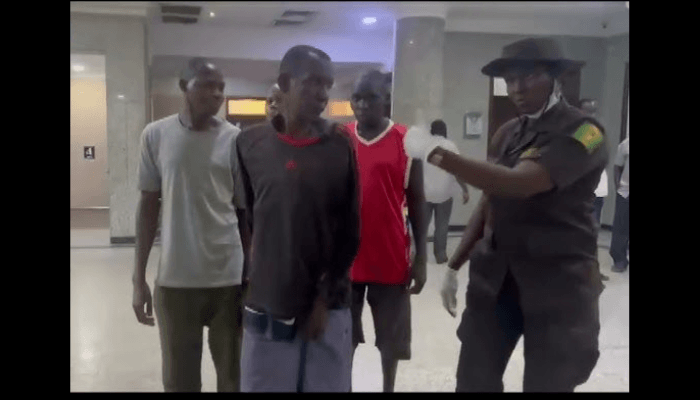
Justice James Omotosho of the Federal High Court, Abuja, recently sentenced four Boko Haram terrorists to life imprisonment after they pleaded guilty to charges brought by the Federal Government.
- +Can life imprisonment deter killer Boko-Haram terrorists?
- +Why churches must review security model
The four terrorists sentenced to life imprisonment are Ali Abiso, Bakura Kabiru, Ado (also known as Luka Garba), and Babagoni Masawai.
The four terrorists sentenced to life imprisonment are Ali Abiso, Bakura Kabiru, Ado (also known as Luka Garba), and Babagoni Masawai.
Justice Omotosho additionally convicted 14 other suspects, handing down prison terms ranging from 20 to 25 years on various counts.
Among them, Ali Mustapha received 20 years in count one and 10 years in each of counts two to seven, totaling 80 years, with the judge ordering that the sentences run concurrently following a plea for mercy.
Other convicts include Danbawa Salisu, Modu Ali, Sanda Bello, Mustapha Fali, Modu Musa, Bidal Modu, Mohammed Abdullahi, Umar Garba, Usman Ahmadu, Hussaini Bukar, Baba Manye, Musa Mai Modu, and Ali Musa.
The convicts were convicted on charges brought by the Federal Government, supported by evidence from the Department of State Services (DSS).
Lateef Fagbemi, SAN, attorney-general of the Federation and Minister of Justice, led the prosecution, highlighting that the maximum penalty for the charges is life imprisonment.
The convictions are part of the Federal Government’s efforts to strengthen national security and prosecute terrorism cases.
While many welcomed the development, others are of the view that the terrorists should have been sentenced to death – hinging their argument of the age-long saying that “those that kill by the sword; die by the sword.”
They believe that life imprisonment is not punitive enough to pay for the lives the terrorists violently took away; adding that “If you are able to do the crime, you should be ready to do the time.”
Fagbemi represented the Federal Government and was supported by lawyers including Rotimi Oyedepo.
During the trial, a witness from the Department of State Services (DSS) gave evidence against the convicted Boko Haram terrorists. Confessional statements of the convicts and investigation reports were tendered through the DSS witness and admitted as evidence.
“Boko Haram, over the years, has been painted as people that are very vicious, very wicked, and murderous, from all the reports and from all the antecedents. So, our system should be able to take them out from society. So, life imprisonment is a way forward,” Taiwo Akinola, presiding bishop, Rhema Christian Church &Towers International, said.
Akinola also said that the life sentences handed down to the four Boko Haram terrorists was the way forward because people like that should be kept away from the society by the system. He added that even the Bible says those who are killed by the sword must fall by the sword.
“But I think generally, civilization has now said to us that we don’t have to kill people because you can’t kill the spirits. So, I think Boko Haram should also be grateful that the people who are arrested are not killed outright,” Akinola said.
Among those sentenced to life imprisonment is Ali Abiso, sentenced on counts two and four and 25 years each on counts one and three, with the judge directing that the sentences for counts one and three run concurrently.
Count four relates to his participation in Boko Haram attacks in Bama, Gwoza, Konduga, Bita, Baza, and Aulari on or before July 8, 2022, contrary to Section 17 of the Terrorism (Prevention and Prohibition) Act, 2022.
Bakura Kabiru received life imprisonment in count two and 25 years in counts one and three. Ado, also known as Luka Garba, was sentenced to life imprisonment in count two and 25 years in count one.
Babagoni Masawai was sentenced to life imprisonment in counts six and seven, 20 years in counts one and two, and 10 years in counts three, four, and five.
“Nigeria is not working because some humans who behave like animals believe they are untouchable. Until we are firm to deter these reprobate minds, we are stuck,” said James Akinadewo, bishop of Lagos, Motailatu Church of God (C&S).
According To him, those that kill by the sword shall die by sword. Adding that, “Only Nigeria negotiates with terrorists. Reality is here; another General was killed yesterday.” (He made this known on Friday)
However, Chidi Anthony, national president, Christian Police Fellowship of Nigeria (CPFN), takes a slightly different approach, saying that life imprisonment may play a role, but might not be enough to deter terrorist groups like Boko Haram.
“The challenge with groups like Boko Haram is that they are not just made up of individuals committing crimes; they are driven by ideology, deep-rooted beliefs, and, in many cases, systemic issues like poverty, injustice, and lack of education,” Anthony said.
He added that while justice must be served and criminals held accountable, Nigerians must understand that the problem is deeper than punishment alone.
“You can imprison one person, but the ideology may still live on in others. In fact, some members are willing to die for their cause, which means the fear of imprisonment is not always a strong deterrent,” Anthony said.
Why churches must review security model
The incessant attacks on worshippers across the country have opened a new wave of security model for churches.
For many churches, it is no longer business as usual considering the level of attacks and killings of worshippers, and huge damage to church properties.
“In my opinion, I will say that faith is not foolishness. Trust in God does not mean ignoring danger, it means relying on Him while also walking in wisdom,” Anthony said.
According to him, the Church must remain strong, prayerful, and vigilant. “God is our protector, yes, but He also expects us to act responsibly. And above all, we must not allow fear to silence our faith or stop us from gathering but we must gather wisely,” he said.
Anthony argues that the Church must not rethink her security model out of fear, rather out of wisdom and responsibility. He added that faith must walk hand-in-hand with wisdom in ensuring safe spaces for all worshippers across the country.
“As shepherds over God’s people, we are called not only to feed the flock spiritually but also to protect them physically. The scripture says, “Be wise as serpents and harmless as doves” (Matthew 10:16).
“The reality today is that worship centres have become vulnerable targets because of their openness and predictability. Ignoring that reality would not be faith, it would be negligence,” Anthony said.
According to him, life is sacred, and every worshipper is precious before God. Hence, it is not wrong for churches to begin to adopt measures such as having trained security personnel, controlled entry points, collaboration with local authorities, and educating members on safety procedures.