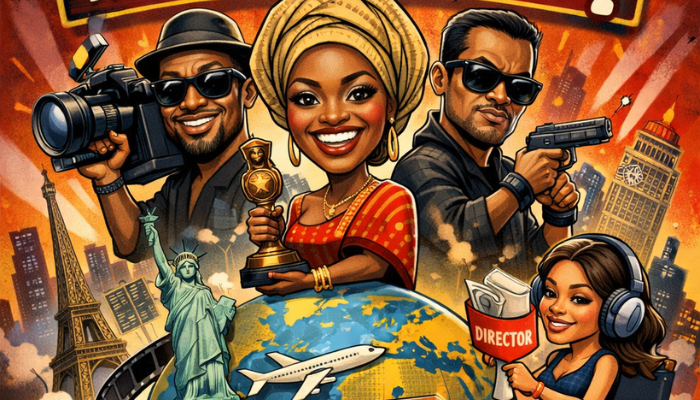
As Nollywood enters a new phase of growth and reinvention, industry conversations are increasingly focused on what will define its next chapter. From evolving audience tastes to the rise of digital platforms and cross-border partnerships, the sector is facing both new opportunities and long-standing structural challenges.
- +Nollywood’s future takes shape through youth stories and platform evolution
BusinessDay’s April Gen Z pick 2026 poll has offered a clear view of where stakeholders believe Nollywood is heading, pointing to shifts in storytelling, distribution, financing and collaboration as the sector responds to changing audience behaviour and global competition.
BusinessDay’s April Gen Z pick 2026 poll has offered a clear view of where stakeholders believe Nollywood is heading, pointing to shifts in storytelling, distribution, financing and collaboration as the sector responds to changing audience behaviour and global competition.
The poll, which gathered perspectives on the future of Nigeria’s film industry, identified several themes shaping Nollywood’s next phase. These include a stronger focus on youth-centred narratives, broader regional partnerships, digital-first distribution models, and increased calls for investment in talent and production technology.
One of the clearest findings from the survey was the growing importance of stories rooted in present-day realities. Respondents highlighted “Youth-driven narratives reflecting economic and social realities” as one of the strongest opportunities for future growth. This suggests that audiences and industry professionals alike see relevance and social connection as central to Nollywood’s continued success.
Alongside this, “Comedy-led content with strong commercial appeal” was also identified as a major opportunity, reflecting the market demand for entertainment formats that can travel across demographics while remaining commercially viable. This indicates that profitability and cultural resonance are being viewed as complementary, rather than competing, goals.
The poll also revealed that platform choice remains central to value creation in the industry. While “Netflix (global reach and visibility)” continues to be recognised for expanding Nollywood’s international profile, respondents also pointed to “YouTube (scale, accessibility, and ad-driven revenue)” as a key driver of present-day value.
This highlights a dual-track strategy within the industry. Streaming platforms provide global exposure and prestige, while open-access digital platforms offer wider audience reach and direct monetisation opportunities. Together, they represent two distinct but connected routes for growth.
On collaboration, respondents ranked “Nollywood x African regional cinema (continental expansion)” as the partnership with the greatest growth potential. This reflects a growing recognition that the future of African storytelling may depend less on competing national industries and more on shared continental production ecosystems.
Cross-border partnerships can create larger markets, diversify narratives, and strengthen bargaining power in global distribution spaces. For Nollywood, such alliances may also help position African cinema as a collective force rather than fragmented national sectors.
Commercial success over the next three years, according to the poll, will depend largely on structural reforms. Respondents identified “Increased investment and financing structures” and “Stronger distribution networks and platform deals” as the factors most likely to shape business outcomes.
These findings point to a long-standing issue within the industry: while creative output remains high, access to sustainable financing and efficient distribution remains uneven. Without stronger capital systems and market pathways, growth may continue to be constrained.
Audience engagement, meanwhile, appears to be closely tied to trust and presentation. Respondents said “Recognisable talent (actors, directors, producers)” and “Visual quality and trailer appeal” are among the strongest determinants of whether they choose to engage with a Nollywood title.
This suggests that star power remains influential, but that production standards and marketing assets now play a more decisive role in first impressions. In a crowded digital environment, trailers and visuals often become the gateway to audience attention.
Beyond immediate market concerns, the poll also surfaced deeper reflections on Nollywood’s cultural direction. One respondent pointed to the “Negligence of African Culture in proper perspective to be translated to modern culture and civiliazation” as one of the industry’s biggest untapped opportunities.
This response underscores an ongoing debate around authenticity and representation. As Nollywood seeks global relevance, there is also pressure to ensure African identities and histories are not diluted in pursuit of broader appeal.
Technology emerged as another area of opportunity. Respondents noted the value of “leveraging AI in creating CGI like productions that have previously been avoided due to budget constraints.”
This reflects a growing interest in digital production tools that can lower barriers to visual storytelling. For an industry often limited by budget, technology could open pathways into genres and formats that were previously difficult to produce at scale.
Talent development also featured strongly in the discussion. Respondents called for “Investment in talent development” and stressed that “Professionals should be protected to deliver real scenes as expected and upcoming artists to fall in line for professionalism.”
These concerns point to the need for stronger industry standards, clearer protections for creative workers, and more structured pathways for emerging talent. In a global market, professionalism is increasingly tied to competitiveness.
Taken together, the poll paints a picture of an industry at a turning point. Nollywood’s future appears to rest not only on the stories it tells, but also on the systems that support those stories, from financing and policy to technology and regional collaboration.
Read previous poll result here.