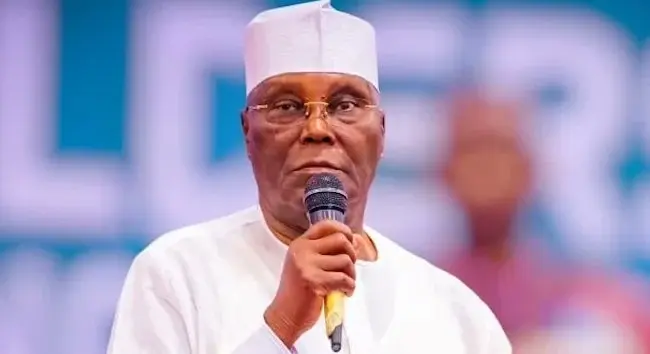
Former Vice President Atiku Abubakar has confirmed his planned visit to the United States to draw international attention to Nigeria’s worsening insecurity, economic hardship, and declining governance standards.
- +Atiku flags insecurity, economic collapse ahead of US trip
During his forthcoming engagement, Atiku will speak with policy and institutional stakeholders in the US.
During his forthcoming engagement, Atiku will speak with policy and institutional stakeholders in the US.
Explaining reasons for the visit through a statement issued on Sunday by his Media Adviser, Paul Ibe, Atiku said the country is facing a “full-blown internal crisis” that can no longer be downplayed or politicised.
“From the ravaging violence in the North-West and North-East, to the persistent bloodshed in the Middle Belt, and the growing spread of kidnapping and criminality across the country, Atiku warns that the Nigerian state is steadily losing its grip on its most fundamental responsibility: the protection of lives and property.
“According to him, the situation has moved beyond isolated incidents to a pattern of systemic failure. Communities are being overrun, livelihoods destroyed, and citizens abandoned to their fate.
“He argues that any government that cannot guarantee basic security forfeits the moral basis of its mandate,” the statement read.
On the economy, Atiku highlighted what he described as deepening hardship, citing rising inflation, a weakened currency, and declining purchasing power.
“He notes that rising inflation, a weakened currency, and collapsing purchasing power have pushed millions into distress, while policy inconsistency and lack of strategic direction continue to erode confidence in the economy,” the statement said.
The former vice president also expressed concern about the state of Nigeria’s democratic institutions, warning that declining public confidence in governance, accountability, and the electoral process could threaten national stability.
“As the country moves toward another election cycle, he insists that any attempt to undermine transparency or manipulate outcomes will carry serious consequences for both unity and legitimacy,” the statement said.
Addressing possible criticism of his planned US engagement, Atiku rejected claims that engaging international partners amounted to inviting foreign interference.
“Atiku is unequivocal: telling the truth about Nigeria is not unpatriotic. He rejects the notion that engaging global partners amounts to inviting foreign interference, stressing that Nigeria does not exist in isolation and cannot pretend that its internal failures have no external implications.
“He maintains that the world already sees what is happening; the real question is whether Nigerian leaders are prepared to confront it honestly.
“He reiterates that only Nigerians will decide Nigeria’s leadership, but insists that international partners have a legitimate interest in the stability, governance standards, and democratic health of a country as strategically important as Nigeria,” the statement said.
In a message to the current administration, Atiku urged the government to “urgently reset its priorities,” restore public confidence, and demonstrate a credible strategy to address insecurity and economic challenges.
He also called on Nigerians to remain vigilant and demand accountability from leaders, stressing that meaningful change would come from within.
Atiku said Nigeria was at a critical juncture, requiring “courage, honesty, and decisive leadership” to avert further instability.
The development comes as political activities begin to heat up ahead of the 2027 general elections.
Atiku, who served as Vice President between 1999 and 2007, exited the Peoples Democratic Party, which has faced significant decline following his repeated presidential bids, and joined the African Democratic Congress as part of a broader opposition coalition.
The ADC is currently grappling with internal leadership crises and factional disputes.
The PUNCH had reported that Atiku recently hired the Washington-based lobbying firm Von Batten-Montague-York, L.C. for a $1.2m contract to boost his reputational standing and shape policy perceptions in the United States.
Also on Sunday, Atiku warned the Federal Government over what he described as poor economic management, citing the drop in external reserves despite rising oil earnings.
Nigeria’s external reserves fell to $48.45bn as of April 24 from $48.72bn recorded the previous week, representing a decline of about $1.57bn since March 11.
This comes amid reports of a N5tn oil windfall within the same period.
In a statement by his Senior Special Assistant on Public Communication, Phrank Shaibu, Atiku said the development showed a troubling trend.
The ADC chieftain said the persistent depletion of reserves suggested that the Central Bank of Nigeria was injecting liquidity to support the naira, describing the approach as unsustainable.
He said, “On one hand, the nation’s external reserves have declined to $48.45bn —with a cumulative depletion of about $1.57bn since March 11. On the other hand, Nigeria has reportedly earned a N5tn oil windfall within the same period.
“This contradiction—of dwindling reserves amid rising oil earnings—exposes a dangerous pattern of economic mismanagement.
“This is not stability—it is a fragile illusion sustained by burning through national savings. A nation cannot consume its buffers to mask policy failures while ignoring the structural weaknesses undermining its currency.”
The former vice president said defending the naira without improving productivity, exports and investor confidence would worsen the situation, likening the policy to “pouring water into a basket.”
Atiku also lamented that the oil windfall had not translated into relief for Nigerians, who are facing high fuel prices, rising transport costs and inflation.
While describing the situation as unjust, he called for targeted measures to cushion the impact of fuel price increases, stabilise food supply and support vulnerable Nigerians.
“First, this windfall must not be squandered on recurrent expenditure or political patronage. It must be deployed deliberately to provide targeted relief to Nigerians—through structured interventions that cushion the impact of fuel price increases, stabilise food supply chains, and support the most vulnerable.
“To do otherwise is to profit from the suffering of the people while offering them nothing in return.
“Second, the government must abandon the reckless defence of the naira through reserve depletion and instead invest this windfall in long-term economic strength.
“Priority must be given to domestic refining capacity, critical infrastructure, and policies that boost non-oil exports and restore investor confidence,” he said.