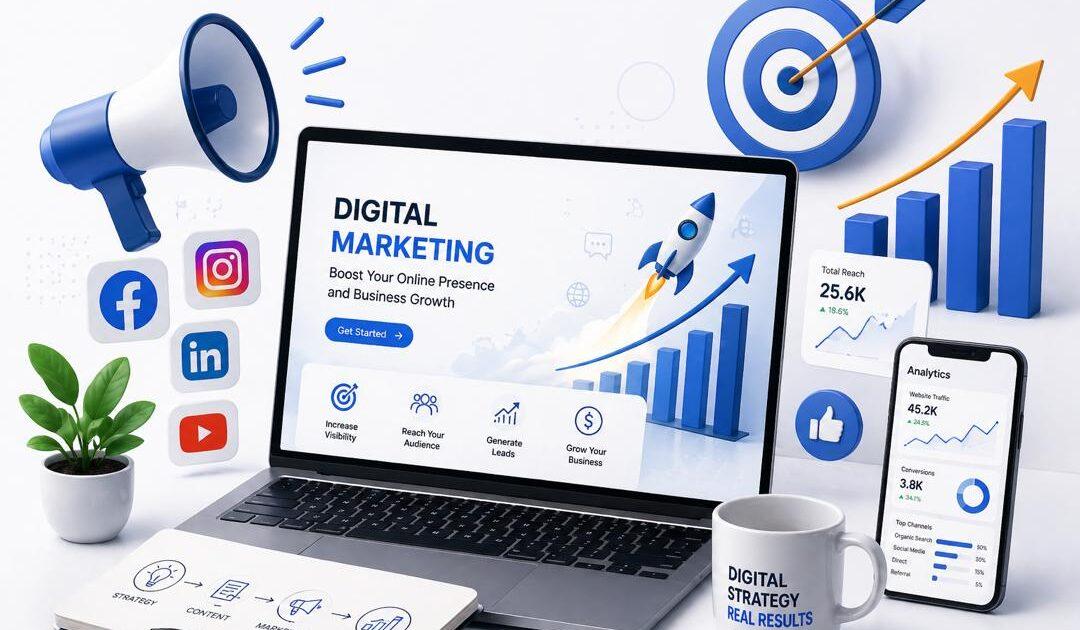
Digital marketing refers to the use of websites, mobile devices, apps, social media, search engines, and other digital channels to promote and sell products and services. In today’s world, it enables businesses to reach targeted audiences and measure performance in real time. Common channels include websites, search engines, social media, email, and paid advertising. Marketers rely on data analytics to optimize campaigns and improve results. However, rapid platform changes and digital saturation have made competition for attention more intense (Investopedia, 2024).
- +Digital Marketing: Boost Your Online Presence and Business Growth
The four main types of digital marketing are SEO, SEM/PPC, Social Media Marketing, and Content Marketing.
The four main types of digital marketing are SEO, SEM/PPC, Social Media Marketing, and Content Marketing. These are essential for building an online presence and increasing conversions (TechAffinity, 2025).
In summary, SEO and Content Marketing support long-term growth, while SEM provides immediate visibility and Social Media encourages interaction and engagement.
A website remains the foundation of all digital marketing activities. It is often the first interaction between a business and its audience, so its design and performance are very important. Without it, other strategies may not be effective.
In recent years, tools like Wix and WordPress have made website creation easier. Notably, WordPress powers approximately 42.5% of all websites globally and holds about 59.6% of the Content Management System (CMS) market share (W3Techs, April 2026). Thus, it is widely trusted for its flexibility and scalability.
The rise of design-focused platforms like Wix highlights the importance of appearance. Studies show that nearly 38% of users abandon a website if the design feels unattractive, and that visual design can influence up to 75% of a visitor’s perception of credibility. First impressions matter greatly. Moreover, AI tools like Pineapple Builder now allow users to create websites within minutes, often including built-in SEO and analytics features. Similarweb is another useful analytics tool that provides competitor traffic insights, and according to Prostats, it has over 50 million monthly users .
Website speed also affects user experience. Websites that load within 2–3 seconds retain more users, while slower ones lose visitors quickly (Google, 2018). As a result, speed optimization is essential.
In conclusion, choosing the right platform ultimately depends on your business goals, technical comfort level, and growth plans. Different digital platforms offer unique advantages. WordPress is ideal for flexibility and long-term control, while Wix and AI tools excel at quick, visually appealing website creation.