Dangote Cement Plc grew its half-year profit to N638.5 billion, up from N520.5 billion in the same period last year, as its Nigerian operations absorbed the weight of a Pan-African business whose bottom line was all but wiped out by finance and currency costs.
- +Dangote Cement’s home market boost margins despite Pan-African profit decline
The cement maker’s unaudited results for the six months ended June 30, 2026, show group revenue rising 21.4 percent to N2.51 trillion from N2.07 trillion, driven by higher sales volumes of 14.9 million tonnes, compared to 13.4 million tonnes a year earlier.
The cement maker’s unaudited results for the six months ended June 30, 2026, show group revenue rising 21.4 percent to N2.51 trillion from N2.07 trillion, driven by higher sales volumes of 14.9 million tonnes, compared to 13.4 million tonnes a year earlier. Profit before tax climbed 34.4 percent to N981.4 billion, while profit attributable to owners of the company rose 24.3 percent to N640.2 billion, lifting earnings per share to N38.22 from N30.74.
Gross margins widened as production costs grew more slowly than revenue: production costs of sales rose 8.3 percent to N924.3 billion, even as revenue expanded over 21 percent, pushing gross profit up 30.5% to ₦1.59 trillion. Group EBITDA rose 25.8% to N1.19 trillion.
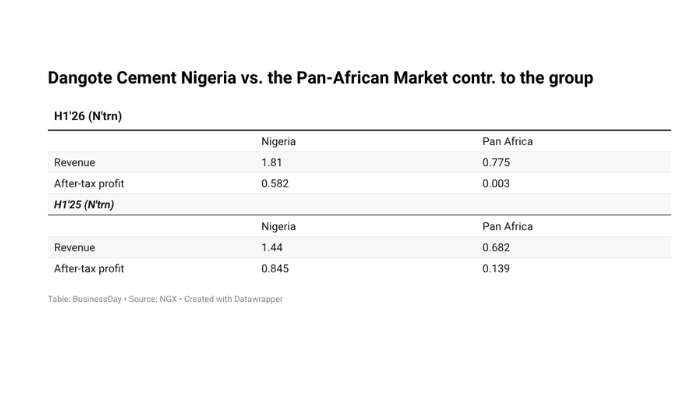
Pan-Africa’s profit-thin bottom line The strain shows up once the results are split by geography. The domestic business generated N1.81 trillion in revenue, representing nearly 72 percent of group sales, while operating profit climbed to N1.01 trillion from N787.00 billion. Profit from the Nigerian segment rose to N582.64 billion, accounting for more than 90 percent of the group’s consolidated earnings.
The stronger regional performance helped lift group revenue by 21.4 percent to N2.51 trillion, while gross profit advanced 30.5 percent to N1.59 trillion. Operating profit rose 30.7 percent to N1.06 trillion, outpacing revenue growth as the company expanded margins despite higher operating costs. Gross margin improved to 63.2 percent from 58.8 percent a year earlier.
EBITDA increased to N1.19 trillion from N944.90 billion, driven by higher profitability in both Nigeria and the Pan-African markets. Nigeria contributed N1.09 trillion of EBITDA, while Pan-Africa generated N136.57 billion, broadly stable despite macroeconomic pressures across several countries where the group operates.
Pan Africa’s revenue grew faster, up 13.7 percent to N775.4 billion, and its operating profit rose 36.2 percent to N82.9 billion — yet segment profit for the period came in at just ₦2.8 billion, down from N139.9 billion a year earlier, a decline of nearly 98 percent.
The group recorded a net foreign exchange loss of N45 billion in the second quarter alone, against a gain in the prior year, and the Sierra Leone operation remains classified as hyperinflationary under IAS 29.
Pan-Africa carried N4.06 trillion in liabilities against N3.15 trillion in assets as at June 2026, while Nigeria’s N2.38 trillion in liabilities sat comfortably under N5.72 trillion in assets.
Operating expenses nevertheless continued to rise alongside expanding sales Selling and distribution expenses climbed 25 percent to N401.85 billion, driven mainly by haulage costs, which increased to N318.60 billion from N253.64 billion as higher sales volumes translated into greater transportation expenses. Administrative expenses rose a more moderate 11.6 percent to N138.64 billion, allowing operating margins to continue improving.
Operationally, the company expanded cement and clinker sales volumes by 11.8 percent to 14.94 million tonnes, while production rose to 14.49 million tonnes from 12.98 million tonnes. Nigeria accounted for 9.70 million tonnes of sales, while the Pan-African business contributed the balance, reflecting stronger demand across the group’s regional footprint.
The improved earnings translated into stronger cash generation. Net cash generated from operating activities increased to N1.06 trillion from N874.21 billion, while cash and cash equivalents rose to N764.86 billion from N300.99 billion a year earlier, strengthening the group’s liquidity position as it continued investing in capacity and infrastructure.