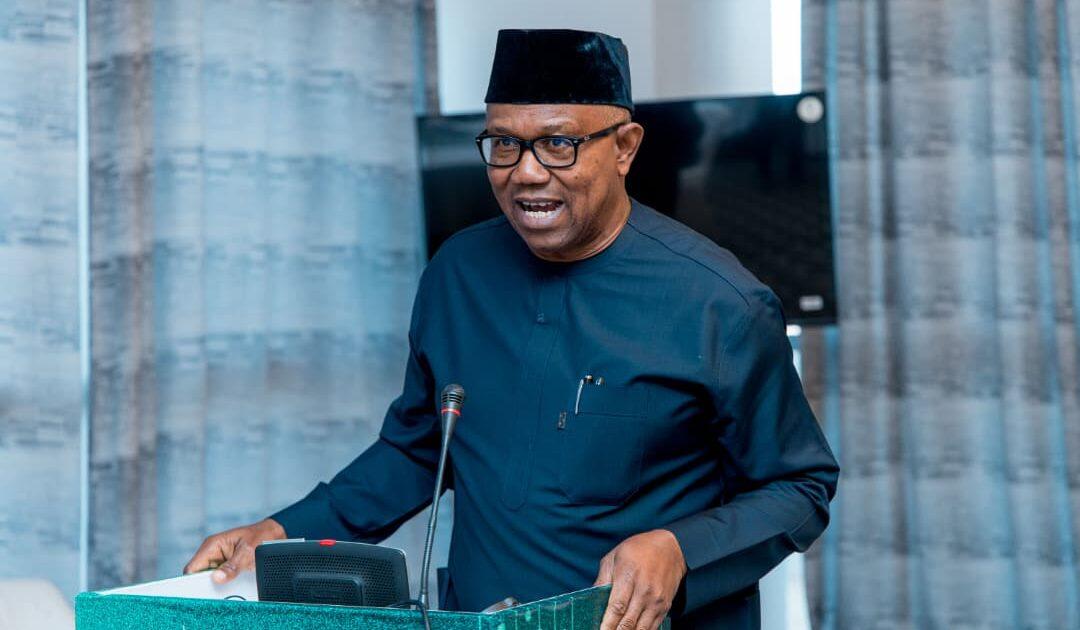
Presidential candidate of the Nigerian Democratic Coalition, Peter Obi on Saturday formally accepted his nomination and unveiled an ambitious reform agenda aimed at confronting Nigeria’s worsening insecurity, economic stagnation and infrastructure deficit, including a pledge to raise electricity generation to 10,000 megawatts within four years.
- +Obi accepts NDC ticket, vows to end insecurity, fix power
Obi made the pledge in his acceptance speech delivered in Abuja after emerging as the party’s flag bearer, where he expressed gratitude to party leaders and delegates for what he described as their confidence in his leadership capacity.
Obi made the pledge in his acceptance speech delivered in Abuja after emerging as the party’s flag bearer, where he expressed gratitude to party leaders and delegates for what he described as their confidence in his leadership capacity.
“It is with deep humility that I accept the role of presidential candidate for our party. I express my profound gratitude to the leaders of our party, His Excellency Seriake Dickson, the National Chairman, National Secretary and the National Working Committee members of our relentless supporters, and the Nigerian populace who have steadfastly kept the spirit of hope alive,” he said.
He said Nigeria was currently at a difficult crossroads marked by insecurity, economic hardship and declining public confidence in governance.
According to him, the situation had created widespread disillusionment across communities and businesses, though he insisted that the country still had the capacity for recovery if leadership choices improved.
“Businesses are struggling, communities are suffering, and an alarming number of citizens have lost faith in the very concept of governance.
“Yet, I stand before you filled with optimism and strong faith in the resilience of our people, for I firmly believe that a New Nigeria is possible,” he said.
Obi stressed that Nigeria’s diversity should be seen as a strength rather than a fault line, warning against deepening ethnic, religious and regional divisions.
Turning to insecurity, the NDC presidential candidate said Nigeria’s security challenges had deteriorated significantly in recent years, citing global rankings that placed the country among the worst affected by terrorism.
He said, “In terms of security, the situation in Nigeria has considerably worsened. The global terrorism impact assessments ranked Nigeria as the 8th most affected nation in 2022, 6th in 2024, and 4th in 2026.”
However, he contrasted the current situation with Nigeria’s historical role in international peacekeeping missions, where its military once enjoyed global respect.
The former governor referenced Nigeria’s contributions to global missions across several countries and praised the legacy of Nigerian military leadership in international operations.
Obi vowed that his administration would prioritise security reforms.
“We must address insecurity with resolve and urgency, for no nation can thrive while its citizens live in trepidation. The primary responsibility of government is to ensure the safeguarding of lives and property,” he said.
He promised an intelligence-driven and technology-supported security framework aimed at tackling both immediate threats and underlying causes such as poverty and unemployment.
On health, Obi decried Nigeria’s poor indicators, particularly infant mortality and low health insurance penetration, promising major reforms.
“Nigeria suffers from one of the highest infant mortality rates in the world. Furthermore, health insurance coverage in Nigeria hovers around a mere 10 per cent, in stark contrast to countries like Indonesia, which boast over 90 per cent coverage.
“This situation is regrettable. I pledge that within four years, our health insurance coverage will more than double to over 20 per cent,” he said.
On energy, Obi described Nigeria’s electricity crisis as a major constraint to development, noting the gap between Nigeria and other comparable economies.
“Nigeria today is the nation with the highest number of citizens lacking access to electricity globally. We currently generate and distribute a mere 4,000 megawatts (MW) of electricity for a population exceeding 200 million,” he said.
He compared Nigeria’s output with that of other countries to underline the scale of the challenge.
Obi then made a major campaign promise.
“Over the next four years, I commit to ensuring a minimum of 10,000 MW power increase generation and distribution,” he said.
The NDC candidate also addressed unemployment, insisting that official figures do not reflect Nigeria’s real labour market crisis.
He pledged targeted support for small businesses and youth-driven enterprises, alongside reforms to reduce corruption and governance costs.