Recently, in Oxford, in a room meant for forty people, we had to bring in more chairs. And then we ran out.
- +What it means for climate, health and how we work together
It was a side conversation during the Skoll World Forum, one of many happening across the city that week.
It was a side conversation during the Skoll World Forum, one of many happening across the city that week. But something about that moment stayed with me. Not because the room was full, but because of what it represented.
“Partnership is not a new idea. But what is becoming clearer is that partnership cannot remain a coordination exercise. It has to become a shared way of working, where institutions are willing to align, to trust, and in some cases, to step back.”
For a long time, those working at the intersection of climate, health and gender have been carrying the work quietly. Not as a defined sector, and not always as a clearly funded priority, but as a lived reality.
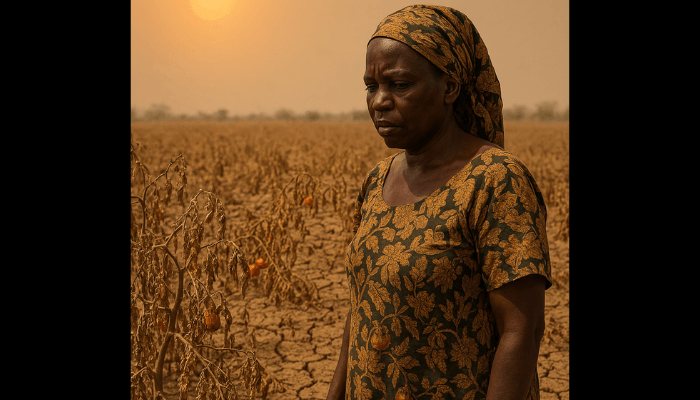
Communities have never experienced these issues in isolation. A flooded road is not just a climate issue when it prevents a woman from reaching a clinic. A facility without power is not just an infrastructure gap when it means a newborn cannot receive care. A failed harvest is not just an environmental concern when it reshapes household decisions about health, nutrition and survival.
These are not separate problems. They are one system, experienced in real-time.
And yet, the way we have organised ourselves – our funding structures, our institutions, even our language – has often treated them as if they were.
What I saw in that room was a shift. Not a breakthrough, and not a solution. But a shift in attention.
Funders, implementers, researchers and policymakers were leaning into the same conversation, not from theory, but from practice. There was less debate about whether these intersections matter and more focus on what it actually takes to respond to them.
That distinction is important.
Because the work itself is not new. What is new is the willingness to take it seriously and to begin aligning around it.
We are seeing this reflected more broadly.
Development finance is starting to move, slowly, but meaningfully, toward a more system-oriented approach, where institutions recognise that impact is not created in isolation but through coordinated effort across sectors and actors.
That shift is necessary. But it also requires us to be honest about what it takes to make it significant.
First, it requires us to stay close to the problem.
Some of the most effective work I have seen has not come from perfectly designed programmes, but from people responding directly to what they see in front of them. Solarising primary healthcare facilities so care can continue at night. Mapping thousands of facilities to understand what is actually available and where the gaps are. Designing tools with the people who use them, not for them.
These are not abstract interventions. They are practical responses to lived conditions. Second, it requires us to rethink how we define community.
Community is often described as a stakeholder.
But in reality, the community is the design team.
The most resilient solutions are the ones shaped from the start by those closest to the problem.
When that does not happen, the gap between intention and reality widens very quickly.
Third, it requires us to be precise about how we talk about women in this work.
Women are often framed as a vulnerable group. But in many contexts, they are the ones already holding the system together. They are the health workers, the carers, the decision-makers navigating impossible trade-offs every day.
Recognising this is not about shifting language for its own sake. It is about accuracy. When we understand where resilience already exists, we can design systems that strengthen it rather than overlook it.
And finally, it requires us to change how we work together.
Partnership is not a new idea. But what is becoming clearer is that partnership cannot remain a coordination exercise. It has to become a shared way of working, where institutions are willing to align, to trust, and in some cases, to step back.
This is not easy. There are actual incentives that drive fragmentation – funding cycles, organisational mandates, and internal metrics.
But if the problems we are trying to solve are interconnected, then our response has to be as well.
That is where the real work sits.
Not in adding another theme to an already crowded agenda, but in responding more honestly to how people experience risk, vulnerability and care.
The full room in Oxford did not signal that we had arrived. The data still tells a different story.
Only a small percentage of climate finance is directed toward health, and even less explicitly addresses gender.
But the room not being empty matters.
It means more people are willing to engage with the complexity of the problem. It means there is growing recognition that working in silos is no longer sufficient. And it creates the possibility, still fragile, but meaningful, of doing this work differently.
At one point that morning, a senior colleague placed a small pin on my lapel, a symbol of solidarity carried by women on the front lines of climate justice.
It was a simple gesture, but it captured something important.
The future we are trying to build will not come from one institution, one sector or one idea. It will come from how we choose to work together and how seriously we take the realities that communities have been navigating for years.
The question now is whether our systems, our funding, and our partnerships will move with it.
Ota Akhigbe is the Director of Partnerships and Programmes at eHealth Africa, where she leads strategic partnerships and system-level initiatives to strengthen health outcomes across Africa. Her work focuses on building integrated, country-led solutions at the intersection of climate, health and digital infrastructure. She works across government, philanthropy and the private sector to shape how capital and delivery come together at scale.