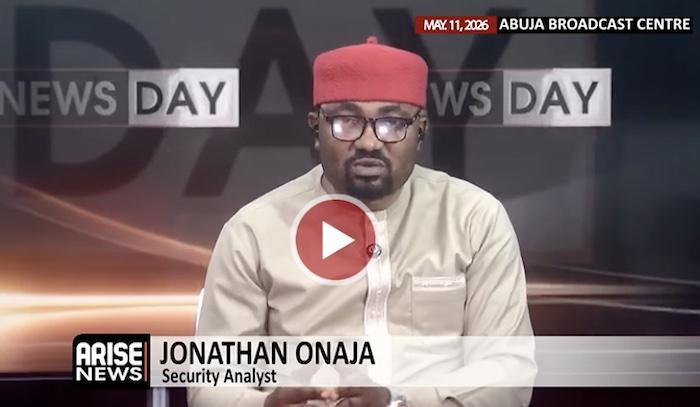
Security analyst says stronger cooperation within the Sahel region is more critical than foreign meetings in tackling insecurity.
- +Jonathan Onaja: Nigeria Needs More Regional Security Cooperation
Nigeria must prioritise deeper regional security cooperation within the Sahel region if it hopes to effectively tackle insurgency, banditry, and cross-border insecurity, according to security analyst Jonathan Onaja.
Nigeria must prioritise deeper regional security cooperation within the Sahel region if it hopes to effectively tackle insurgency, banditry, and cross-border insecurity, according to security analyst Jonathan Onaja.
Speaking during an interview on ARISE News, Onaja argued that while Nigeria’s growing engagement with the United States and other Western partners remains important, lasting security solutions will depend more on collaboration with neighbouring African countries directly affected by the same threats.
“Nigeria needs more regional security cooperation,” he said.
Onaja explained that insecurity across the Sahel is interconnected, with violent extremist groups and criminal networks operating across multiple national borders.
“The insecurity within the Sahel region is driven by jihadists… not just only situated in Nigeria,” he stated.
According to him, Nigeria would benefit more from investing time and resources into building stronger regional partnerships than relying primarily on high-level foreign meetings.
“Rather than investing time… far in America, I think we should rather invest in regional cooperation,” he said.
He pointed to countries such as Mali, Burkina Faso, Niger, Chad, and Senegal as critical partners in addressing insecurity across West Africa.
Onaja stressed that effective intelligence sharing and coordinated border management are essential in preventing criminals and insurgents from moving freely across borders.
“If a criminal escaped from Nigeria to Niger, we’ll be able to get such criminals out,” he said.
He noted that insecurity in the region is also fuelled by poverty, weak governance, and ungoverned spaces that extremist groups exploit for recruitment and operations.
“The weapons being used… is poverty,” he stated.
According to him, security agencies increasingly understand that military action alone cannot solve the crisis without broader regional and governance reforms.
“The military is aware of what is happening,” he said.
Onaja also commended the Nigerian military and security leadership for already taking steps toward improving cooperation with neighbouring countries.
“That cooperation is already ongoing,” he explained.
Despite his emphasis on regional partnerships, he maintained that cooperation with the United States still remains valuable, particularly in intelligence gathering and precision security support.
“The relationship with the United States of America cannot just be underrated,” he said.
He cited previous intelligence-assisted operations as examples of how international collaboration has strengthened Nigeria’s counterterrorism efforts.
“What they are doing… is exploring all angles,” he said.
However, Onaja insisted that Nigeria’s long-term security stability depends on securing the broader Sahel region collectively rather than treating insecurity as an isolated domestic problem.
“If we can’t get our regional security, then we cannot achieve internal policing,” he warned.
He further argued that balancing regional partnerships with international cooperation would provide Nigeria with stronger security capacity and intelligence coordination.
“We need both the internal and the external,” he said.
Onaja concluded that while foreign partnerships remain important in combating insecurity, Nigeria’s most sustainable security strategy lies in strengthening intelligence sharing, border coordination, and regional cooperation across the Sahel to address the root causes and cross-border nature of insecurity.