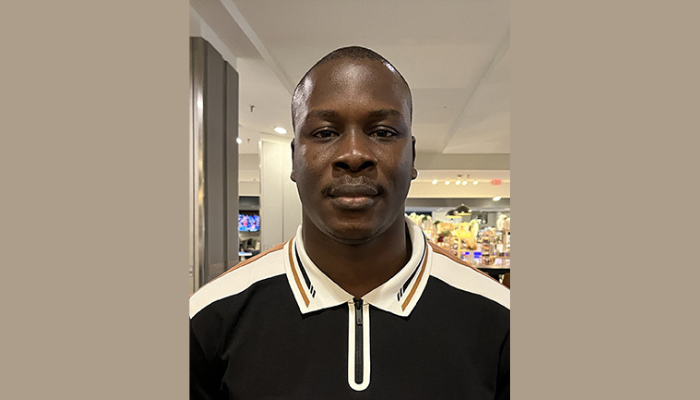
Academic leadership not just about personal achievement, but also helping others discover their potential — Humphrey Samuel
Humphrey Sam Samuel has been active in scholarship leadership since his undergraduate days as the president and secretary of the chemistry student organisations at the Federal University Wukari (FUW), Taraba State, Nigeria.
Humphrey Sam Samuel has been active in scholarship leadership since his undergraduate days as the president and secretary of the chemistry student organisations at the Federal University Wukari (FUW), Taraba State, Nigeria. He is currently a doctoral student at Emory University, Georgia, United States, where he teaches, researches, serves, volunteers, and leads in many capacities that have won him grants, fellowships, and awards. He volunteers through membership on editorial journal boards. In this interview with REMI FEYISIPO, he spoke about his scholarly and leadership endeavours, and also about leadership in the Nigerian education sector. Excerpts:
How would you define leadership in the context of your scholarly journey and what leadership ideals do you live by?
Leadership, to me, is the intentional use of one’s position, knowledge, and influence to create pathways for others. In my scholarly journey, leadership has been about showing up consistently, serving others, and pushing boundaries in ways that inspire those around me.
The leadership ideals I live by are integrity, collaboration, and impact. I believe that a true leader listens as much as he speaks, mentors as much as he achieves, and remains committed to excellence even when no one is watching. As an undergraduate student at the Federal University Wukari (FUW), Taraba State, Nigeria, where you made a First Class from the Department of Industrial Chemistry, you served as the student president of the Royal Society of Chemistry, and the secretary of the American Chemical Society of the university’s chapter.
What lessons did serving in these capacities teach you, and how did it influence your future academic and leadership goals?
Serving as the president of the Royal Society of Chemistry (RSC) of FUW international student chapter and as the secretary of the American Chemical Society (ACS) of FUW international student chapter taught me the importance of building community, fostering collaboration, and advocating for the value of science education in environments where resources are limited.
As the president of the RSC, FUW chapter, I spearheaded initiatives to promote chemistry education, grew our membership significantly, and represented the chapter at university-wide events. As the ACS FUW Secretary, I learned the discipline of record-keeping, communication, and organisational management. Together, these experiences taught me that leadership in academia is not just about personal achievement, but about creating an environment where others can thrive and discover their own potential.
Last year, you started your PhD programme in Physical Chemistry at Emory University, Atlanta, Georgia, United States. How have you demonstrated scholarly and community leadership since starting the Emory programme?
One month after joining Emory, I became the secretary of the Pi Alpha Chemical Society (PACS), actively fostering collaboration among graduate students and organising departmental events. These efforts were recognised with the Heart of Emory SOAR Award by Emory Student Involvement, Leadership, and Transitions Campus Life.
I also served as a graduate teaching assistant, directly impacting the academic development of about 30 undergraduate students per semester through laboratory instruction in physical chemistry concepts and principles of reactivity, fostering critical thinking and scientific communication skills. Beyond the campus, I volunteered and participated in the Atlanta Science Festival with PACS, National Organisation for the Professional Advancement of Black Chemists and Chemical Engineers (NOBCChE) and Association for Women in Science (AWIS), which impacted over 2000 attendee including students, families, and different organisations engaging directly with children and students to bring the wonders of chemistry to life through hands-on demonstrations and interactive activities inspiring the next generation of scientists across the Atlanta metropolitan area.
I was also awarded the 2026 Piedmont TATTO Fellowship in Sustainability and Curriculum Development at Emory’s Office of Sustainability Initiatives, contributing to sustainability-focused curricula that directly influence the academic experience of more than 10,000 students, faculty, and staff across the Emory University community. This fellowship comes with a monetary value of $500 and a field trip.
My PhD journey at Emory has been tremendously rewarding, intellectually challenging, and deeply fulfilling.
Recently, you were awarded the CAS Future Leaders Award by CAS, a division of the American Chemical Society, and the Leadership Development Award by the Younger Chemists Committee of the American Chemical Society. What are these awards about, and what do they mean to you and your scholarship?
The CAS Future Leaders Award is one of the most prestigious early-career recognitions in the global chemical sciences community, selecting only 30 emerging scientific leaders and the top 100 worldwide each year from a highly competitive international pool of candidates. This involves a fully funded trip to CAS headquarters in Columbus, Ohio, for a two-week leadership programme, Chicago for the ACS Fall 2026 conference, and a stipend of $1,000. Being selected as one of these 30 leaders is a profound honour that affirms the global significance and impact of my research contributions in the field of chemistry with respect to environmental remediation, sustainable nanotechnology, and green chemistry-driven solutions for addressing water pollution and climate change, as well as my research on safer management of nuclear waste, a challenge of critical national and environmental importance.
The Younger Chemist Leadership Development Award supported my participation in the ACS Younger Chemists Leadership Development Track, equipping me with invaluable training in scientific leadership, advocacy, and professional development in service of the American Chemical Society’s mission of advancing the broader chemistry enterprise for the benefit of humanity.
These awards confirm that the hard work, dedication, and passion I have poured into my research and community service have been recognised at the highest levels of global science, which has inspired the next generation of scientists, particularly young Africans aspiring to make their mark on the world.
You recently announced that you participated in the Green Chemistry for Climate and Sustainability Certificate Programme by the Yale School of the Environment. What is the programme about, and how did it impact your work?