Building homes or building an economy? Why nigeria’s housing strategy will determine the path to a us$1 trillion economy
Nigeria needs approximately 20 million additional homes.
Nigeria needs approximately 20 million additional homes. Most discussions focus on how quickly those homes can be built. That is an incomplete question. The more important question is what building those homes can do for the Nigerian economy.
Countries that became economic powers did not treat housing merely as shelter. They used housing as an engine of industrialisation, job creation and wealth creation. Nigeria has an opportunity to do the same by using housing policy to create Homes, Industries and Wealth
The recent publication regarding a proposed Chinese intervention in Nigeria’s housing sector provides the immediate context for this opinion. It is important to state from the outset that there should be no objection to Chinese participation, or indeed to any credible foreign investor bringing capital, expertise and technology into Nigeria. On the contrary, Nigeria requires significant investment partnerships if it is to address its infrastructure and housing challenges at scale.
The issue, therefore, is not whether Chinese companies, or foreign companies generally, should participate. The more important question is whether the structure of such interventions maximises Nigeria’s long-term economic interests. Does the intervention simply deliver houses, or does it use the opportunity to build Nigerian industries, create jobs, transfer skills, strengthen domestic companies and expand productive capacity? That distinction matters because Nigeria’s housing challenge exists within a much broader national ambition: the goal of becoming a US$1 trillion economy.
A trillion-dollar economy cannot be achieved simply by constructing more buildings or importing more goods and services. It requires a fundamental expansion of Nigeria’s productive capacity: more manufacturing, stronger domestic enterprises, higher productivity, better-paying jobs and a larger middle class. Housing provides one of the greatest opportunities to achieve these objectives simultaneously.
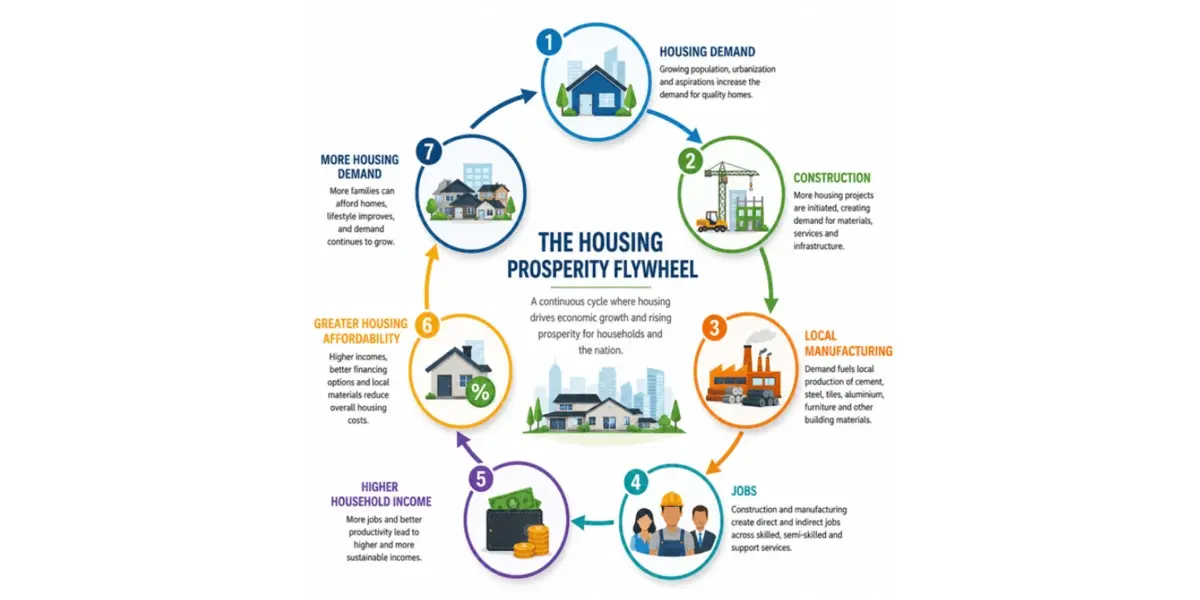
The real measure of success should therefore not only be the number of houses delivered, but the economic capability created in the process of delivering them. Housing has one of the highest economic multipliers of any sector. Every house built generates demand across dozens of industries—from cement and steel to furniture, transport, insurance, banking and professional services.
The world’s most successful economies did not view housing merely as a social intervention. They recognised that housing is also industrial policy. Every housing development creates demand across a broad economic ecosystem. Imagine 500,000 home annually – 80% local materials, 250,000 direct contruction jobs, 1m indirect jobs, domestic cement, steel, tiles, furnitute, logistics, engineering, finance, insurance and professional services. A well-designed housing programme does more than provide shelter. It creates factories, develops technical skills, supports small businesses and generates employment far beyond the construction site itself.
Countries such as South Korea, Singapore, Malaysia and Turkey deliberately used housing and infrastructure development to strengthen domestic industries that later became internationally competitive. Perhaps the most instructive example is China.
China did not become a global construction powerhouse because it relied on foreign companies to build its cities. It used its enormous domestic demand to develop Chinese manufacturers, construction companies, engineering firms, equipment producers and technology providers. Over time, these companies became global players.
That is perhaps the most important lesson Nigeria should take from China. The objective is not to reject foreign participation but to ensure that foreign participation builds Nigerian capability. Every housing developmement should pursue four objectives simultaneously: 1) Shelter 2) Industrialization 3) Employment 4) Wealth Creation
There is an important distinction between attracting foreign investment and importing economic activity.
Nigeria undoubtedly needs foreign capital, technology and expertise. However, a predominantly turnkey approach, where foreign companies finance, design, supply and execute projects with limited domestic participation, risks solving today’s housing shortage while missing tomorrow’s industrial opportunity.
Government must therefore carefully weigh not only the intention behind every policy intervention but also its broader consequences.
Every policy creates incentives. It influences whether local manufacturers invest in new capacity, whether Nigerian contractors develop expertise, whether young Nigerians acquire technical skills and whether domestic companies can grow into competitive enterprises. A policy may achieve its immediate objective while unintentionally weakening the foundations required for long-term economic transformation.
The question policymakers must therefore ask is not simply: “Will this policy deliver houses?” It should also extend to: “Will this policy leave Nigeria with greater productive capacity than it had before?”
This is especially important given the ambition of building a US$1 trillion economy. A trillion-dollar economy cannot be built by importing economic activity. It must be built by expanding domestic production.
Much of the housing debate focuses on the shortage of supply. That is certainly a major challenge. However, Nigeria faces another equally important problem: affordability. The depreciation of the naira has fundamentally changed the economics of housing delivery. Construction costs have risen significantly due to foreign exchange pressures, imported inputs and higher financing costs. House prices have inevitably followed. Household incomes, however, have not increased at the same pace. The result is a widening affordability gap.
This reveals a deeper reality: Nigeria’s housing challenge is not only a housing supply challenge. It is also a wealth creation challenge. A country cannot achieve mass homeownership if a significant proportion of its population lacks the purchasing power to buy homes. This is a lesson that many successful economies understood.
Broad-based homeownership did not emerge simply because governments built houses or expanded mortgage availability. It emerged because those countries first created productive employment, increased incomes and expanded the economic capacity of their citizens. In other words, prosperity generally precedes widespread homeownership. This is an important distinction for Nigeria.