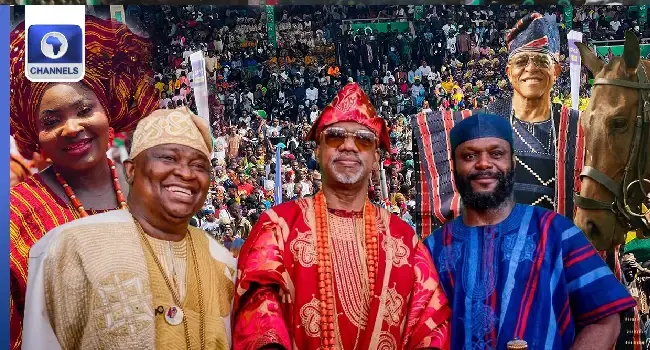
The 2026 Ojude Oba Festival arrived not merely as a celebration but as a moment of reflection, remembrance, and renewal.
- +Colours, Culture And Fashion Meet At Ojude Oba 2026
In the ancient city of Ijebu-Ode, thousands of people from across Nigeria and the diaspora converged for what has become one of Africa’s most remarkable cultural spectacles.
In the ancient city of Ijebu-Ode, thousands of people from across Nigeria and the diaspora converged for what has become one of Africa’s most remarkable cultural spectacles.
The atmosphere was electric. Vibrant colours filled the air, rhythmic drumming echoed through the town, horses paraded proudly before cheering crowds, and generations of Ijebu sons and daughters reunited in a celebration of heritage, identity and communal pride.
Yet this year’s gathering carried a deeper emotional weight.
It was the first since the passing of the revered Awujale of Ijebuland, Oba Sikiru Kayode Adetona, who joined his ancestors in July 2025 after an extraordinary 65-year reign.
The festival, therefore, became more than an annual tradition; it became a tribute to a monarch whose influence reshaped traditional leadership and projected Ijebuland onto the global stage.
Held on Friday, May 29, 2026, the event attracted dignitaries, celebrities, business leaders and tourists, including President Bola Tinubu’s son, Seyi Tinubu, Minister of Art, Culture, Tourism and the Creative Economy, Hannatu Musawa, and Ogun State Governor Dapo Abiodun.
Representing the Awujale, the Ogbeni Oja of Ijebuland, Chief Sonny Kuku, reflected on how far the festival has come.
“It is very gratifying for me that what we started is getting bigger and bigger and bigger,” he told Channels Television.
His words captured the remarkable transformation of a festival that has grown beyond a ceremonial gathering into a cultural institution.
“Ojude Oba has opened the eyes of the Ijebu people to the fact that we need to develop more. It has also opened our eyes to social welfare. The essence of the festival is to pay homage to the Kabiyesi on the third day of the Ileya celebration. It is a uniting factor. Christians, Muslims and traditional worshippers come together and pay homage to one person,” he added.
In many ways, that spirit of unity remains the festival’s most enduring feature. Across faiths, generations and social classes, Ojude Oba continues to serve as a powerful expression of communal harmony and shared identity.
As the celebration unfolded, many speakers pointed to the festival’s growing international profile.
Musawa described Ojude Oba as one of Nigeria’s strongest cultural exports and a benchmark for cultural festivals across the country.
“Ojude Oba has become a global phenomenon, really the bastion of showcasing our culture. There is no better personification of expressing Nigerian culture, especially Yoruba culture.
“My hope is that this will become a template for how we continue to grow other cultures and festivals across Nigeria as the government works hard to build partnerships with different states so that each state can showcase its unique festivals. I hope that Ojude Oba will remain a staple for exporting our culture to the world,” she said.
Governor Abiodun echoed similar sentiments, describing the event as a symbol of peaceful coexistence and cultural sophistication.
“We are building a state that honours its heritage because culture is not only our identity, but also a source of social cohesion and economic opportunity.
“This is why we have positioned Ojude Oba as a flagship within our tourism development agenda. Today, the economic impact of the festival is visible everywhere as hotels are fully occupied, businesses are flourishing, artisans are engaged, and our youths are being productively empowered,” he said.
For many attendees, the festival’s significance extends far beyond the ceremonial.
Each year, Ojude Oba functions as a homecoming, drawing people back to their roots from cities and countries across the world.
The Sobaloju of Egbaland described the celebration as a gathering that has matured into a permanent feature of Nigeria’s cultural calendar.
“Ojude Oba Festival is a festival that has come of age, and I can tell you it has come to stay.
“I will implore other states and ethnic groups to emulate Ojude Oba. People come from all walks of life, from the United Kingdom, Canada and other parts of the world. Ijebu sons and daughters everywhere are here today,” he said.
The return of thousands of visitors also translates into substantial economic activity.
“The economic importance is enormous. Billions of naira are brought into Ijebuland. To get a hotel room in Ijebu during this period, you often have to book four, five or six months ahead.
“Food vendors, transport operators, artisans and many others benefit. It has improved the economy of Ijebuland. I want to appeal to the Ijebu people to keep the flag flying,” he stated.
While the festival already enjoys widespread recognition, organisers are looking even further ahead.
The Bagbimo of Ijebu and long-time coordinator of the festival, Professor Adetokunboh Fassy, disclosed that efforts are underway to secure UNESCO recognition for Ojude Oba.
He described the festival as a symbol of unity, cultural pride and religious tolerance that continues to bring together Christians, Muslims and traditional worshippers.
According to him, the celebration has evolved beyond its original purpose into a broader cultural event embraced across faiths and backgrounds, reflecting the inclusive nature of Ijebu society.
Amid the pageantry, Ojude Oba is also shaping how younger Nigerians view culture and identity.
Fashion designer Sewa Similara said the experience had altered her perception of Nigeria’s cultural richness.
“As a Gen Z, this has been a huge game-changer in the way we perceive Nigeria,” she said, noting that “our culture has depth that many of us do not fully understand. Coming to this beautiful experience is truly amazing.”
Her words reflected a broader sentiment among young attendees who increasingly see Ojude Oba as a bridge between modern life and traditional values.
Former House of Representatives aspirant for Ijebu-Ode Constituency, Adetunji Olugbesan of the Obaneye family group, also stressed the importance of engagement between government, local communities and cultural institutions.\
He notedthat festivals such as Ojude Oba offer leaders opportunities to connect directly with the people.
If there is a heartbeat to Ojude Oba, it is found in the Regberegbe age-grade groups.
More than 40 groups entered the festival arena in grand fashion, transforming the venue into a moving gallery of colour, elegance and family heritage.
The Balogun Kuku, Josi Jonda family, Eleshi Kegberegbe, Agbongbadri Adebule, Omoba Sadiku Odedeji, Eleshi Omo Ajibike, Eleshin Oreagba and the Aregbesola family group were among those who participated.