Clean energy project connects five Epe communities to solar power, serving 8,000 residents and boosting economic activity in Lagos.
- +REA, EU, Germany Deliver 505kWp Solar Mini-Grid To Power Five Lagos Communities
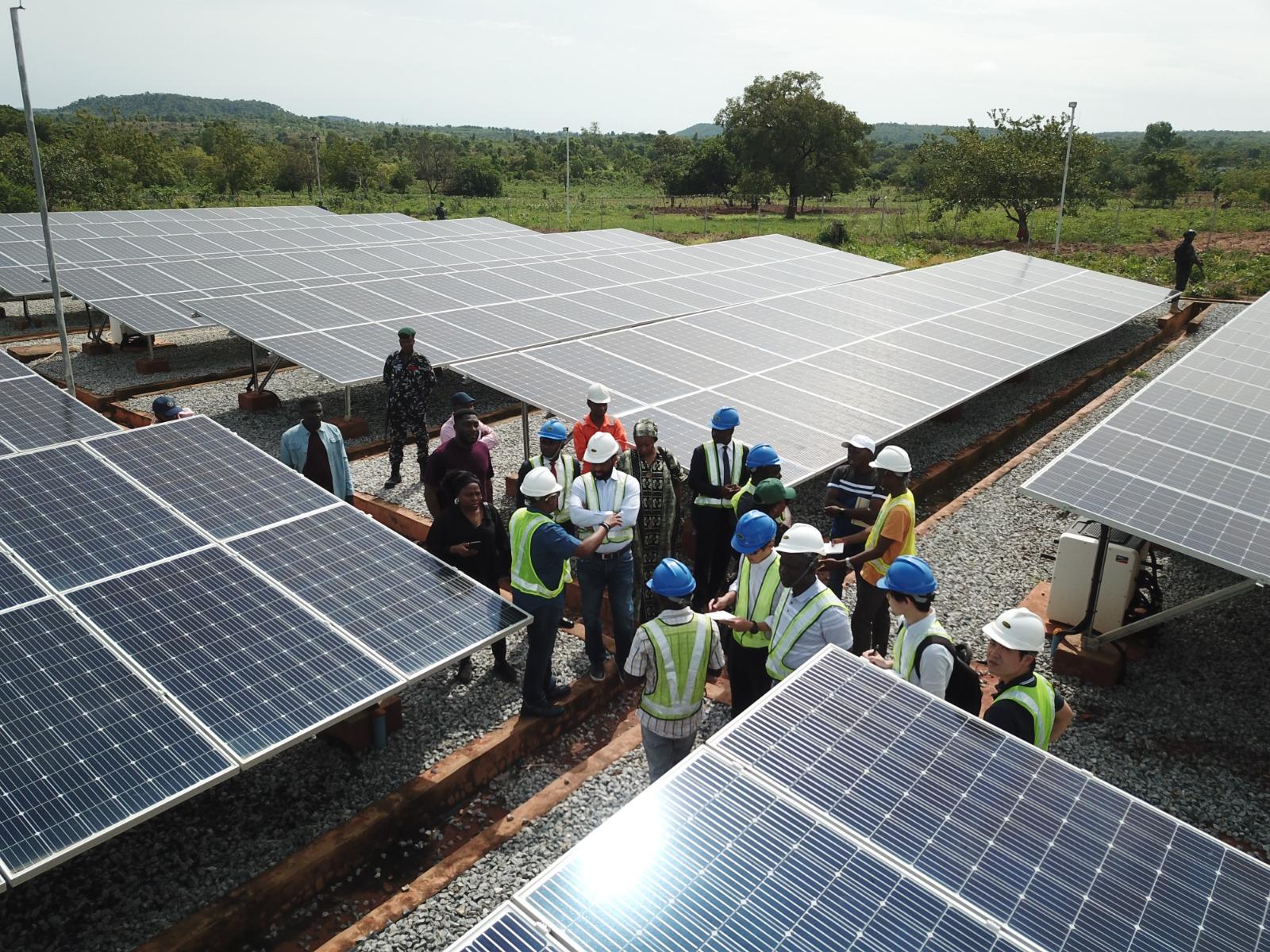
Five communities in Majoda, Epe Local Government Area of Lagos State, were on Wednesday connected to clean, reliable power as the Rural Electrification Agency (REA), European Union (EU), and German Government formally inaugurated a 505 kilowatts power (kW) interconnected solar mini-grid.
Five communities in Majoda, Epe Local Government Area of Lagos State, were on Wednesday connected to clean, reliable power as the Rural Electrification Agency (REA), European Union (EU), and German Government formally inaugurated a 505 kilowatts power (kW) interconnected solar mini-grid.
The agency also pledged to scale it to 5 megawatts (MW) to support Epe’sgrowing industrial base.
The project, delivered under the Interconnected Mini-Grid Acceleration Scheme (IMAS), will serve about 8,000 residents, businesses, schools, healthcare facilities, and commercial enterprises, cutting dependence on costly diesel and petrol generators and extending productive hours across the coastal community.
The benefitting communities are Odogbawojo, Odoshiwola, Odoayan, Ora, and Ibowon.
Speaking at the inauguration, REA Managing Director/Chief Executive Officer, Mr. Abba Aliyu, described the mini-grid as more than infrastructure.
Aliyu said, “Today, we are not simply commissioning a power project. We are commissioning economic opportunity, industrial productivity, enterprise growth, and a sustainable future for the people of Epe.”
The REA boss confirmed that Epe was only the starting point, as the 505kwp project represented the first phase of its long-term vision.
Recognising the tremendous economic potential of the community, he said REA was already working towards the deployment of an additional 5 megawatts (MW) of renewable energy capacity within Epe and its surrounding economic clusters.
Aliyu stressed that IMAS proved that collaboration helped to greater results.
He stated, “Government alone cannot deliver universal energy access. Development partners alone cannot achieve scale. The private sector alone cannot overcome every market barrier.
“Communities alone cannot finance major infrastructure. But when all stakeholders work together, transformation becomes possible.”
According to him, the federal government provided the needed policy, EU and Germany gave catalytic funding, private developers brought technical expertise, financiers provided capital, distribution companies (Discos) handled network integration, and the community provided social ownership, which collectively led to the successful delivery of the project.
To Epe residents, Aliyu said, “This project belongs to you. We encourage you to protect it, utilize it productively, and leverage the opportunities it creates to grow businesses, expand economic activities, and improve living standards.”
He said the expansion will support agro-processing, cold-chain facilities, digital enterprises and industrial activities to drive jobs and revenue.
In his remarks, Minister of Power, Joseph Tegbe, said over 1,000 mini-grids were currently under active development across the nation and that 3.9 million Nigerians had been reached with solar home systems under the World Bank-supported Distributed Access Recovery Scheme (DARES) initiative.
He highlighted the 704kW hybrid mini-grid in Offa, serving 3,000 customers, and solar-housing projects in Katsina combining energy with peacebuilding.
Tegbe said the majoda mini-grid aligns with Tinubu’s Renewed Hope Agenda, which placed infrastructure, industrialisation, and poverty reduction at its core.
“None of these objectives can be achieved without reliable and affordable electricity,” he said.
The minister said expected benefits for Majoda included improved electricity reliability, reduced diesel/petrol costs, lower energy expenditure for households and small and medium enterprises (SMEs), increased productivity, enhanced healthcare delivery, better learning outcomes in schools, reduced pollution, and job creation.
“Most importantly, this project demonstrates how renewable energy can serve as a catalyst for rural economic transformation,” Tegbe added.
He linked the project to the Electricity Act 2023, which decentralisedelectricity governance, encourages state participation and promotes private investment in distributed renewables.
He said, “Mini-grids and distributed renewable energy systems are now increasingly becoming important components of Nigeria’s evolving electricity landscape.”
Tegbe paid tribute to REA’s transformation under Aliyu, saying, “The agency has, in recent years, undergone a remarkable transformation from a body of admirable mandate but modest delivery, into an institution that is genuinely, visibly, measurably changing lives across Nigeria.”
He said, “REA has shown that the energy transition is not an abstract policy document. It is happening. Community by community, kilowatt by kilowatt, life by life.”
He also praised the EU and Germany, through Nigerian Energy Support Programme (NESP) and GIZ, for the IMAS programme.
“It leverages public funding to attract private developers, creates clear market rules, and builds in long-term commercial viability rather than dependence on perpetual subsidy.”
Aliyu said, “To our partners from the EU and Germany, Nigeria is grateful. Your investment in our energy future is an investment in our shared future.”