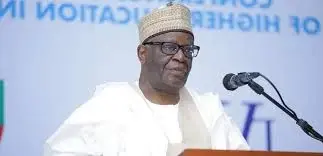
Former Chief of Staff to the late President Muhammadu Buhari, Prof Ibrahim Gambari, Diplomat Moudjib Djinadou and Dimas Garba have called on African leaders and citizens to embrace self-rediscovery as a pathway to the continent’s progress.
- +Africa cannot progress with imported governance models — Gambari
They argued that decades of dependence on imported political, economic and governance models have failed to deliver the desired development outcomes.
They argued that decades of dependence on imported political, economic and governance models have failed to deliver the desired development outcomes.
Speaking at the launch of “Renegade Africa: All it Takes to Be African,” written by Djinadou, a former United Nations official and founder of the Itumo Institute, a think-tank based in Porto-Novo, Republic of Benin, on Tuesday, the speakers urged a return to indigenous governance systems, values, and knowledge structures.
The event was held at the Savannah Centre for Diplomacy, Democracy and Development, Utako, Abuja.
The African continent is currently confronted with numerous challenges spanning economic, security, social, and other developmental sectors.
As efforts to overcome these difficulties continue, many argue that Africa possesses the resources and potential required to tackle its challenges and chart a path toward sustainable development.
Gambari, who is the chairman of the book launch, stressed that sustainable development in Africa could only be achieved when policies and institutions were rooted in the continent’s historical realities, cultural heritage and collective aspirations.
He stated, “The external cannot love us more than we love ourselves, and we are the ones who know where the shoe pinches because we wear it. We are the ones who need to show that we care about life.
“The book asks a simple question, one that too many African intellectuals forbid themselves from voicing frankly: despite all our efforts, could it be that Africa’s shortcomings in building genuine sovereignty are first and foremost failures toward itself?
“And, you know, if you don’t define yourself, if you don’t promote your own narrative, other people will not do it for you. And if you don’t blow your own trumpet, nobody else will blow it for you because they are very busy blowing their own trumpets.
“So really, what we need to look at is the book’s central argument, which is this: that our weakness is not geographical or historical; it is the result of an alienation that has led us to undervalue our own governance systems, our own indigenous economic philosophies, our own languages, and our collective knowledge.
“We have imitated, persisted in, and mimicked—never adapted—values and policies external to our environment. This mimicry has, in many regards, made us strangers to ourselves.
“So we have to rediscover ourselves in order to move forward. Let’s reclaim ourselves. Let’s go deep into ourselves. Let’s bring out our souls because that’s unique to us.”
Gambari recalled that the Chinese, when they adopted socialism, always said socialism with Chinese characteristics.
He lamented that here in Africa, the people practice democracy without African characteristics, and are surprised that sometimes it does not work.
“So the author points out, furthermore, that in order to open up to the world and make a contribution to it, one must first be oneself.
“And for that, we must unearth our pre-colonial heritage, which is our true patrimony—its political institutions founded on deliberation and consensus,” he added.
Prof Gambari said Africa remained economically constrained by exporting raw materials while relying on imports for manufactured products, including food.
“On the economic front, particularly, we are trapped by extroversion. We export our raw materials and import manufactured goods, including food.
“The solution lies, therefore, in productive sovereignty through the development of local domestic capacity.
“We must escape from situations where our place in the global value chain is more chain than value. And it will not change unless we add value to our production, so that we can be true participants in a value chain that benefits all of us.
“On demography, often presented as a threat, it is, on the contrary, an incredible opportunity if we invest massively in education, mentoring, and training of our youthful population,” he said.
The book reviewer, a Baze University lecturer, Garba, said the book examines how Africa has gradually abandoned its values, systems, and cultural heritage in favour of Western models.
He stated, “This abandonment did not just happen today, but took place through a gradual process since Africa came into contact with the West as early as the 8th century, as reported by the author.
“This was occasioned by the latter’s move in search of trade routes and natural resources. Since this contact, Africa has become distorted and brainwashed to see itself as inferior to the West and to think like the West, which consequently resulted in the stagnation that we are worried about.”
Garba said the work is structured into three parts, beginning with a diagnosis of African society, law, power, and its “confiscated heritage,” followed by an examination of Africa’s condition through Enlightenment ideas, racism, and multilateralism.
He added that the final section explores the symptoms of Africa’s challenges in democracy, economy, security, and education, while concluding that Africa’s underdevelopment stems not only from colonial history but also from the loss of its pre-colonial values and systems, which were replaced by imported models.
“What is more worrisome to the author is Africa’s acceptance of Western values. It is an acceptance no longer imposed by economic or geopolitical power relations, but one chosen directly as an act of consciousness, not out of subjugation or by force.
“Now Africans have come to accept, willfully and consciously, the fact that our own ways are inferior to those of the West.
“In my own view, the author is very correct because no nation can make authentic progress by negating or relegating its own history to the background.
“The history of a people is not just a chronology of events, dates, times, or even actors, but an account of experience, learning, and heritage, which culminates in knowledge about what works and what does not work, and how to move society forward.
“However, modern Africa is indeed a continent that has forgotten its past and accepted that reality,” the book reviewer stated.
He described the author’s message as a strong call for Africa to awaken.
Garba added, “The intent of the author, from what I see, is not to blame the West. It is not to point fingers. Rather, it is a clarion call for Africans to wake up, because no amount of pursuing Western models for Africa will work for Africa unless we come back to Africa and look back at our history.
“The author says that modern Africa can exist only through the creative adaptation of its fundamental realities.