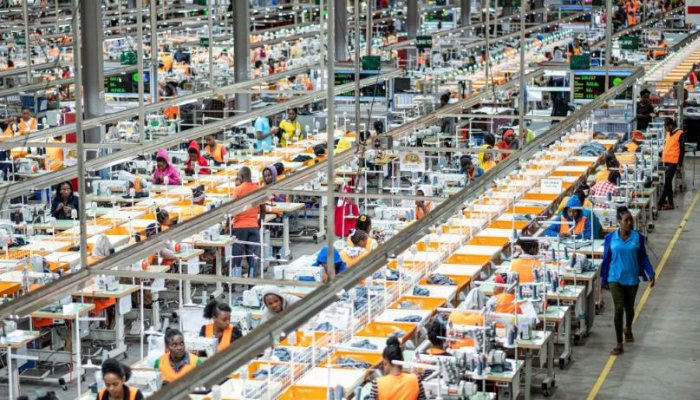
Nigeria is not yet structurally positioned to sustain high-growth industrialisation despite showing signs of progress, according to the 2025 RED Index of Industrial Development in Africa released by the Business Council for Africa.
- +Nigeria falls short of industrial readiness despite progress, RED Index shows
The report identifies only four African economies, Morocco, Egypt, South Africa, and Mauritius, as having the structural alignment required to achieve and sustain industrial growth, underscoring a widening gap between a small group of ready economies and the rest of the continent.
The report identifies only four African economies, Morocco, Egypt, South Africa, and Mauritius, as having the structural alignment required to achieve and sustain industrial growth, underscoring a widening gap between a small group of ready economies and the rest of the continent.
While Nigeria is recognised among countries making meaningful strides, the Index classifies its industrial trajectory as incomplete, indicating that key structural conditions required for transformation at scale are still missing.
The RED Index argues that industrialisation in Africa is less constrained by ambition and more by underlying structural factors. It evaluates economies across three core dimensions: Engines of Industrialisation, which reflect foundational capabilities; Accelerators, which determine the pace of transformation; and Decelerators, which represent constraints capable of slowing or reversing progress.
Across Africa, the report identifies corruption and security instability as the most significant decelerators, weakening institutional effectiveness and limiting the implementation of industrial policies, factors that continue to weigh on countries such as Nigeria.
In contrast, Morocco, Egypt, South Africa, and Mauritius are highlighted as economies where these structural elements are sufficiently aligned to support sustained industrial expansion.
The report draws on the historical experiences of countries including South Korea, Malaysia, Vietnam, Brazil, Morocco, and Ethiopia to identify the conditions that consistently underpin successful industrialisation. It positions the RED Index as a practical framework to guide long-term policy decisions and industrial strategy.
In a foreword to the report, Aliko Dangote, president and chief executive of the Dangote Group, emphasised the need for Africa to build its industrial base internally.
“Africa’s development cannot be imported or outsourced. It must be built, owned, and sustained from within. What is required now is clarity of structure and commitment to execution,” he said.
Also commenting, Arnold Ekpe, chairman of the Business Council for Africa, described the Index as more than a ranking tool, urging stakeholders to take decisive action.
“This is not just an index. It is a call to action, for African policymakers, investors, and businesses to take ownership of Africa’s industrial future and commit to the structural changes required to deliver sustained growth,” Ekpe said.
The report comes at a time when global capital is increasingly seeking scalable and resilient growth opportunities, with the Index offering insight into where industrialisation is viable, where risks remain elevated, and where targeted reforms could unlock long-term value.