Akwa Ibom State is staking a claim as Nigeria’s South-South clean energy pacesetter, anchored by a compressed natural gas mass transit terminal now under construction that its governor says will reorder how millions of commuters move across one of the country’s most oil-rich but infrastructure-starved regions.
- +Akwa Ibom bets on CNG transit hub to drive clean energy shifts in South-South
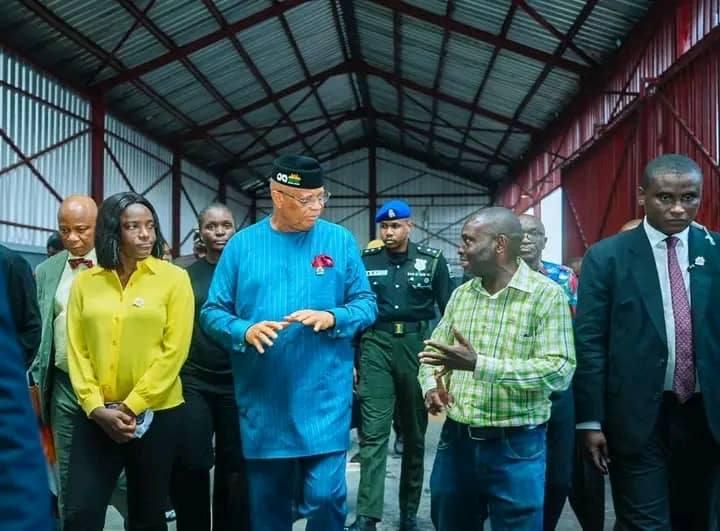
Umo Eno, the governor of the state, made an unscheduled sweep of four major project sites including the CNG bus terminal, which will integrate a gas filling station, a training academy, maintenance workshops, a police post, restaurants, and an automated car wash.
Umo Eno, the governor of the state, made an unscheduled sweep of four major project sites including the CNG bus terminal, which will integrate a gas filling station, a training academy, maintenance workshops, a police post, restaurants, and an automated car wash.
Nigeria’s federal government has for two years pushed compressed natural gas as a bridge fuel to reduce petrol dependency, a policy logic made urgent by the removal of the decades-old fuel subsidy in 2023.
Akwa Ibom’s terminal represents one of the most ambitious sub-national commitments to that agenda yet, a multimodal hub designed to seed demand, supply, skills, and safety regulation under a single roof.
The training academy embedded in the complex signals an intent to build local technical capacity in gas handling, a workforce gap that has hampered earlier CNG rollouts elsewhere in the federation.
The governor’s first stop was the Aviation Village, a 15-hectare residential estate being built to house aviation agency staff ahead of the state’s planned international flight commencement at Victor Attah International Airport.
With 100 housing units, a split of two- and three-bedroom apartments, a dual-carriageway access road, internal road network, and perimeter fencing already advancing, Eno declared confidence in timely completion.
He also directed that additional government contracts be awarded to the female contractors overseeing portions of the project, citing their professionalism, a directive that, if followed through, could shift procurement patterns in a sector where women remain marginalised.
The Equipment Leasing and Maintenance Plant, Eno’s second stop, anchors the state’s mechanised agriculture push. Fitted with 20 tractor sheds, a fully equipped maintenance workshop, 25 tractors with attachable implements, and two low-bed transport vehicles, the facility is designed to lower the barriers to commercial farming by pooling capital equipment too expensive for individual smallholders. In a state where the share of GDP derived from agriculture remains well below its potential, the plant is a structural intervention in the economics of food production.
Eno concluded the inspection at the Dakkada Luxury Estate, where construction of the State Assembly Quarters and Executive Council Quarters is underway, a project that will eventually consolidate legislative and executive residential functions on a single campus, reducing the logistical fragmentation that has long characterised government operations in the state capital.
The governor’s site visits, unannounced to avoid choreographed staging, are a deliberate management tool.