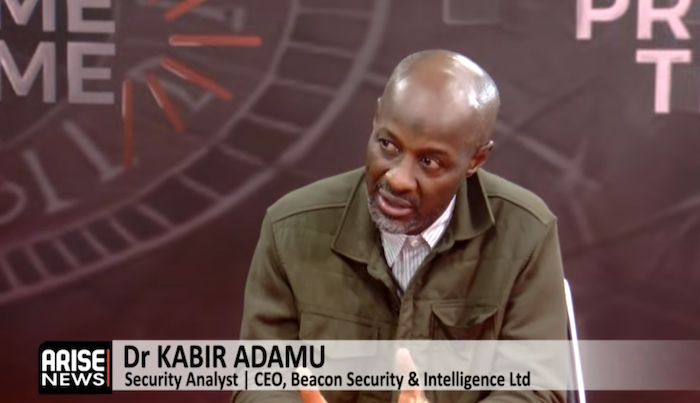
Security expert Dr. Kabir Adamu alleges evidence from several northern states suggests some government actors support community negotiations with terrorists.
- +Kabir Adamu: FG Elements Encouraging Communities To Negotiate With Terrorists
A security analyst and also the CEO of Beacon Security and Intelligence Limited, Dr.
A security analyst and also the CEO of Beacon Security and Intelligence Limited, Dr. Kabir Adamu, has alleged that parts of the federal government and some state governments are encouraging communities affected by insecurity to negotiate with bandits.
Speaking during an interview with ARISE NEWS on the worsening security situation in northwestern Nigeria, Dr. Adamu said there is evidence suggesting that some peace agreements between communities and non-state armed groups were undertaken with varying levels of official knowledge and support.
“I would also add that at least we know part of the federal government, and to an extent, some state governments, are encouraging communities to negotiate with these non-state armed groups,” he alleged.
Adding, he said: “In neighboring Katsina, there is enough evidence to show that the Sulhu, which is the negotiation sort of pact between the communities and the non-state armed groups, there, the bandits, had some element of state sanction. In Zamfara State. The point I’m trying to make is that there is evidence in both Katsina, Kaduna, and most likely Zamfara State, that this type of peace pact has some knowledge, as it were, of the government.”
Challenging the notion that authorities do not know where bandits are located, Dr. Adamu said there is enough evidence to suggest the state is aware of their locations. He argued that the difficulty lies in the complexity and scale of the crisis, despite ongoing operations that have eliminated several bandit leaders and targeted their hideouts.
“Let’s not build a premise on a sort of wrong assumption. And that is the fact that the state does not know where the bandits are. I think there is enough evidence to show that the state knows where the bandits are.
“They are not going there perhaps because of the complexity of the issue itself. The banditry has been described as a sociological challenge, and despite its criminality and what it has done to the country,” he explained.
On negotiations with bandits, the security expert warned that dialogue becomes dangerous when it is poorly managed. He argued that disarmament must be a key part of any peace process, noting that some agreements have proceeded without the surrender of weapons. According to him, this has allowed some criminal groups to retain influence, continue attacks, and even shift their operations to neighbouring states.
“At the point where it is mishandled. I mean, the best sort of approach for dialoguing is the UN DDR approach: Demobilization, Deradicalization, and Rehabilitation, with a series of steps that should be taken under it. You cannot, for instance, demobilize without retrieving the weapons of the enemy.
“What we’ve seen in Katsina—I think about 18 local governments, if I’m right—is some element of demobilization without retrieving the weapons of the bad guys. And that in itself is another avenue for encouraging militarization.
“It’s recorded everywhere, we’ve seen instances where these criminals have become authorities on their own, where they’ve carried out criminality within that pact that has been signed. We’ve also seen a dislocation of the crime. We’ve seen them moving from Katsina into parts of Kano State, carrying out such incidents.
“And I think it’s a lesson for us as a country to realize that these things are structured. You can’t do one without the other. And if you do it wrongly, you create bigger challenges,” he warned.
Commenting on the recent release of kidnapped victims in Borno State, Dr. Adamu said uncertainty often surrounds such operations because governments rarely disclose all the details, especially where ransom payments may be involved.
He explained that while the military provided a detailed account of the rescue operation, concerns would remain if the victims were released through negotiations, as concessions to kidnappers could encourage future abductions.
“What the military said is that they rescued them. I saw a very detailed statement by the military indicating how they released or rescued these victims. They indicated it was a function of intelligence. Although, there were other sources from within the victims themselves indicating that it may have been otherwise. The other thing is to be concerned if at all it was a release and not a rescue because that would mean several other kidnaps down the road. If they get what they want—financial or whatever it is—then it means they’re going to carry out other abductions down the road,” Dr. Adamu warned.
Responding to concerns that Nigeria’s anti-kidnapping efforts appear reactive, Adamu said the country has established structures such as the Kidnap Fusion Centre to coordinate responses.
“A Kidnap Fusion Centre was established in Nigeria. In 2014. It reached some level of maturity in 2015, and this was with the support of our partners from the UK. So, there is some semblance of a strategy that is being implemented. It’s work in progress; it hasn’t matured,” he said.
On the debate over state police, Dr. Adamu said he has shifted from focusing on the risks to believing that the political momentum now strongly favours its creation. He noted that support from key political actors, ongoing constitutional review efforts, and the dominance of the ruling party at both federal and state levels suggest the proposal could become a reality.
“I’ve moved from the point where I was highlighting the risk associated with state police to a point where I believe that the political sort of direction is to have state police. And the ruling party—I mean, the desire seems to be coming from the presidency. I can’t say all the governors. Whether that support is tacit or it was a support given on the basis of certain promises, we don’t know why, but the support is there. So, it looks like it is politically expedient and possible to have state police.
“Now, the other element, which is also critical, is that the constitution would need to be amended. And just yesterday, we’ve heard from the National Assembly saying that they’ve isolated that element of state police and that they would treat it singly and not together with the other elements of constitutional review that they would do. And we know that the ruling party has dominance within the National Assembly. So, it looks like they can do it fairly quickly,” he noted.
He, however, stressed that concerns about political abuse by governors must be addressed through safeguards. According to him, recommendations submitted by a committee established by the Inspector General of Police have already identified such risks and proposed measures to mitigate them, while other challenges, including economic considerations, also require careful attention.