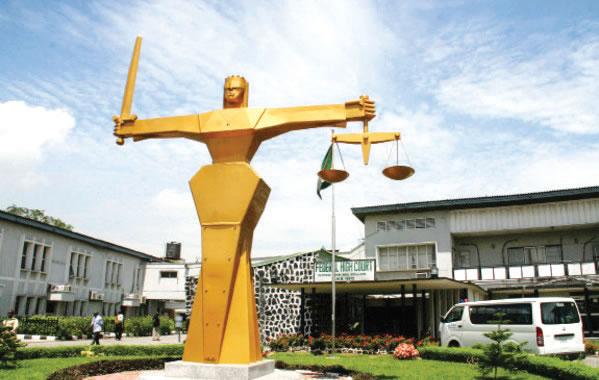
The Federal High Court in Abuja on Friday nullified the deregistration of the National Youth Council of Nigeria and ordered the Corporate Affairs Commission to restore the council’s certificate of registration and reinstate Sukubo Sara-Igbe Sukubo and other members of its Board of Trustees.
- +Court orders CAC to reinstate NYCN, dissolves interim committee
In a judgment delivered by Justice Binta Nyako, the court held that the CAC acted beyond its statutory powers when it withdrew the NYCN’s registration and subsequently constituted an Interim Management Committee to oversee the affairs of the organisation.
In a judgment delivered by Justice Binta Nyako, the court held that the CAC acted beyond its statutory powers when it withdrew the NYCN’s registration and subsequently constituted an Interim Management Committee to oversee the affairs of the organisation.
The court further ordered the immediate dissolution of the nine-member IMC led by Buhari Shehu, which was jointly established by the CAC and the Federal Ministry of Youth Development following the withdrawal of the council’s registration.
The dispute arose after the CAC, on October 6, 2025, withdrew the NYCN’s certificate of registration, which had originally been issued on October 28, 2020.
A day later, the commission and the Ministry of Youth Development announced the formation of an interim management body to administer the council pending the resolution of leadership disputes.
Dissatisfied with the action, Sukubo, who serves as NYCN president and secretary of the Board of Trustees, alongside another claimant, instituted Suit No. FHC/ABJ/CS/2142/2025.
The suit challenged the legality of the CAC’s actions and questioned whether provisions of the Companies and Allied Matters Act (CAMA) 2020 empowering the commission to suspend trustees, appoint interim managers and establish administrative committees were consistent with constitutional guarantees of freedom of association.
The claimants also argued that earlier court decisions which invalidated Sections 839 and 851 of CAMA rendered any reliance on those provisions unlawful.
They further contended that the CAC’s actions were improper because related disputes over the leadership and trusteeship of the NYCN were already pending before the courts.
In her ruling, Justice Nyako stated that while the CAC possesses regulatory oversight powers over incorporated trustees, those powers do not extend to determining leadership disputes or displacing existing governing structures, particularly where such matters are already the subject of ongoing litigation.
She said: “The real question is whether those powers extend to the wholesale displacement of existing leadership structures.”
She noted that disputes relating to the NYCN’s trusteeship and administration were already before courts of competent jurisdiction.
According to her, administrative agencies must exercise restraint when issues are pending before the courts and should not take actions capable of prejudicing judicial proceedings.
“The Commission may investigate. It may supervise compliance with statutory requirements. It may make inquiries into the affairs of an association. What it cannot do is assume the role of the court by effectively deciding who should govern the association while the issue remains the subject of pending litigation,” she held.
Justice Nyako found that the withdrawal of the NYCN’s registration certificate and the installation of an Interim Management Committee effectively altered the status quo and replaced the existing leadership structure while litigation remained unresolved.
She held that such actions exceeded the limits of regulatory oversight and amounted to interference in matters reserved for judicial determination.
“The law does not permit a party, directly or indirectly, to achieve administratively what remains unresolved judicially,” the judge said, adding that the actions taken under the circumstances of the case were unlawful and could not be sustained.
Although the court declined to make a blanket declaration that Sections 839 and 851 of CAMA are unconstitutional, it ruled that the CAC’s reliance on those provisions in the specific circumstances of the case was improper.
Consequently, Justice Nyako ordered the restoration of the status quo that existed before the CAC’s intervention, directing the commission to immediately restore the NYCN’s certificate of registration, recognise Sukubo and other duly registered trustees as the legitimate Board of Trustees, and dissolve the Interim Management Committee.
The court also directed all parties to maintain the pre-intervention position pending the determination of the substantive leadership dispute currently before the Court of Appeal.