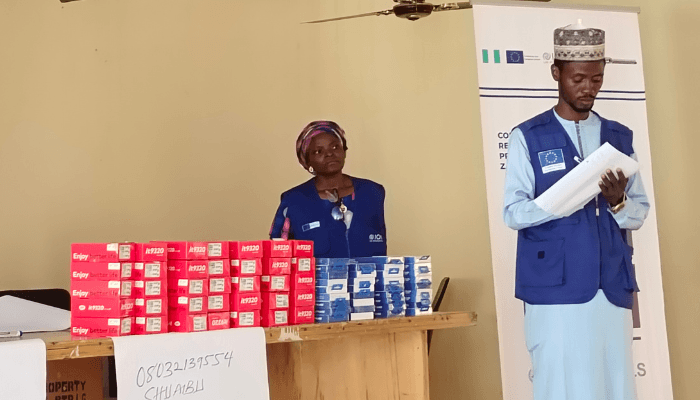
IOM strengthens community early warning network in Katsina with mobile phone donations
The International Organisation for Migration, in partnership with Mercy Corps and the Centre for Democracy and Development, has intensified efforts to strengthen community-based conflict prevention mechanisms in Katsina State.
The International Organisation for Migration, in partnership with Mercy Corps and the Centre for Democracy and Development, has intensified efforts to strengthen community-based conflict prevention mechanisms in Katsina State.
Talatu Gambo, IOM field team representative, while briefing journalists during a refresher training for community contact persons under the Conflict Prevention, Crisis Response and Resilience Programme funded by the European Union – Foreign Policy instrument on Wednesday in Batsari local government area of Katsina State, said the event aimed at improving the capacity of the participants to report conflict-related incidents, support early warning and early response mechanisms, as well as monitor movements along transhumance corridors.
According to the rep., “the exercise was designed to reinforce the knowledge and responsibilities of community contact persons who serve as the link between local communities and conflict response structures.
“They are responsible for responding to alerts, providing timely alerts for the conflict prevention structures to act upon, and monitoring the movement of transhumance along the corridors,” the official said.
The official further noted that the programme deliberately uses the term community contact persons instead of key informants, reflecting the community-focused approach adopted under the intervention.
The official said that the participants received additional guidance on data collection, incident reporting and providing feedback on the outcomes of conflict response interventions.
“The training is also to empower them with communication gadgets such as mobile phones and power banks. These tools will enable them to provide alerts promptly, share feedback on conflict situations, report whether incidents were resolved or not, and support their activities alongside the Technical Support Committees (TSCs) and local government structures,” the official added.
The official explained that the contact persons also contribute to Transhumance Flow Monitoring (TFM) by observing and reporting population and livestock movements that could influence resource competition or trigger tensions between farming and pastoral communities.
A total of 35 community contact persons, also known as the community peace and resilience committee members from the project implementation communities in the local government area, benefited from the exercise.
The participants were selected from seven project communities and strategic transhumance corridors where seasonal movements of herders and livestock frequently occur.
The CPCRR Programme seeks to strengthen community resilience by enhancing local capacities for conflict prevention, crisis response and peaceful coexistence in Katsina and Zamfara states.
Through improved early warning systems, timely information sharing and community engagement, the programme aims to reduce the risk of violence, strengthen trust among stakeholders and support evidence-based responses to emerging conflict trends.