When Emmanuel Quartey temporarily lost hearing in one ear in February 2024, the impact was immediate. Everyday conversations became frustrating, and even simple interactions required more effort than he was used to. It was the first time he had experienced, even briefly, how losing one sense could reshape everyday life. Then a friend asked him a question that would redirect his ambitions as a young engineer.
- +How one Ghanaian developer is redesigning assistive AI for African users
- +“Imagine it was your eyes. What would you do?”
At the time, Quartey was a second-year Information Technology student at Pentecost University in Ghana, experimenting with computer vision and artificial intelligence.
“Imagine it was your eyes. What would you do?”
At the time, Quartey was a second-year Information Technology student at Pentecost University in Ghana, experimenting with computer vision and artificial intelligence. He had already spent years building automation systems, robotics projects and agricultural technologies. Assistive technology had never crossed his mind.
But the question stayed with him.
As he continued experimenting with computer vision, he began wondering how it could be used to solve challenges faced by people with disabilities.
A few days later, another friend cancelled a meeting because she was accompanying her visually impaired friend, Angela Kona, to the hospital.
When they eventually met, Quartey demonstrated a computer vision project that could recognise currency and extract printed text. Watching Kona use it convinced him he was building something that could make a real difference.
“That was when I realised this shouldn’t remain just a project,” he says.
Two years later, that experiment has evolved into Steward Vision Assistant, an AI-powered platform that helps blind and visually impaired users recognise currency, identify objects, read printed text and better navigate their surroundings.
Steward is emerging at a time when advances in artificial intelligence are reshaping assistive technology. Capabilities that once required years of specialised engineering, including optical character recognition (OCR), computer vision, scene description and speech recognition, can now be built on top of existing AI models, allowing smaller teams to focus on adapting the technology to local needs rather than developing every capability from scratch.
The shift comes as access to assistive technology has become a growing priority across Africa. The World Health Organisation (WHO) estimates that more than 200 million people in the region need at least one assistive product, a figure expected to double by 2050. Among them are an estimated 26 million persons with some degree of visual impairment, many of whom rely on assistive technologies to read, navigate and interact more independently.
Yet despite the scale of the need, many of today’s most advanced assistive technologies were designed with users in developed markets in mind, and the cost of importing them can run into thousands of dollars.
AI-powered devices such as Envision Glasses, which start at about $1,900, can read printed text, recognise faces, identify objects and describe a user’s surroundings, while navigation aids such as WeWalk, which costs more than $600, use artificial intelligence and sensors to help blind users move more safely and independently.
While those products have expanded what is possible for blind users, Quartey believed they could be adapted further for African contexts. Rather than replicate existing devices, he set out to build a platform shaped by the realities of the people he hoped would use it.
“When we looked at some of the existing smart glasses, the currency detection didn’t even include the Ghanaian cedi,” he says. “If a Ghanaian bought those glasses, one of the most important features simply wouldn’t work.”
The same challenge extended to speech recognition. Voice models trained primarily on American or British accents often struggle with African speech patterns.
Quartey says his team has begun training its models to recognise Ghanaian accents while also exploring support for regional languages such as Hausa and Swahili. As development continues, it also plans to add Ghanaian languages, including Twi and Ga.
For Olamide Daniel, a disability inclusion consultant, that local focus is what makes products like Steward significant. He says Africa has long depended on imported assistive technologies that are often expensive and not always designed for the realities of users on the continent.
“It’s encouraging to see people thinking about building assistive technology for local use,” Daniel says. “Many of the products we use come from abroad, and they’re expensive to bring in. Envision AI, for example, offers similar capabilities, but it’s beyond the reach of many ordinary Africans. If Steward can deliver on what it promises and remain affordable, it could make a real difference.”
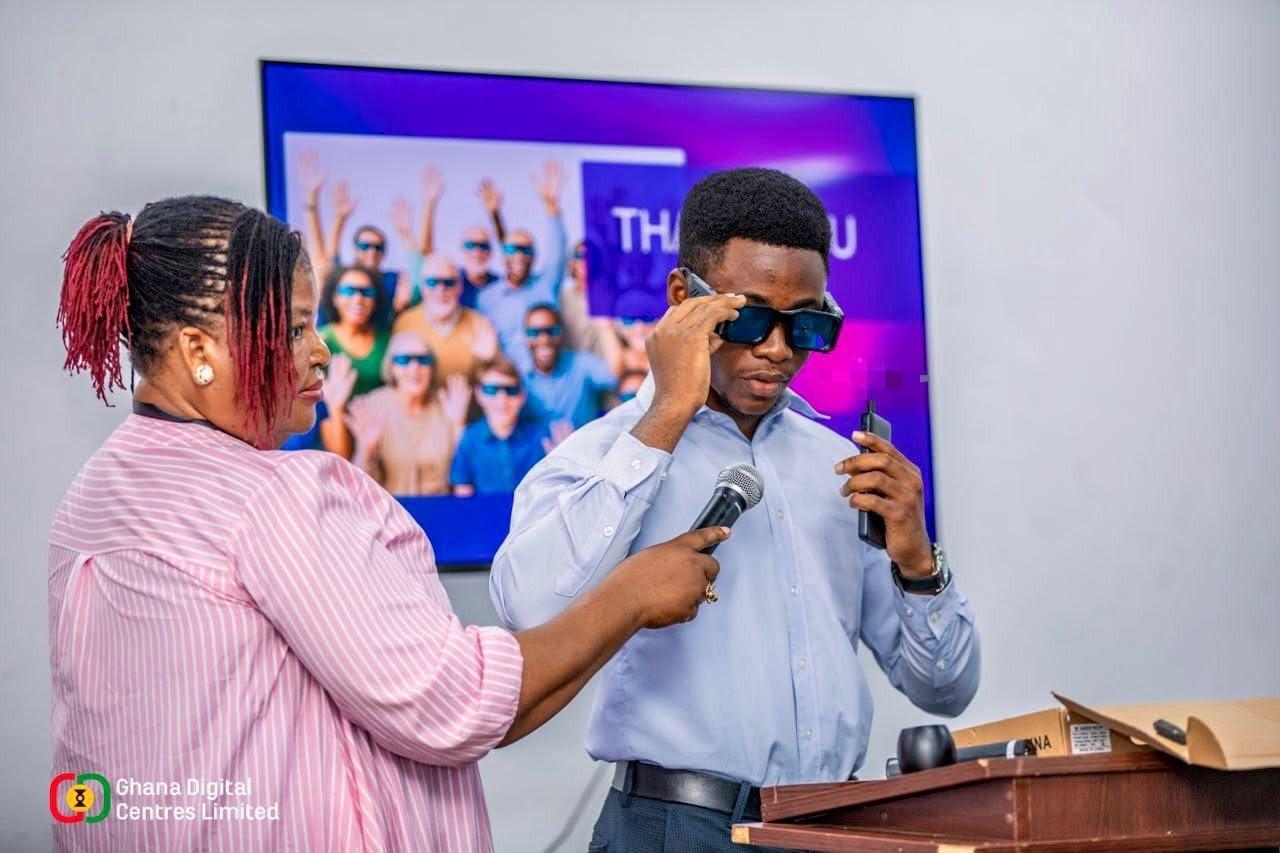
Today, Steward consists of two devices designed to support blind and visually impaired users.
The first is a pair of AI-powered smart glasses that combine a camera, computer vision and generative AI to interpret visual information.
Users simply point the glasses at printed text, currency, everyday objects or unfamiliar environments.
The system analyses what the camera captures before delivering spoken descriptions through audio. It can also summarise lengthy documents into shorter explanations, making printed information easier to access.
Quartey says the text-reading feature was inspired in part by visits to schools for blind students, where he found Braille libraries often stocked with outdated materials while newer textbooks remained inaccessible.
The second is a handheld device that uses ultrasonic sensors to detect obstacles above ground level.
As users move closer to an object, the device responds with increasingly stronger vibrations, helping them identify hazards such as hanging objects, signposts and tables that a white cane might not immediately detect.
That, however, was not Quartey’s original plan.
“When I started building it, I thought I could replace the white cane,” he says. “But when I engaged with visually impaired users, I realised the white cane actually does much more than I thought. It gives tactile feedback that technology cannot easily replace.”
Those conversations reshaped Steward’s design. Rather than replacing the white cane, Quartey repositioned the handheld device as a companion, helping users detect obstacles beyond the cane’s reach while preserving a mobility aid they already trusted.
Feedback also reshaped the hardware itself. During early testing with members of the Ghana Blind Union, participants said the first prototype of the glasses was too heavy and suggested improvements to the frame size and button placement.
Quartey says those conversations informed several design changes before the current version.
William, one of the visually impaired users who tested Steward, says the object detection feature left a strong first impression.