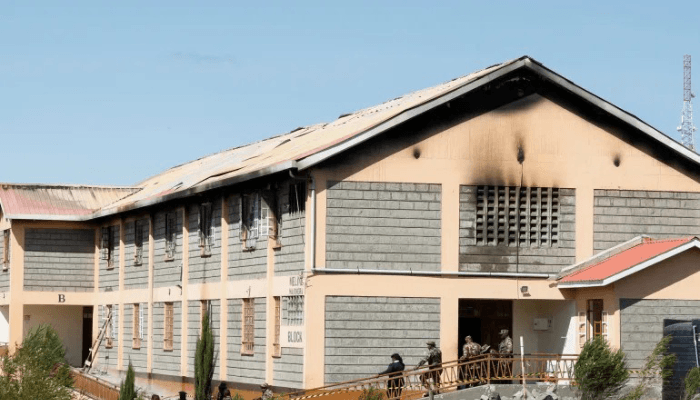
At least 16 students have been killed after a fire ripped through a girls’ boarding school in central Kenya, in one of the country’s deadliest school tragedies in recent years, according to the BBC.
- +Kenya school dormitory fire kills 16 students as authorities launch probe
- +“I ask everyone to be patient and avoid speculation.”
The blaze broke out in the early hours of Thursday at Utumishi Girls Academy in Gilgil, about 120 kilometres north-west of Nairobi, while students were asleep in their dormitories.
The blaze broke out in the early hours of Thursday at Utumishi Girls Academy in Gilgil, about 120 kilometres north-west of Nairobi, while students were asleep in their dormitories.
Julius Ogamba, Kenya’s education minister said dozens of other students were injured in the fire, with 71 later discharged from hospital while seven remained admitted for further treatment.
“The response teams managed to put out the fire by about 03:00, but by then the damage had already been done,” Ogamba said while visiting the scene.
He said the cause of the fire had not yet been established and investigations were ongoing.
According to authorities, the fire started on the first floor of a dormitory block that housed about 220 students and was completely destroyed in the blaze. More than 800 children were in the school at the time of the incident.
Distraught parents and relatives gathered outside the school compound for hours as officials worked to identify victims and account for missing students.
Interior minister Kipchumba Murkomen appealed for calm as the country mourned the victims.
“It’s a very anxious moment and even as we account for the 16 so far identified as having passed on, I want to ask the people of Kenya that together we stand with the families… in prayer, in support,” he said.
“I ask everyone to be patient and avoid speculation.”
Masoud Mwinyi, the Police commander described the tragedy as “a sad and distressing situation”, adding that some students fled into nearby areas during the chaos and were still being traced by security officers.
“As we speak, our officers are combing the area because some students fled in shock and fear during the night,” Mwinyi said.
Parents who rushed to the school described scenes of fear and confusion.
Leah Serem, whose daughter is a final-year student at the school, said she travelled from the nearby town of Nakuru after hearing news of the fire.
“We were anxious because we didn’t know whether our children were alive,” she said.
Serem later reunited with her daughter and expressed relief after hours of uncertainty.
“I was very happy, and thanked God,” she told reporters, adding that students had tried waking each other up as flames spread through the dormitory.
“We are praying for parents who have not yet met their children… we ask Kenyans to pray for us and remain calm as the cause of the fire is investigated.”
School fires have remained a recurring problem in Kenya, where overcrowded dormitories and poor compliance with safety regulations have frequently been blamed for high death tolls.
According to the BBC, many past incidents have been linked to arson by disgruntled students protesting discipline or living conditions, while others resulted from accidents.
In 2024, at least 21 people died in another dormitory fire in central Kenya.
A subsequent government assessment found that many schools had dormitories fitted with grilled windows, single exits and inward-opening doors, conditions that compromised evacuation during emergencies.
The education ministry later announced the closure of 348 schools for failing to meet safety standards.
Government data previously presented to parliament showed there were 126 school arson cases recorded between January and November 2020, while Reuters cited research indicating that 60 arson incidents were reported in Kenyan schools in 2018.