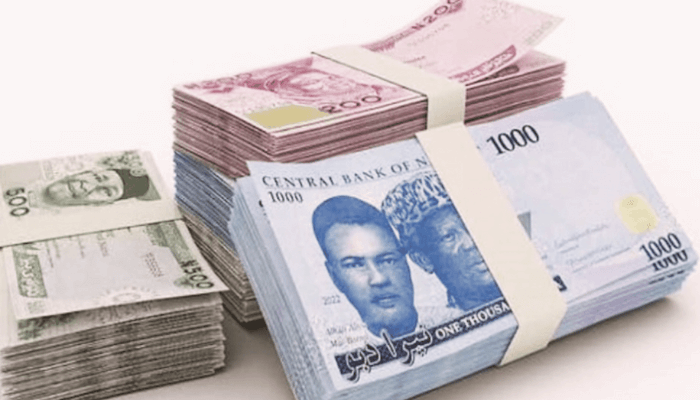
The naira held steady in the official foreign exchange (FX) market on Tuesday, supported by improved market liquidity and stronger external reserves.
- +Naira holds steady on improved FX liquidity
Data published by the Central Bank of Nigeria (CBN) showed the naira appreciated by N2.28 as the dollar was quoted at N1,362.55 on Tuesday, compared with N1,364.83 recorded on the previous trading day at the Nigerian Foreign Exchange Market (NFEM).
Data published by the Central Bank of Nigeria (CBN) showed the naira appreciated by N2.28 as the dollar was quoted at N1,362.55 on Tuesday, compared with N1,364.83 recorded on the previous trading day at the Nigerian Foreign Exchange Market (NFEM).
In the parallel market, also known as the black market, the local currency closed at N1,412 per dollar on Tuesday, representing a 0.21 percent gain from N1,415 recorded previously. The gap between the official and parallel market exchange rates widened slightly to 3.7 percent from 3.5 percent last week.
Total turnover at the interbank segment of the FX market increased by 13.99 percent to $156.23 million on Tuesday from $137.05 million recorded on Monday. The number of deals remained largely stable, rising marginally to 139 transactions from 138 recorded a day earlier.
Although NFEM turnover and deal figures for Tuesday were unavailable as of the time of filing this report, trading activity had strengthened significantly earlier in the week. The number of deals jumped by 50 percent to 333 on August 3, 2026, from 222 recorded on July 31, 2026, while total turnover surged by 130 percent to $532.25 million from $231.41 million over the same period.
Nigeria’s external reserves, which provide the CBN with the firepower to support the naira and meet external obligations, have continued to strengthen, rising to $51.94 billion as of August 3, 2026. This represents a 30.47 percent increase from $39.81 billion recorded on August 4, 2025, according to data published on the CBN’s website.
According to analysts at Quest Merchant Bank, Nigeria’s gross external reserves increased by $1.9 billion to $51.5 billion in June 2026 and were up by $2.3 billion on a quarter-on-quarter basis. The increase marked the second consecutive month of reserve accretion after temporary drawdowns in March and April, which were largely attributed to seasonal external debt-servicing obligations.
The analysts said the sustained recovery in external reserves has been driven by several factors. Despite a more uncertain global environment, foreign portfolio inflows have remained resilient, supported by Nigeria’s attractive carry trade opportunities arising from the CBN’s prolonged tight monetary policy stance.
They noted that elevated domestic yields, improved market liquidity, stronger external buffers and a more stable foreign exchange environment have further boosted investor confidence. The reserve position has also been supported by stronger export receipts, reflecting higher crude oil prices and a steady improvement in Nigeria’s crude oil production.
Quest Merchant Bank added that Nigeria’s external reserves are sufficient to cover 14.4 months of merchandise imports based on the balance of payments for the 12 months to December 2025, and 9.9 months when imported services are included.