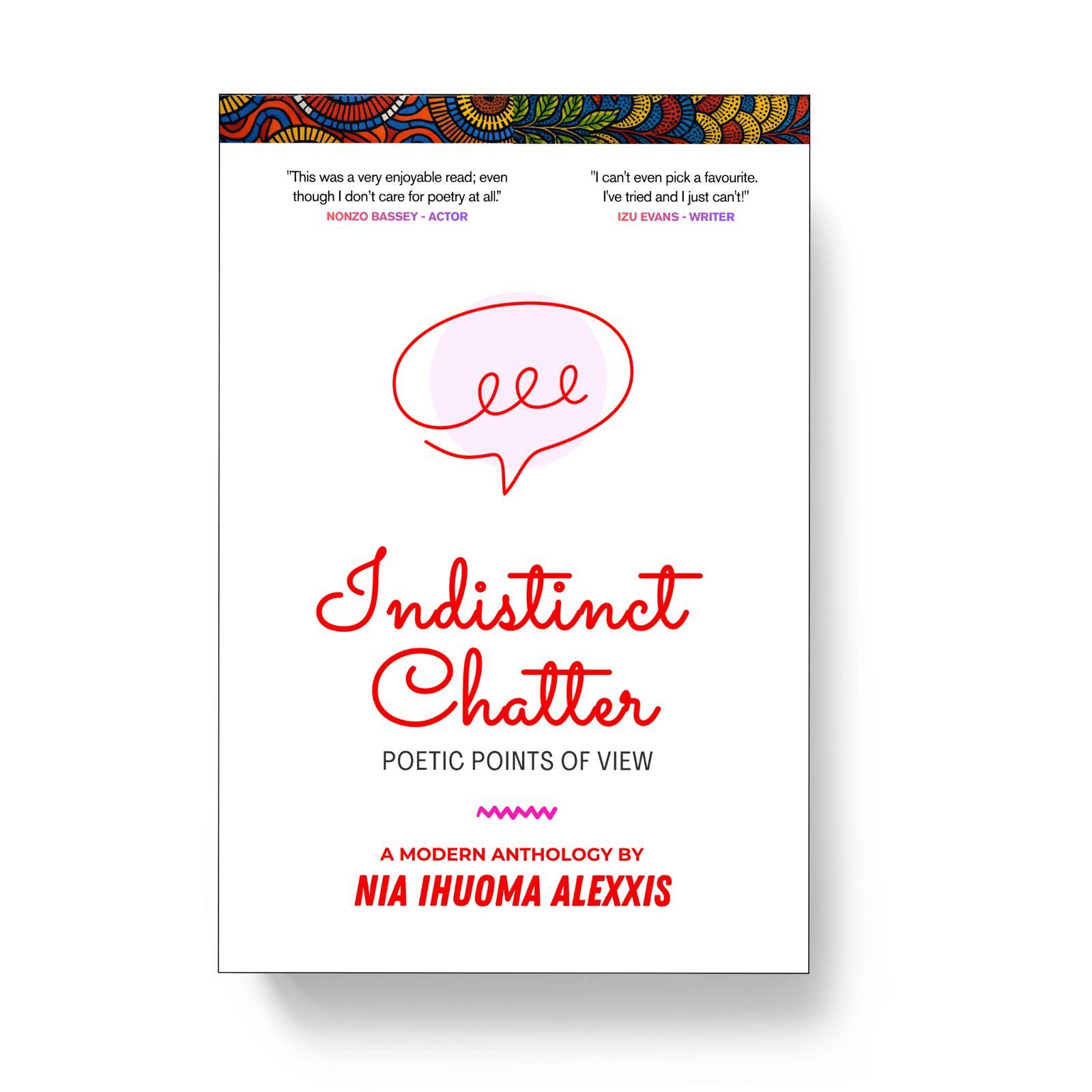
Poetry for people who think they don’t like poetry, and also for those who love it too much
- +INDISTINCT CHATTER: Poetic Points of View
- +Nigeria’s Free Verse Tradition
- +Conclusion: a confident, courageous, and deeply human debut
Writerly Press, Lagos, 2026.
Writerly Press, Lagos, 2026. 144pp.
I’ll be honest: I approached this collection warily. Poetry debuts can be precious things—overwrought, self‑conscious, desperate to impress. The collection is also close to home.
But Indistinct Chatter caught me off guard from its very first pages. It opens with a diptych that gives voice to Israel and Palestine, not as abstract political blocs but as wounded, defensive, almost recognisable human speakers. That takes guts and skill. Nia Ihuoma Alexxis has both.
The organising idea is wonderfully simple: every poem is a first‑person monologue, yet the “person” shifts constantly. Sometimes it’s a woman staring at her own body in “Heavy Wait”; sometimes it’s a nation, a parent, a scammer, even the concept of anxiety itself. The effect is like overhearing fragments in a crowded room—overlapping, sometimes contradictory, yet always alive. You never feel the poet is showing off; you feel she’s listening, then transcribing.
What struck me most is how accessible the language is. This isn’t the kind of poetry that demands a dictionary or a PhD. Alexxis writes in the idioms we actually speak: jollof, danfo, Aso Oke, WAEC, the casual “Kini gini?” that peppers Lagos chatter. And yet the poems don’t feel slight. They tackle body image, caregiving, parental pressure, queer denial, prosperity gospel, even the dread of AI replacing us (look out for “The Futility of Everything”—a brilliant, unnerving piece). She moves from satire to grief to tenderness without whiplash, because the voice always feels grounded in a real person.
My favourite pieces are those that leave you in ambivalence. This reviewer is particularly taken by the Israel/Palestine diptych and “The Death of Silence,” whose ambivalence echoes the conflicted tenderness of Jim Reeves’ “But You Love Me, Daddy.” The poem closes with a disarming paradox: You have ruined my life In the most beautiful way… I love you I adore you …and I did not consent to any of it Sincerely, Your reluctant aunty.
That’s the kind of honesty that makes you wince and nod at the same time. Similarly, the Israel/Palestine exchange doesn’t resolve anything—it simply lets both sides speak and trusts you to sit with the discomfort.
Of course, not everything lands perfectly. A few of the satirical monologues—the pastor, the “pick‑me,” the absentee father—feel a bit on the nose and may put off readers who don’t immediately catch the irony. There’s also a tendency, in a handful of poems, to tell rather than show; the abstractions pile up when a single concrete image would have done more. But these are minor gripes in a debut that mostly knows what it’s doing.
Technically, Alexxis has a good ear for line breaks. She knows when to isolate a single word— “small” in “Heavy Wait” sits alone on the page and breaks your heart—and she shifts registers effortlessly, from bureaucratic coldness to intimate confession. The free verse never feels sloppy; it feels chosen.
The poet tackles a broad range of issues that traverse intimate and public terrains:
• Body image and deferred living (“Heavy Wait”). • Ambivalent caregiving and the shock of attachment (“The Death of Silence”). • Parental expectation and career determinism (“a posteriori”). • Gender, sexuality, and social performance—effeminacy, “hard” fatherhood, ageing, feminist contestation, queer denial, materialism. • National personification and civic anger (“Heart and Might”). • Satire on scamming, influencer culture, prosperity religion, iPhone fetishism, and romantic exploitation. • Anxiety, disability, coercive parenthood (“Papa Bear”). • Existential unease—AI displacement and probabilistic fear.
I should mention that this collection arrives at a timely moment—2026 is poetry’s turn in the Nigeria Prize for Literature cycle, so all eyes are on the form. Indistinct Chatter meets that attention not by being difficult, but by being startlingly human. It’s poetry for people who think they don’t like it, and for those who love it too much.
In the end, I found myself returning to the preface—a grief poem Alexxis wrote at thirteen about losing her mother. It sets the emotional tone for the whole book: poetry can be a way of holding on to what you’re afraid to lose. This collection feels like that—a holding, a listening, a gathering of voices that might otherwise remain indistinct.
The collection’s greatest asset is its unflinching emotional honesty. Alexxis possesses a rare gift for emotional transcription, refusing to sanitise or prettify human experience. The opening poem, written when the author was just thirteen, is a raw, unpublished elegy for her mother: “I’m crying, I’m weeping… / My eyes are red. My bedsheet is soaked…”. It sets an uncompromising tone. Grief is not intellectualised; it is felt. This honesty extends into uncomfortable territory: the poem about a predatory pastor (“Machiavellian maven in a liturgical robe”) is genuinely chilling in its self-awareness, while “The Death of Silence” captures the ambivalence of reluctant love with startling precision.
It would seem that Alexxis found expression for her courage through the adoption of free verse. A word, then, on that form.
Nigeria’s Free Verse Tradition
Indistinct Chatter joins a rich Nigerian tradition of free verse poetry that stretches from the political engagements of Niyi Osundare to the revolutionary struggles documented by Ebinyo Ogbowei, from the versatile explorations of Akachi Adimora-Ezeigbo to the contemporary voices of Seyi Ojenike and Osadolor Osayande.
Alexxis’s work demonstrates that free verse is not about the absence of structure but about finding an organic form for each feeling or idea—a form not imposed from outside but growing from the poem itself. The collection signals a shift in poetry’s philosophy: from expressing universal truths through shared, objective structures to centring subjective, individual experience.
Conclusion: a confident, courageous, and deeply human debut
Indistinct Chatter is a confident, courageous, and deeply human debut. Alexxis has created space for voices usually relegated to the background—the “chatter” most people ignore—and has given them not only a microphone but also a stage. Her insistence on directness, refusal to sanitise, and willingness to inhabit uncomfortable perspectives mark a writer of genuine vision.
I watched Ihuoma grow as a writer and mass-communication student—painfully shy, curling in on herself at the first touch of praise or criticism. It is a joy to see her come into full bloom. She has my blessings to write even more work that showcases her tremendous gifts.
In this work, the designer of the cover of my Media Relations Playbook provides the cover art for her own book, Indistinct Chatter.
Highly recommended. Just don’t expect to walk away unchanged.