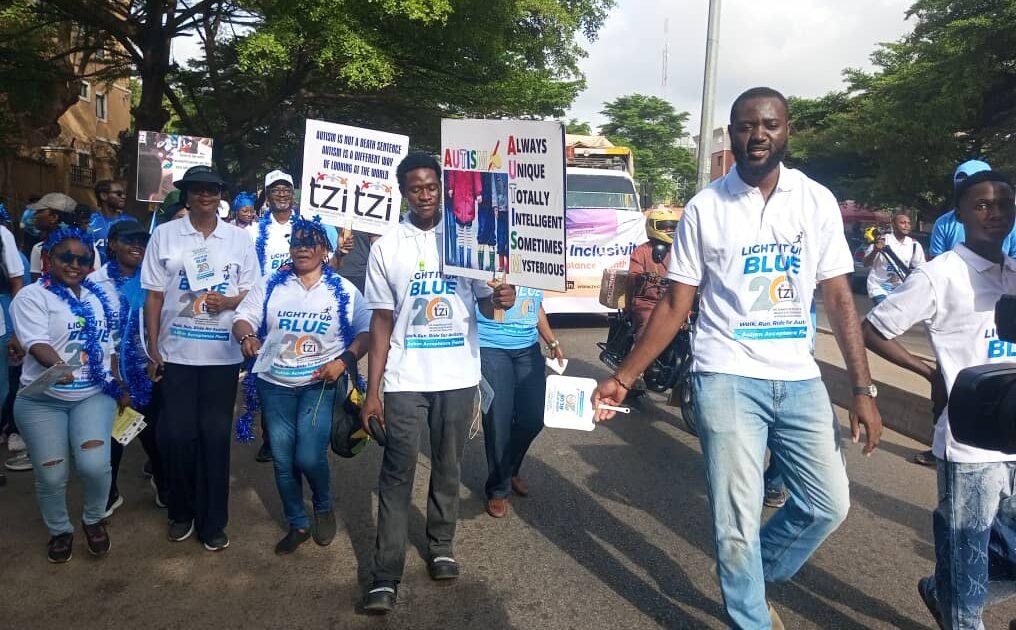
The Founder and Chief Executive Officer of the Zamarr Institute Centre for Children and Adolescents with Special Needs, Oluronke Katagum, on Saturday led calls for greater acceptance of persons on the autism spectrum, urging society to embrace neurodiversity and support inclusive development.
- +Autism advocates urge acceptance, stronger support for neurodiverse children
Speaking after a commemorative walk held from Jabi to Wuse Berger in Abuja to mark Autism Acceptance Month, Katagum stressed that the focus must shift from awareness to full societal acceptance.
Speaking after a commemorative walk held from Jabi to Wuse Berger in Abuja to mark Autism Acceptance Month, Katagum stressed that the focus must shift from awareness to full societal acceptance.
“This is Autism Awareness Month. It is no longer just about awareness; it is about acceptance. What we want in our society is for all of us to be able to walk together and celebrate our differences. Let’s celebrate neurodiversity.
“This walk is being organised by Zamarr Institute, which is celebrating 20 years of providing special needs assistance,” she noted.
The event, themed ‘Light It Up Blue: Walk, Run, Ride for Autism,’ drew participants, including children with special needs, caregivers, and advocates.
The CEO highlighted the uniqueness and potential of children on the autism spectrum, citing the example of one of the participants.
“Erioluwa was non-verbal until the age of seven, but now he is very smart and intelligent. He knows all the states of the country and all the presidents.
“He knows so much and is still eager to learn more,” the CEO said.
Katagum emphasised the need for improved support systems, noting that children with special needs have valuable contributions to make to society.
“We must do more. We have to provide a lot more for persons with special needs, especially for children who are neurodiverse, because they have a lot to offer.
“Around the world, you see people with special needs integrating into society. Let us do the same here and stop criticising and condemning our differences,” Katagum stated.
The CEO identified stigma and financial limitations as major challenges confronting families and institutions supporting children with special needs.
“My children face stigmatisation because we often frown at differences, and that is what we want to change. Finance is also a challenge.
“Even now, we are planning a fundraising event at the end of May because we want to raise funds to build a respite centre where our children can stay while their parents take a short break,” she said.
The institute, which currently cares for 25 children on a day basis, is seeking to raise N250m to establish a special needs facility, adding, “We will also need funds for sustainability, even though we have other plans that will help subsidise and support the project.”
Katagum also called for increased government involvement, noting ongoing collaboration with the Ministry of Women Affairs to harmonise efforts and strengthen advocacy.
“The government needs to participate more and provide greater support. I think the private sector believes the government is not interested, but I believe that once we engage them properly, they will respond.
“Even now, the Minister for Women Affairs, Imaan Sulaiman-Ibrahim, wants to bring all the organisations together so we can have a unified voice.
“Instead of working separately, the Ministry of Women’s Affairs can serve as the coordinating body, especially for autism, because there is a bill that is expected, and I am confident it will be refined to work for everyone,” she explained.
One of the special needs children, Enoch, shared his enthusiasm for learning.
“I have learnt a lot. I really love animals so much. I know the different species across the world and other things like space and the universe,” he said.
Autism, a developmental condition characterised by challenges in communication, social interaction, and behaviour, affects an estimated one per cent of the global population. Experts say early diagnosis and intervention remain critical in improving outcomes for individuals on the spectrum.