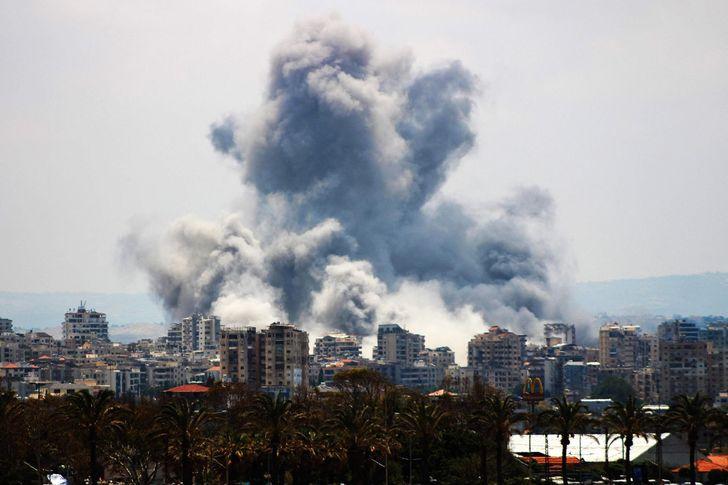
Fighting persists in southern Lebanon despite Israel and Hezbollah agreeing to a US-backed ceasefire proposal.
- +Clashes Continue In Lebanon Despite Israel-Hezbollah Ceasefire Deal
Fresh exchanges of fire occurred in southern Lebanon even after Israel and Hezbollah accepted a US proposal aimed at reducing hostilities, highlighting the fragile nature of the latest ceasefire effort.
Fresh exchanges of fire occurred in southern Lebanon even after Israel and Hezbollah accepted a US proposal aimed at reducing hostilities, highlighting the fragile nature of the latest ceasefire effort.
US President Donald Trump said he had spoken with both sides and that they agreed to halt attacks after Iran warned that Israeli military actions in Lebanon could jeopardise the US-Iran ceasefire.
Lebanese authorities said Hezbollah accepted a plan under which it would stop attacks on Israel while Israel would refrain from targeting Beirut. Israeli Prime Minister Benjamin Netanyahu also confirmed the arrangement.
Netanyahu, however, stated that strikes on Beirut could resume if Hezbollah continued attacking Israeli cities and civilians. He also maintained that Israeli forces would remain active in southern Lebanon.
Despite the agreement, Hezbollah said its fighters targeted Israeli tanks in the towns of Haddatha and Bayada using missiles and artillery shells overnight.
The Israeli military later announced that it intercepted two projectiles launched from Lebanon during the early hours of Tuesday. No injuries were recorded.
Lebanon’s National News Agency said Israeli strikes hit several southern locations, while a powerful explosion linked to a large-scale demolition shook the town of Debbine.
Earlier on Monday, Netanyahu said he had ordered attacks on what he described as terrorist targets in Beirut’s southern suburbs following Hezbollah rocket and drone attacks.
The move prompted strong reactions from Tehran. Iranian Foreign Minister Abbas Araghchi said the ceasefire between the United States and Iran applied to all fronts, including Lebanon, and warned that violations in Lebanon would amount to violations of the wider truce.
Iran’s Tasnim news agency also reported that Tehran could suspend indirect talks with Washington over Israeli military actions in Lebanon. The agency added that Iran and its allies could activate other fronts, including the Bab al-Mandab Strait at the entrance to the Red Sea.
Trump later insisted that negotiations with Iran were continuing at a rapid pace and described his conversations with both Netanyahu and Hezbollah representatives as productive. He said Israeli troops would not enter Beirut and that both sides had agreed to stop shooting.
Lebanon became involved in the wider conflict on March 2 after Hezbollah launched rockets into Israel following an Israeli strike that killed Iran’s supreme leader. Israel responded with an air campaign across Lebanon and a ground operation in the south.
According to Lebanon’s health ministry, at least 3,433 people have been killed since the conflict began. The figures do not distinguish between civilians and combatants. Israel says 25 soldiers and four civilians have died over the same period.
The United States has sought to separate developments in Lebanon from negotiations with Iran, although Tehran continues to insist that any future agreement must include peace in Lebanon.
A US official said Secretary of State Marco Rubio proposed a plan for gradual de-escalation to Netanyahu and Lebanese President Joseph Aoun.
Israel has struck Beirut twice since the Israel-Lebanon ceasefire came into force on April 16, most recently on Thursday. However, such attacks have become less frequent amid reports that the White House has been encouraging Israel to limit military action in Beirut as part of wider efforts to end the conflict with Iran.
Meanwhile, the separate ceasefire between the United States and Iran, which took effect on April 8, has failed to completely halt hostilities. Tensions rose again over the weekend after the US said it struck Iranian military sites and Tehran claimed it responded by targeting an American base in Kuwait.
The renewed exchange of attacks pushed oil prices higher on Monday. Brent crude climbed by almost $5 a barrel to $97.44 before easing to $95.70.
Oil markets have remained volatile since Israel and the United States launched strikes on Iran on February 28, with both diplomatic developments and military escalations influencing prices.
The three-month conflict has effectively closed the Strait of Hormuz, a vital route through which around one-fifth of the world’s oil and liquefied natural gas supplies normally pass.
Trump has repeatedly said Washington and Tehran are close to reaching a permanent agreement, but no formal deal has yet been concluded.