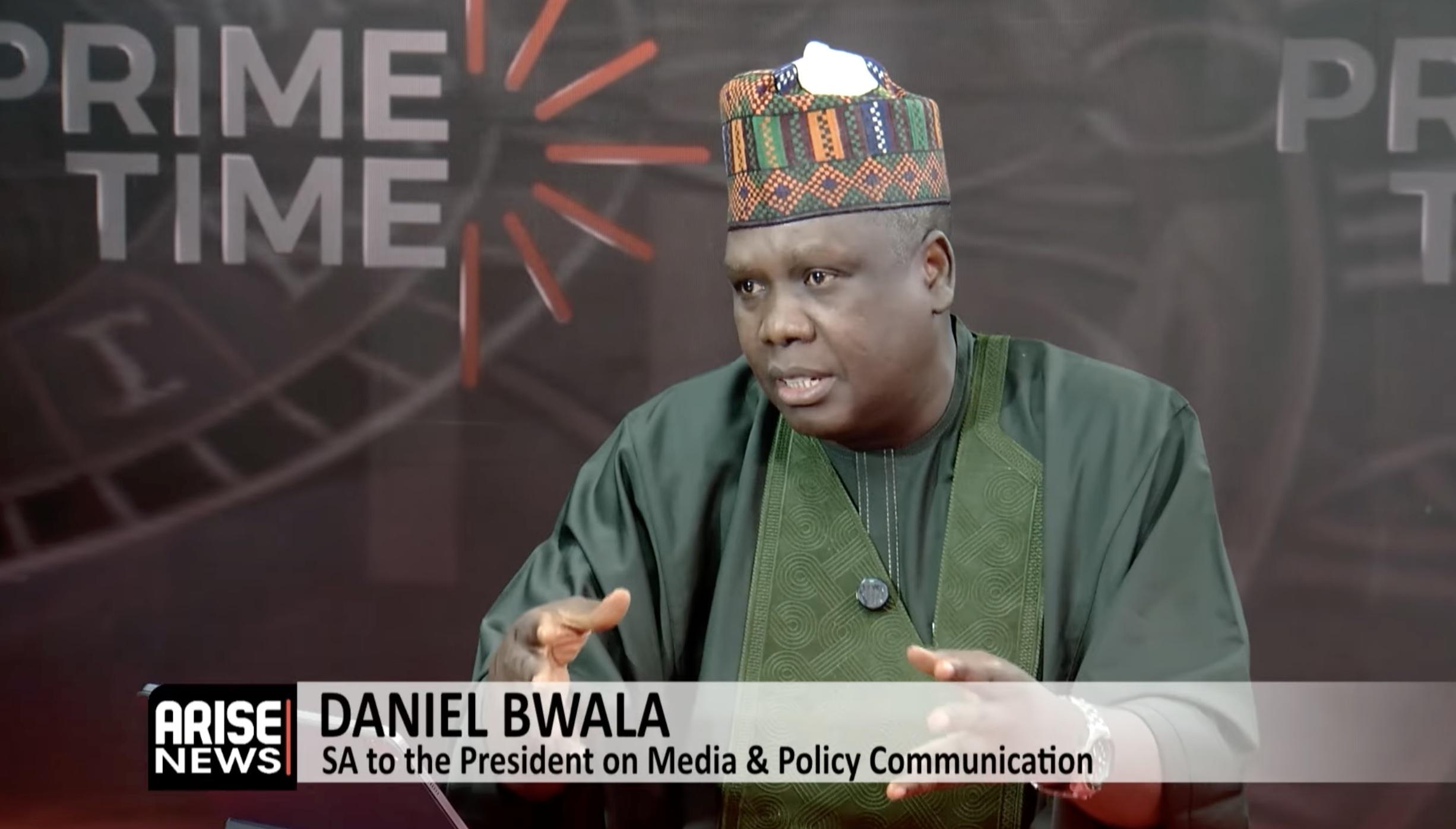
Daniel Bwala: Population, Infrastructure Deficit Are Why Nigerians Are Not Feeling Tinubu’s Economic Reforms
Daniel Bwala says Nigeria’s large population and infrastructure deficit explain why citizens are yet to feel economic reforms’ benefits.
Daniel Bwala says Nigeria’s large population and infrastructure deficit explain why citizens are yet to feel economic reforms’ benefits.
A special adviser to President Bola Ahmed Tinubu on Media and Policy Communication, Daniel Bwala, has attributed the slow impact of President Bola Tinubu’s economic reforms on ordinary Nigerians to the country’s large population and significant infrastructure deficit, noting that available resources remain insufficient to meet growing national needs.
“The answer is simply population and resources. The population is over 230 million. The resources we have, however—even with the increased revenue—are not enough to match the population and the deficit in terms of infrastructure. So, growth will inevitably be slow, but it will be slow, steady, and consistent,” he stated.
He said this while speaking in an interview with ARISE NEWS on Tuesday.
Bwala maintained that increased federal revenue is already translating into higher state allocations, which he said are improving governance and delivering tangible and state-level interventions.
“When you talk about the increased revenue, the effect of that increased revenue is the higher allocation to states, which has resulted in state administration improvements and has also impacted the people. So, the increased revenue is directly proportional to the positive effect that we see in states because of the increased allocation.”
Refusing to engage in state-by-state comparisons, Bwala said his focus remains on federal reforms, arguing that their outcomes are reflected across various states.
” I am actually not here to start talking about state versus state because it would take away from my job description, which is to talk about what the federal government is doing, the concomitant effect of which is seen in the states. I appreciate the fact that Abia is doing a lot in its state, but I can tell you that for me, based on stats and facts on the ground, Enugu far outpaces Abia in terms of tangible infrastructure,” he claimed.
Outlining key interventions by the Tinubu administration, Bwala cited programmes such as the student loan scheme (NELFUND), CNG transportation initiative, and healthcare subsidies including dialysis and Caesarean section support, arguing that these policies are directly benefiting low-income Nigerians and would reach far more people if additional resources were available.
“The federal government and the government of President Bola Ahmed Tinubu have introduced policies that have affected the common man on the street. For example, when we talk about over one million beneficiaries of the Student Loan Fund (NELFUND), these are not children of the rich; these are children of the poor. Without the intervention in this regard, they may not have had the opportunity to achieve their dreams. That is a direct impact on the poor.
“When we talk about transportation, look at what the CNG initiative has done. The direct effect is on the poor man.
“When we talk about healthcare, look at the Caesarean section initiative I told you about last time, and look at the 50% subsidy on dialysis. These are for poor people because rich people don’t need that; most of them go abroad. So, every policy introduced by this government has the poor as its direct beneficiaries,” he maintained.
Speaking on how much the Tinubu administration has reduced poverty in Nigeria, Bwala said progress should be assessed using data and surveys rather than perception, adding that macroeconomic improvements may take time to reflect in household living conditions.
“This is where we then start to look at numbers and stats. The argument most people make is that the administration appears to be too focused on macroeconomic indicators. That’s what you always see in the papers: this percent, that percent, inflation is coming down, all kinds of things. They are not focused enough on household economics. I think that it is the argument—so you are celebrating numbers while citizens are counting their losses. That’s a fact.”
Defending the Tinubu administration’s social intervention programmes, Bwala reiterated limited resources and Nigeria’s large population constrain poverty reduction.
“My answer would be the population. For those who do economics and understand planning, no matter the acumen, if the resources you have are so scarce and the population is overwhelming,” he maintained.
Bwala defended the administration’s security efforts, citing recent military operations, airstrikes, and rescue missions as evidence of ongoing progress against insurgents and kidnappers, while stressing that government actions should be recognised alongside reports of continued insecurity across the country.
“In the month of May alone—and we acknowledge the fact that we have seen these activities of the insurgents and the bandits—it is so unfortunate that it is happening at a time when we are close to an election, which you see most of this crisis-economy taking place. But we try to tell Nigerians, because there are individuals who are in the forest as we speak tonight, who lose their loved ones because they are dying in the forest so we can have a free life. It would not be fair to our security forces in the bush, in the desert, and in towns engaging with these terrorists for us to sit here and talk about no successes being made.
“In the month of May alone, A joint air strike between the Nigerian and US forces killed 175 terrorists in the Northeast. Several foreign ISIS trainers from Iraq were allegedly among the people killed. Two days later, there was a strike that also resulted in massive casualties. What I am saying is the report. Air strikes reportedly neutralized about 176 terrorists.
“A joint military operation with the US two days later, on the 30th of May, also killed about 21 ISWAP members. Their camp was completely destroyed. The troops of the 12th Brigade of the Nigerian Army rescued 23 kidnapped passengers in Kogi. Troops rescued 31 kidnapped victims and neutralized 5 terrorists. On the 19th of May, troops of the 4th Brigade of the Nigerian Army arrested 12 suspected kidnappers and collaborators, and a drug operation kicked in. They were nabbed.
“While we talk about the suffering, the killings, and the kidnappings going on, we also as a government deem it fit to bring to the Nigerian people the progress that the Nigerian government and President Bola Ahmed Tinubu’s administration is making in this regard. This is a way of encouraging them to know that the government is doing its best, and we are going to put that behind us,” he assured.