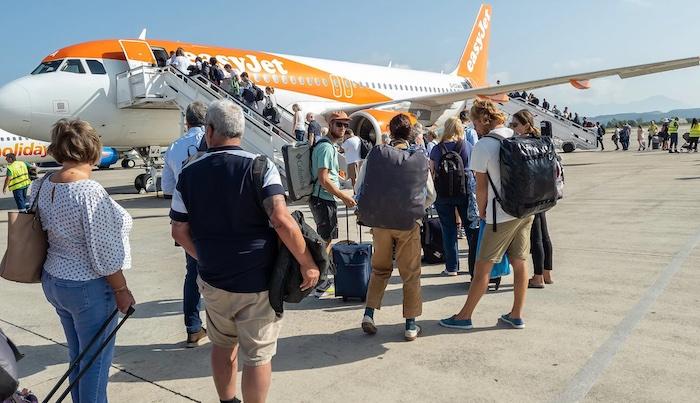
EasyJet Flight Diverted To Rome After Passenger’s Power Bank Found Charging In Aircraft Hold
Flight diverted midair after passenger reported a charging power bank inside checked luggage, triggering aviation safety precautions.
Flight diverted midair after passenger reported a charging power bank inside checked luggage, triggering aviation safety precautions.
An EasyJet flight travelling from Egypt to the United Kingdom was forced to divert to Rome after a passenger reported that a power bank stored in checked luggage was charging in the aircraft hold, prompting safety concerns over lithium-ion battery risks.
Flight EZY2618, travelling from Hurghada, Egypt, to London Luton, was diverted to Rome Fiumicino Airport on Tuesday night as a precautionary measure in line with aviation safety regulations.
According to flight tracking data from FlightRadar24, the aircraft had been cruising at 36,000 feet for nearly three hours over the Adriatic Sea when it suddenly changed course, making a sharp left turn before landing in Rome about 20 minutes later.
EasyJet later confirmed that the diversion was triggered after a passenger informed cabin crew during the flight that a portable charger had been left charging inside luggage stored in the aircraft hold.
Although there was reportedly no malfunction or fire involving the device, aviation regulations prohibit power banks from charging in an aircraft’s cargo hold because lithium-ion batteries can overheat or ignite.
The airline said passengers disembarked safely and the flight was rescheduled for the following day.
In a statement, an EasyJet spokesperson said:
“The aircraft landed safely and passengers disembarked routinely and we provided hotel accommodation and meals where available. As some customers remained in the airport, they were provided with refreshments.”
“The safety of its passengers and crew is EasyJet’s highest priority and EasyJet operates its fleet of aircraft in strict compliance with all manufacturers’ guidelines.”
The airline also apologised to affected passengers, saying:
“We would like to apologise to all passengers for any inconvenience caused by the diversion and subsequent delay.”
EasyJet’s regulations state that power banks are only permitted in cabin baggage and are prohibited from being used during flights to charge other electronic devices. The airline allows a maximum of two power banks per passenger, provided they do not exceed 160 Watt-hours and are individually protected, either in original packaging or inside plastic bags.
The incident reflects growing concerns within the aviation industry over lithium-ion battery safety. Airlines worldwide have tightened restrictions on portable chargers because fires involving such batteries are easier to detect and extinguish inside the cabin than in the cargo hold.
Ryanair similarly bans power banks from checked luggage and overhead compartments and prohibits their use during taxiing, take-off, and landing. British Airways also limits power banks to 100 Watt-hours and requires them to be stored under seats or in seat pockets rather than overhead bins.
The International Civil Aviation Organisation (ICAO), a United Nations agency, introduced stricter rules on power banks in March following a series of battery-related incidents globally.
In November 2025, a man suffered burns to his leg and fingers after a lithium power bank in his pocket caught fire at Melbourne International Airport.
Earlier, in January 2025, South Korean authorities said a portable power bank was the likely cause of a fire that destroyed a passenger aircraft, leaving three people with minor injuries.