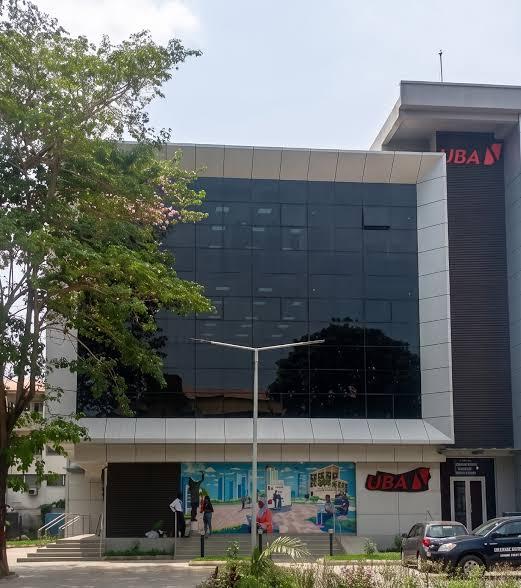
Demonstrating its expanding footprint in Nigeria’s tertiary education sector, the United Bank for Africa (UBA) has unveiled an ultramodern branch at the University of Lagos (UNILAG), as its customer base within the university community climbs beyond 80,000.
- +UBA unveils ultramodern UNILAG branch, hits 80,000 customers
Oliver Alawuba, group managing director, UBA, speaking at the commissioning ceremony on Monday, said the landmark project speaks for the partnership, legacy, education, and shared beliefs between the bank and UNILAG.
Oliver Alawuba, group managing director, UBA, speaking at the commissioning ceremony on Monday, said the landmark project speaks for the partnership, legacy, education, and shared beliefs between the bank and UNILAG.
“It is a renewal of our relationship with UNILAG, which we’ve entered for decades now. We were the first bank to open a branch in any university, and it had to be the University of Lagos; and today, that branch has over 80,000 customers.
“That represents the shared trust, and the friendship that we have. e believe UBA branch is the right investment, because we are investing in African students,” he said.
Alawuba emphasised that the bank believes in the future of Africa, and that it is through education, and African youth that answers to the calls of the local responsibility can be met.
This drive, he said is the bank, through the UBA Foundation, a non-governmental organisation is organising essay competitions around African countries.
“We are donating to one African countries, and we are going to contribute so much to sustainable development,” he said.
Folasade Ogunsola, vice-chancellor, UNILAG, in her speech, described the building as a symbol of what industry and university partnership looks like.
“This is a structure that is both a banking facility serving a vibrant campus community and a purposeful contribution dedicated to academia.
“This building is not just about brick and mortar, but it is a symbol of what industry and university partnership looks like,” she said.
Ogunsola said that UNILAG was established in 1962, with a mandate to produce graduates who would drive the engines of national development, and that from the very beginning, it was understood that the institution would not be an ivory tower.
“It would be a place where knowledge met purpose, and where the life of the nation found its intellectual heartbeat.
“It is therefore entirely fitting, and a matter of institutional pride, that when the question arose of which bank would be the first to establish a presence on this campus, it was UBA that answered the call. UBA was the first bank to set up in this university,” she noted.
In addition, the vice-chancellor, said, “Today, as we commission this new building, a permanent purpose-built structure, depicting the relationship between two iconic institutions, we are not starting a new chapter.
“We are deepening one that has been building for decades. We are also positioning for the future of Africa, a prosperous Africa, and a Nigeria that is not only pan-African in our view, but sits at the centre of the prosperity of Africa.”
To achieve this development, Ogunsola said requires looking both inwards, working together as a people, as well as outwards, reaching out to embrace more countries.
Reflecting a corporate philosophy of genuine investment in human capital, she said UNILAG recognise and applaud UBA’s commitment to youth, to education, and to the future of this continent.
“Today, with the commissioning of this building, which gives two floors to the university to support our academic and operational programmes, UBA has made a concrete brick-and-mortar declaration of faith in this institution. It is not a small thing.
“In a time when public universities across Africa fight for resources, having an institution of UBA’s stature invests in our infrastructure and in our human capital development,” she said.
Adedoyin Lawal, current chair-occupier of the UBA professor of finance at the Department of Finance, UNILAG, said the chair office has a budget of about $60 million, and we want to prepare Nigerian youth through curriculum development to be able to fill the fintech skills gap.
“We’ve done the first phase of the drafts. We drafted four curriculum for FinTech. One for BSc in financial technology, second one MSc for financial technology and third one PhD for financial technology in finance,” he said.