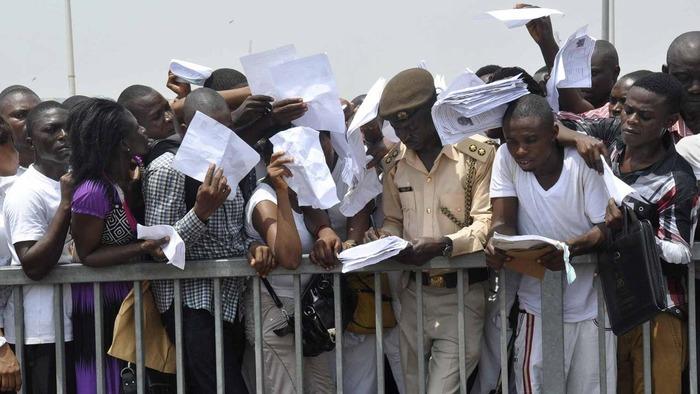
As Nigeria marks another Democracy Day on June 12, scores of young citizens say they have little reason to celebrate.
- +Nigerian youths decry poverty, unemployment despite 26 years democracy
For the generation born after the return to civil rule in 1999, democracy has become less a symbol of freedom and more a painful ledger of broken promises, rising debt, shrinking opportunities and deepening poverty.
For the generation born after the return to civil rule in 1999, democracy has become less a symbol of freedom and more a painful ledger of broken promises, rising debt, shrinking opportunities and deepening poverty.
While politicians deliver speeches about democratic gains, many young Nigerians say they have inherited a country weighed down by debt, unemployment and inflation. To them, democracy’s dividends have been captured by a tiny elite while the majority struggle merely to survive.
A graduate, turned transport operator, Emberga Gabriel, told BusinessDay that recent economic reforms have further worsened the situation for many young Nigerians.
He cited rising fuel prices, inflation, unemployment and declining purchasing power as evidence that democracy’s benefits have not trickled down to ordinary citizens.
“We love our country, but the country doesn’t seem to love us back. When I compare my effort to my income, migration begins to look like the logical option.”
His statement reflects a growing trend among Nigerian youths increasingly considering relocation abroad in search of better opportunities.
Ugwu Blessing, a certified Nurse, said she remains unconvinced that democracy has substantially improved the lives of young Nigerians.
“Despite more than two decades of democratic governance, many young people still face unemployment, poverty, insecurity and limited opportunities,” she said.
“I believe democracy can only make a meaningful difference when governance becomes more accountable and policies genuinely address the needs of young people,” she added.
Many young Nigerians born in the 1980s and 1990s told BusinessDay in separate interviews that they inherited a nation burdened by record debt, soaring inflation, widespread unemployment and a political system that rewards connections over competence.
The International Monetary Fund (IMF) on Tuesday projected that Nigeria’s public external debt could rise from $51.9 billion in 2025 to $72.6 billion by 2027.
At home, public debt has already crossed N159 trillion, with debt servicing consuming a substantial share of government revenues that could otherwise be invested in education, healthcare, innovation and job creation.
For many young Nigerians, those figures are not abstract economic statistics. They represent a future increasingly mortgaged before it even begins.
“I graduated into hopelessness,” said Yakubu Nzuwe, an Accounting graduate of Benue State University, Makurdi.
Like many graduates, Nzuwe from Taraba State told BusinessDay that he believed earning a university degree would provide a pathway to a decent life, But years later, he realised democracy has failed.
“Most of the jobs go to people with connections. Some employers ask for years of experience even when they advertise entry-level positions. Democracy has not given the majority of youths anything to write home about,” he told BusinessDay.
His experience mirrors the reality confronting millions of young Nigerians navigating one of the toughest economic periods in the country’s democratic history.
Observers say many incidents captured the frustration of Nigerian youths. More dramatic is the action of Alvin Ilenre, a graduate of History and International Studies from Ajayi Crowther University, who in December 2023 publicly burnt his academic certificates.
The certificates included his university degree, NYSC certificate and primary school leaving certificate.
Explaining his action, Ilenre said the country’s worsening socio-economic realities had reduced educational qualifications to mere pieces of paper.
His protest sparked nationwide debate and highlighted growing concerns among graduates who believe that years of academic effort no longer guarantee economic mobility.
In Mararaba, Nasarawa State, an automobile mechanic from Edo State, who gave his name as Major Charles, expressed disappointment with the democratic experience.
“Nothing is happening. Democracy is worsening the situation of this country. Sometimes I even think military rule would have been better,” he said.
His comments reflected a dangerous trend emerging among some Nigerians who increasingly measure democracy not by political freedoms but by economic outcomes.
The feeling that democracy has failed to improve living standards is also shared by Mama Aisha, a food vendor in Birnin Kebbi.
“Every week, prices change. Rice, tomatoes, cooking oil—everything keeps increasing. Customers complain, but I am also feeling the heat,” she said.
“When politicians campaign, they promise jobs, empowerment and development. After elections, they disappear,” she added.
Across the country, inflation continues to erode purchasing power, leaving many families struggling to afford necessities.
For Aondongu Daniel Wachin, a diploma holder working in Abuja, the contrast between his generation and that of his father is striking.
“My father retired as a senior police officer. During his youth, he built houses, raised a family and paid school fees comfortably,” he said.
“I cannot even afford a room of my own. What is more painful is watching politicians’ children secure lucrative appointments immediately after graduation. The system works for them, not for us,,” he added.
According to Wachin, Democracy Day carries little meaning when opportunities appear reserved for a privileged few.
“Only those with high-profile connections are benefiting. The youths have been pushed to the background,” he said.
The growing disillusionment among young Nigerians has increasingly manifested in protests and public demonstrations.
Only this week, youths marched to the National Assembly under the banner of “Nigerians Unite Against Terror,” demanding urgent government action against insecurity.
Addressing journalists during the protest, Isah Abubakar, the convener, said insecurity had become a national challenge affecting citizens irrespective of ethnicity, religion or political affiliation.
The demonstration echoed similar protests that erupted in Minna, Niger State, in February 2024, when hundreds of women and youths blocked major roads to protest worsening economic hardship and rising food prices.
The protesters complained that insecurity had prevented farmers from accessing their farms, disrupted schooling and made travel increasingly dangerous. For many young Nigerians, insecurity has become one of democracy’s greatest failures.
In farming communities, bandit attacks continue to threaten livelihoods. In urban centres, kidnapping, armed robbery and violent crime remain persistent concerns. The consequences have been devastating.
In February 2025, a Mass Communication student of the University of Ilorin reportedly took his own life after allegedly becoming overwhelmed by economic hardship.