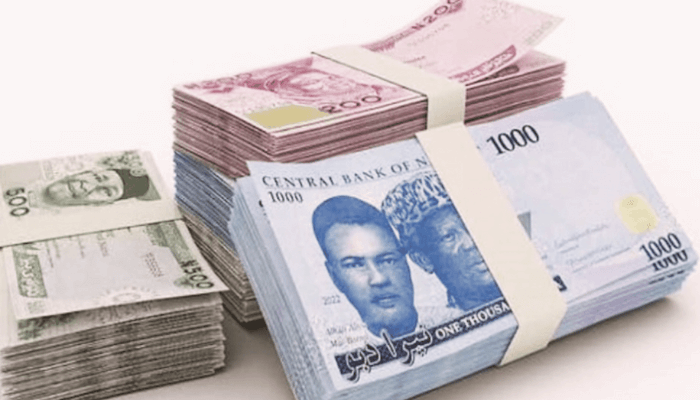
The naira strengthened slightly against the dollar in the official foreign exchange (FX) market on Thursday, despite zero turnover and no recorded deals at the Nigerian Foreign Exchange Market (NFEM).
- +Naira appreciates despite zero turnover
Data published by the Central Bank of Nigeria (CBN) showed that the naira appreciated by N4.52, with the dollar quoted at N1,374.94 on Thursday, representing a 0.33 per cent gain compared with N1,379.46 recorded on Wednesday at the NFEM.
Data published by the Central Bank of Nigeria (CBN) showed that the naira appreciated by N4.52, with the dollar quoted at N1,374.94 on Thursday, representing a 0.33 per cent gain compared with N1,379.46 recorded on Wednesday at the NFEM.
In the parallel market, also known as the black market, the local currency held steady at N1,400 per dollar, unchanged since last week. As a result, the gap between the official and parallel market rates widened to N26 per dollar from N21 recorded on Wednesday.
Nigeria’s external reserves, which provide the Central Bank with a buffer to support the naira, continued their downward trend, declining to $48.36 billion as of 29 April 2026, according to data from the apex bank.
Market activity weakened sharply, with the NFEM recording zero deals on Thursday, down from 393 deals on Wednesday. Total turnover in the official window also dropped from $802.44 million to zero, underscoring a severe liquidity squeeze.
With no trades executed in the official window, price formation was driven entirely by the interbank segment, where turnover also fell significantly to $58.03 million from $249.91 million, suggesting that liquidity pressures extended across the broader FX market.
Analysts note that the naira’s appreciation under such thin trading conditions may not reflect underlying market strength, but rather the impact of limited transactions influencing pricing in an illiquid environment.
Meanwhile, Nigeria’s financial market is undergoing a structural shift with the introduction of the Nigerian Overnight Financing Rate (NOFR), a benchmark designed to improve transparency, strengthen pricing and align the system with global standards.
According to analysts at the Financial Markets Dealers Association (FMDA), a benchmark rate serves as the foundation upon which other interest rates are built. Much like fuel prices influence transport and food costs, movements in benchmark rates affect loan pricing, asset valuation and funding costs across the financial system. In this context, NOFR provides a reference point that helps reduce uncertainty and enhances market transparency.
However, the Central Bank of Nigeria clarified that NOFR does not determine loan margins or total borrowing costs, as these remain dependent on factors such as credit risk, tenor and contractual terms. While NOFR offers a reliable starting point, the final pricing of transactions will continue to reflect the specific risk profile and structure of each deal.