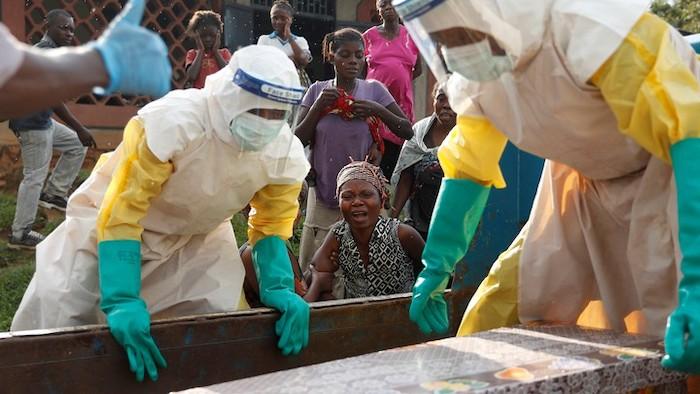
WHO Warns DR Congo Faces ‘Catastrophic Collision’ Of Ebola Outbreak And Conflict
- +“We cannot build community trust or isolate the sick while bombs are falling.”
- +“Stopping transmission in the region depends entirely on humanitarian access.”
- +“We’re still far behind having a control on the situation.”
WHO says conflict in DR Congo is crippling Ebola response as infections outpace containment efforts in affected regions.
WHO says conflict in DR Congo is crippling Ebola response as infections outpace containment efforts in affected regions.
The World Health Organisation has warned that ongoing conflict in the Democratic Republic of the Congo is severely undermining efforts to contain a growing Ebola outbreak in the country’s eastern region.
WHO Director-General Tedros Adhanom Ghebreyesus described the situation in Ituri province as a “catastrophic collision” between disease and armed conflict, saying the outbreak was spreading faster than response efforts.
“The east of the country was at the centre of a ‘catastrophic collision of disease and conflict’ with the Ebola outbreak in Ituri province outpacing the response.”
Tedros said insecurity and violence were making it impossible for health workers to build trust within communities and isolate infected patients effectively.
“We cannot build community trust or isolate the sick while bombs are falling.”
The WHO chief is expected to arrive in DR Congo on Wednesday to help scale up emergency operations aimed at containing the outbreak, which has already recorded 220 suspected deaths since it was declared.
Health workers and aid organisations are facing major logistical difficulties as conflict, displacement and damaged infrastructure continue to weaken the healthcare system.
“Stopping transmission in the region depends entirely on humanitarian access.”
Tedros warned that ongoing fighting was forcing displaced people into overcrowded camps and disrupting disease containment efforts.
“Yet ongoing clashes are driving mass displacement, pushing exposed contacts into overcrowded camps and severing critical containment corridors.”
He added that attacks on medical facilities were making surveillance and contact tracing increasingly difficult.
“Frontline workers are risking everything, while attacks on health facilities make tracking cases and their contacts nearly impossible.”
The WHO chief called for an immediate ceasefire to allow medical teams safe access to affected communities.
Concerns over the possible international spread of the virus have prompted several countries to tighten border controls and travel restrictions.
Canada announced a temporary 90-day entry ban on residents from DR Congo, Uganda and South Sudan, while the Bahamas introduced quarantine and isolation measures for travellers from the affected countries.
Last week, the United States also barred non-citizens who had recently travelled to the three countries from entering.
Congolese authorities say around 1,000 people are currently showing symptoms linked to Ebola, although only 17 deaths have so far been confirmed through laboratory testing.
The outbreak involves the rare Bundibugyo strain of Ebola, for which there are currently no approved vaccines or medicines.
Médecins Sans Frontières said it could take several weeks to establish the infrastructure needed to contain the outbreak effectively.
MSF country director Ewald Stals said limited testing capacity and insecurity meant health workers were still struggling to understand the full scale of the outbreak.
“We’re still far behind having a control on the situation.”
He added: “As long as that is the case, we kind of can say that we’re running behind the virus, that the virus is still ahead of us.”
The European Centre for Disease Prevention and Control said on Wednesday that it would increase its deployment of experts to the region through the EU Health Task Force.