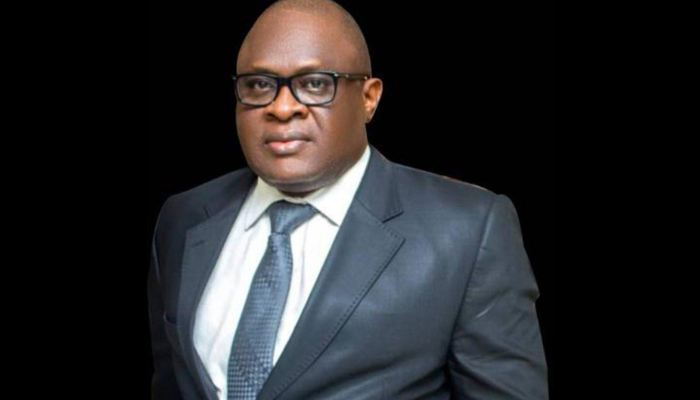
Sylva Opuala-Charles, a professor and president of Garden City Premier Business School, Port Harcourt, and one-time commissioner for Finance in Bayelsa State, has experience that spans both the public and private sectors of the economy. In this interview with SAMUEL ESE in Port Harcourt,
- +Blue Economy needs blueprint for actionable plan in Nigeria – Opuala-Charles
he discussed the huge potentials of Nigeria’s Blue Economy, the challenge of environmental pollution, and infrastructure, but stressed the need for action by developing a blueprint to galvanised action among the three tiers of government.
he discussed the huge potentials of Nigeria’s Blue Economy, the challenge of environmental pollution, and infrastructure, but stressed the need for action by developing a blueprint to galvanised action among the three tiers of government. But he also believes that the organized private sector led by the various chambers of commerce, BRACED Commission and governments of South-South states should start the conversations. Excerpts:
There has been this talk about the Blue Economy in recent times and its huge potentials. What are the prospects of the Blue Economy in Nigeria?
The Blue Economy actually has to do with the sustainable use, access and conservation of sea and ocean resources for economic development. It is quite massive if you look at our coastline of about 853 kilometres and over 10,000 kilometres of inland waterways. We are a really blessed country in terms of ocean resources and waterways. But, how do we maximize them? If you look at the global economy today, you can see that the Blue Economy is doing close to about $3.0 trillion, which is quite big. And out of that $3.0 trillion, the jobs that come from it are almost 600 million.
In Nigeria, the situation is not as palatable as that, the reason being that pollution is a big issue because when you talk about sustainability, you are talking about preserving it for future generations.
When we were young, you catch kill fish and see big fishes around, even close to our waterways; I’m not talking about the sea and ocean. But today, it’s not the same situation. Oil exploration activities has really driven away all the fish, scattered the water and everything is really bad. And that is the flip side of these multinational corporations that are checked properly by the government.
Inasmuch as we have a lot of opportunities from that, we are not seeing the impact. At another forum, I actually said probably we’ll require about $12 billion to clean up the waterways for us to actually maximise the benefits of the Blue Economy.
Internationally, we are talking about shipping, maritime and other things. Even the ocean related industries that are there such as pharmaceuticals are very big. But, we are yet to see that happening here, so if you look at Nigeria today, you can possibly estimate – look at the Ministry of Blue Economy, the former Governor of Osun State is the minister – they were talking about N700 billion in 2023. This year they’ve announced almost N1.7 trillion.
You can see that in terms of the size of the Blue Economy, it has actually grown widely in terms of revenue. The revenue profile has increased from N700 billion in 2023 to N1.7 trillion in 2026, which is more than double what it was in 2023. So, it’s a very big economy. There are fears that Nigeria’s Blue Economy potentials may not be fully realized because the economy itself, the GDP of Nigeria today, has shrunken because of what happened in the economy, to about $300 billion. So, the Blue Economy cannot be bigger than that. It’s not showing as a significant contributor to the GDP yet.
But I can say that the potential probably lies between $250 billion to $500 billion in terms of the Blue Economy – what it can do in terms of job creation because when you talk of economic development, you are talking about a level of wealth creation, that aspect of what the economy can do for the country, which is quite massive. But, has the government focused its attention on that aspect? Probably, you can look at a government like Lagos State, which is doing a lot of things. Like in Port Harcourt, how much has been put into that economy?
Somebody is at Okrika coming to Port Harcourt, do they do ferries? What type of ferry? Beautiful ferries that they do? If you go to Cross River State and Akwa Ibom, they are doing ferries, but in Rivers State, we are not seeing ferries nor in Bayelsa.
Yes, people use those boats just to roam and come back, not as if they’re doing tourism. Tourism is massive, but because of the issue of insecurity too, the kidnapping, tourism that is supposed to be a key aspect of this business is not there.
I think at the global level, tourism alone is doing about 33 per cent of global GDP. That means it’s quite massive. Shipping is about 22 per cent. Between these two, you’re talking about almost 60 per cent before you talk about the ocean-based industries which is about 16 per cent, and pharmaceuticals and other industries that are related to the ocean.
Now, bringing it back home to Nigeria, you may not see that level of growth, but the potentials are there. It has to be intentional for the government to take action.
First of all, you have to ensure that pollutions are published and people who pollute our areas are punished. Look at this Ogoni cleanup that has taken so many years. It’s almost 30 years now and they’re still talking about it. They had to set up HYPREP and so on.
Ogoni people have been very staunch in refusing to allow any drilling unlike other communities in the riverine areas. We have not been bold to do what the Ogonis have done to say, ‘you can’t come in unless you do this’. So, they have tried to see how the area can be cleaned up.
These are the impediments because environmental remediation is very important for the Blue Economy to thrive. Without that you can’t achieve it. It’s a beautiful name to call, Blue Economy.
Blue Economy means that you have been able to regenerate – continuous regeneration: the sustainable management and regeneration of the marine environment, that is what it is.
From what you are saying now, does it mean that the future, as far as the Blue Economy is concerned for Nigeria, or what can be done in the interim to ensure that small businesses benefit from the Blue Economy?
Quite a lot can still be achieved, but what I am saying is that the major impediment I see there is the pollution because with pollution, you cannot do regeneration. Just like when you want to enter Ogoni, they say come and first cleanup Ogoni land before you can come and do another exploration. The discussion about the Blue Economy must also take care of that (pollution). The oil majors themselves left the onshore to go to the offshore because they have destroyed this side, so they have to go offshore. That’s what they are doing because they are not interested in helping us to regenerate our environment, which is the area that we are concerned with.
So, while we are talking about Blue Ocean and we are excited about Blue Ocean, Blue Ocean, Blue Ocean, we must realize that there’s a lot of work to be done, do a lot of cleanup. That’s the point I’m making.