EPro-Russian Radev’s party leads vote decisively, signalling end to years of instability and potential shift in Bulgaria’s political direction.
- +Kremlin-Friendly Rumen Radev Heads For Landslide Bulgaria Election Victory
Former Bulgarian President Rumen Radev is set for a landslide victory in the country’s parliamentary election, according to early official results, in a development that could reshape Bulgaria’s political direction.
Former Bulgarian President Rumen Radev is set for a landslide victory in the country’s parliamentary election, according to early official results, in a development that could reshape Bulgaria’s political direction.
With 60% of ballots counted, Radev’s Progressive Bulgaria party secured 44.6% of the vote, far ahead of its closest rivals. The pro-European We Continue the Change–Democratic Bulgaria (PP-DB) coalition polled 14.2%, while the long-dominant GERB party, led by Boyko Borissov, trailed with 13%.
The result, surpassing pre-election projections, marks one of the strongest performances by a single political force in Bulgaria in a generation and could bring an end to years of fragile coalition governments and political instability that triggered eight elections in five years.
Radev, widely viewed as sympathetic to Moscow, stepped down from office in January to contest the vote following mass protests that forced the previous government out in December. His campaign tapped into public frustration over corruption and entrenched political elites.
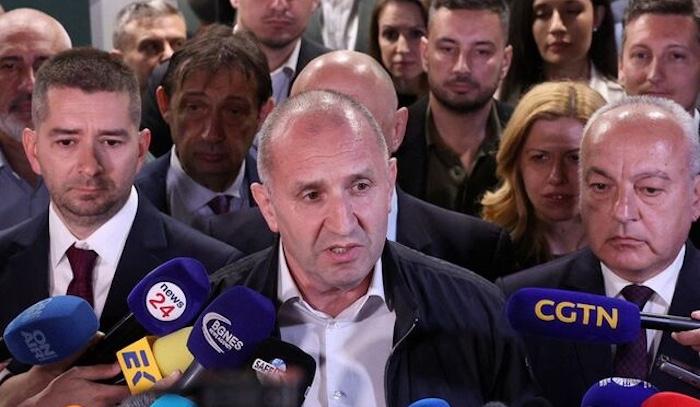
Speaking after the vote, Radev said: “This is a victory of hope over distrust, a victory of freedom over fear, and finally, if you will, a victory of morality.”
Although his party appears capable of forming a strong minority government, Radev has not ruled out cooperation with pro-European groups or smaller parties.
Public reaction reflects cautious optimism. Evelina Koleva, a manager at a digital marketing company in Sofia, told Reuters: “There is now an opportunity for the things people have been hoping to see change to actually become visible.”
Radev’s positions have drawn comparisons to Viktor Orban, particularly over calls to improve ties with Moscow and resume Russian energy supplies to Europe. He has also criticised the European Union for what he described as over-reliance on renewable energy.
However, his policy direction remains unclear. Bulgaria, a NATO member on the EU’s southeastern flank, adopted the euro in January, a move Radev criticised, though he has since indicated willingness to maintain the country’s European course.
“We will make efforts to continue on its European path,” he said, while signalling openness to judicial reforms in collaboration with PP-DB.
Despite economic gains since joining the EU in 2007, Bulgaria continues to face significant challenges, including rising living costs following euro adoption.
Analysts warn that structural issues persist. Tihomir Bezlov, a senior fellow at the Centre for the Study of Democracy in Sofia, said: “The country’s main challenge is the economic crisis and the demographic crisis.”
“There do not seem to be many ideas in the winning camp on either of these issues.”