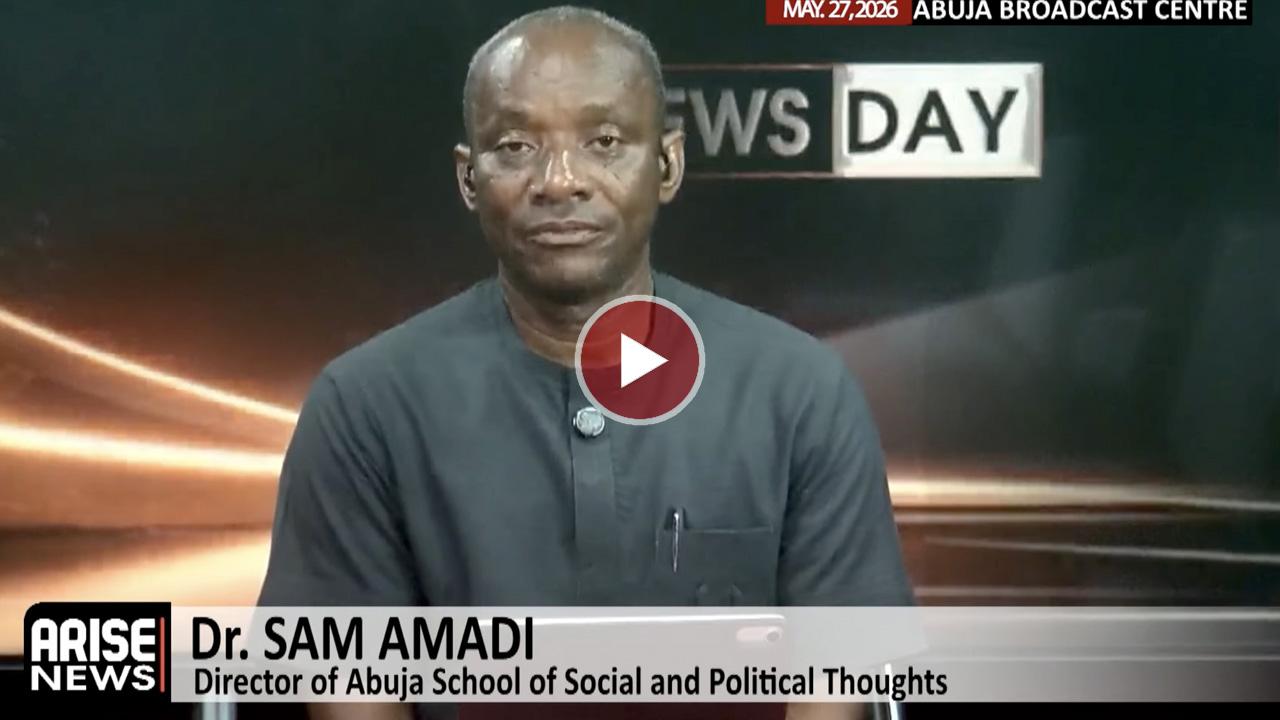
Political analyst says court rulings have largely removed legal barriers to Jonathan’s possible 2027 presidential ambition, leaving the issue mainly in the political arena.
- +Sam Amadi: Jonathan’s Eligibility To Contest Is Now More Political Than Legal
Director of the Abuja School of Social and Political Thought, Sam Amadi, has said the debate surrounding former President Goodluck Jonathan’s eligibility to contest the 2027 presidential election has shifted from a legal issue to a political one following recent court judgments.
Director of the Abuja School of Social and Political Thought, Sam Amadi, has said the debate surrounding former President Goodluck Jonathan’s eligibility to contest the 2027 presidential election has shifted from a legal issue to a political one following recent court judgments.
Speaking during an interview on ARISE News, Amadi said the latest ruling appears to have removed major constitutional obstacles that had previously surrounded Jonathan’s possible return to presidential politics.
“Jonathan’s eligibility to contest is now more political than legal,” he said.
According to Amadi, the recent legal challenge against Jonathan’s eligibility did not appear particularly strong from the outset.
“The case perhaps didn’t quite look robust,” he stated.
He explained that similar legal and political debates had already surfaced before the 2023 elections when speculation first intensified over Jonathan’s possible return.
“We had this in 2023,” he said.
Amadi stated that most attempts either to encourage or prevent Jonathan from contesting have largely been politically motivated rather than driven by genuine constitutional clarification.
“It doesn’t look like too much legal motivation,” he stated.
According to him, courts have not conclusively established that Jonathan violated constitutional term limits by completing former President Umaru Musa Yar’Adua’s tenure before winning his own election in 2011.
“It wasn’t too clear,” he said.
Amadi explained that one of the constitutional debates centres on whether being sworn in twice automatically amounts to serving two full constitutional terms.
“I don’t think that has been very clearly defined,” he stated.
He said that some legal arguments also questioned whether constitutional amendments introduced after Jonathan’s tenure could be applied retroactively to him.
“That section could not go back retroactively,” he said.
According to Amadi, the latest court ruling means any remaining challenge would likely have to proceed to the Supreme Court.
“That obstacle has been taken away,” he stated.
Amadi also discussed the broader political implications of a possible Jonathan candidacy, arguing that Nigeria’s political environment has evolved significantly since 2015.
“The political landscape changes fast,” he said.
He maintained that some core realities of Nigerian politics remain largely unchanged.
“Ethnic and religious configurations still matter,” he stated.
Amadi pointed to the growing influence of social media and youth participation as major factors reshaping Nigeria’s electoral environment.
“Young people are becoming the largest voting population,” he said.
According to him, President Bola Ahmed Tinubu currently retains major political advantages because of his influence within state structures and institutions.
“He has consolidated the establishment,” he stated.
At the same time, Amadi mentioned that public dissatisfaction with governance and economic hardship could still create political vulnerabilities for incumbents.
“When governments fail, people don’t like to re-elect them,” he said.
He described Jonathan as a politician who still carries significant national political influence despite years outside office.
“Jonathan will always be a strong political factor,” he stated.
But, Amadi questioned whether Jonathan would ultimately decide to contest given the uncertainties surrounding party platforms and political alignments ahead of 2027.
“He may come short of running,” he said.
According to him, uncertainty remains over which political platform Jonathan could potentially use if he eventually decides to contest.
Amadi maintained that while Jonathan remains politically relevant, several unresolved political calculations could still prevent him from entering the race.
“There are many uncertainties on the political landscape,” he stated.
Amadi concluded that recent court decisions have largely removed legal barriers surrounding Goodluck Jonathan’s eligibility to contest future presidential elections, but argued that the bigger questions now revolve around political strategy, party alignment, and whether the former president would ultimately choose to enter the race at all.