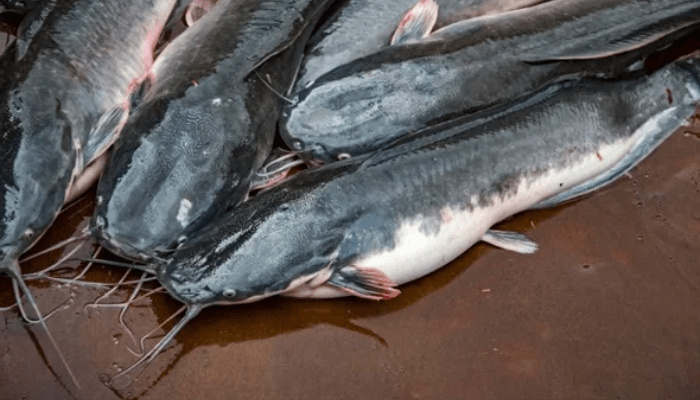
An eight-year United States export ban on Nigerian smoked catfish, imposed after the federal government failed to submit required safety documentation, is hindering investments and limiting farmers’ access to key markets.
- +Nigeria’s fish farmers reel from 8-year-old export ban
- +US ban erodes industry growth momentum
- +Taste for imported fish keeps supply gap wide persist despite production rise
- +Untapped potential and security threats
The US has, since March 2018, placed a ban on the importation of Nigeria’s smoked catfish and all fish product exports because the country failed to submit the Self-Reporting Tool (SRT) requirement before its due date.
The US has, since March 2018, placed a ban on the importation of Nigeria’s smoked catfish and all fish product exports because the country failed to submit the Self-Reporting Tool (SRT) requirement before its due date. Eight years of the ban have shrunk market access for fish farmers, deterred new investments in the industry and threatened the government’s export drive targets.
According to the US Department of Agriculture (USDA), the SRT is a prerequisite for trade. It is the process of determining whether a country’s food safety inspection system is equivalent to that applied domestically in the US.
US ban erodes industry growth momentum
Lanre Badmus, World Aquaculture Society global director, explained that the ban on smoked catfish since 2018 has had deep and wide-ranging economic consequences. He estimated an annual loss of N576 million ($1.6 million) owing to the restriction, noting that it has also led to the total collapse of the country’s fish export market. He added that the prolonged ban is damaging the country’s reputation in the global food market and shrinking the market for farmers.
An executive of a top fishing firm also revealed that the US ban has shrunk the market for farmers and the momentum the industry was gaining then is all gone. He explained that the government has not been sincere in resolving the issue. “It is not the fault of the US or the EU; our government is not serious about resolving the issue despite its negative impact,” he said.
He noted that growth momentum in the industry has been stagnant owing to the ban. Farms are no longer expanding because the export momentum has faded. This issue is eroding the progress the industry made since 2011, when output increased from less than 500,000 metric tons (MT) to 1.1-million MT in 2017, according to Federal Ministry of Agriculture data.
Taste for imported fish keeps supply gap wide persist despite production rise
Ironically, domestic supply gaps still persist. While exact figures are difficult to track, Federal Ministry of Marine and Blue Economy estimates suggest the country needs 3.6-million tons annually to meet demand. Adegboyega Oyetola, Marine and Blue Economy minister, said recently that Nigeria’s fish production rose by 300,000 MT in 2025. This means the country currently produces 1.4-million MT and needs 2.2-million annually to bridge its supply and demand gap.
Olatoye Fajimi, Lagos State Catfish and Allied Farmers Association (LASCAFAN) president, said that both domestically and internationally, the market is contracting for Nigeria’s fish products.
“Since the ban, it has been difficult for farmers. Those exporting are no longer doing so and we are struggling to get a larger share of the local market because of our high preference for imported fish,” Fajimi said.
In 2017, the United Nations Food and Agriculture Organisation (FAO) valued the Nigerian aquaculture industry at $848 million (N1.2 trillion). The fishing subsector attracted $5 million in investment in 2025 after failing to record any in 2023 and 2024, according to Capital Importation report data.
Fish is in high demand in Africa’s most populous country, mostly due to its health benefits. It is considered healthier than meat and contains high omega-3 fatty acids, which lower inflammation and the risk of chronic diseases. With fish consumption rising in Nigeria, the stakes are high. Local producers want a larger slice of the market but are stuck with challenges.
Fajimi noted that fish farmers are currently battling rising energy costs and low consumer patronage. He explained that the cost of production has stabilised since the beginning of the year; but the Iran war is driving up operating expenses again as farms rely on petrol and diesel to power operations.
Potentially, the industry can generate an annual revenue of $296-billion, as projected by the World Aquaculture Society. It can create millions of jobs and reduce pressure on the naira. Yet, the industry is still largely untapped.
“We must address the issue of rising feed costs for us to be competitive,” Fajimi said.
He added that the government must also encourage local consumption of Nigerian fish products, as there is a high preference for foreign imports.
Untapped potential and security threats
Cheta Nwanze, SBM Intelligence partner, said improving Nigeria’s fishing industry must begin by declaring a state of emergency in that sector. “Steps must be taken to also address piracy at sea,” Nwanze said.
He added that the sector is being hampered by a myriad of challenges ranging from infrastructural gaps to a lack of exposure to modern aquaculture practices. Poor access to quality feed and climate change impacts, such as flooding, have made production levels unable to meet growing local demand. Experts say the government must urgently address these issues to drive competitiveness.
While the country has begun building the blocks for the industry, significant practical work remains, including addressing issues of high feed costs and smuggling, experts maintain.